
Dark Showers at the LHC: from benchmarks to Run-3 readiness
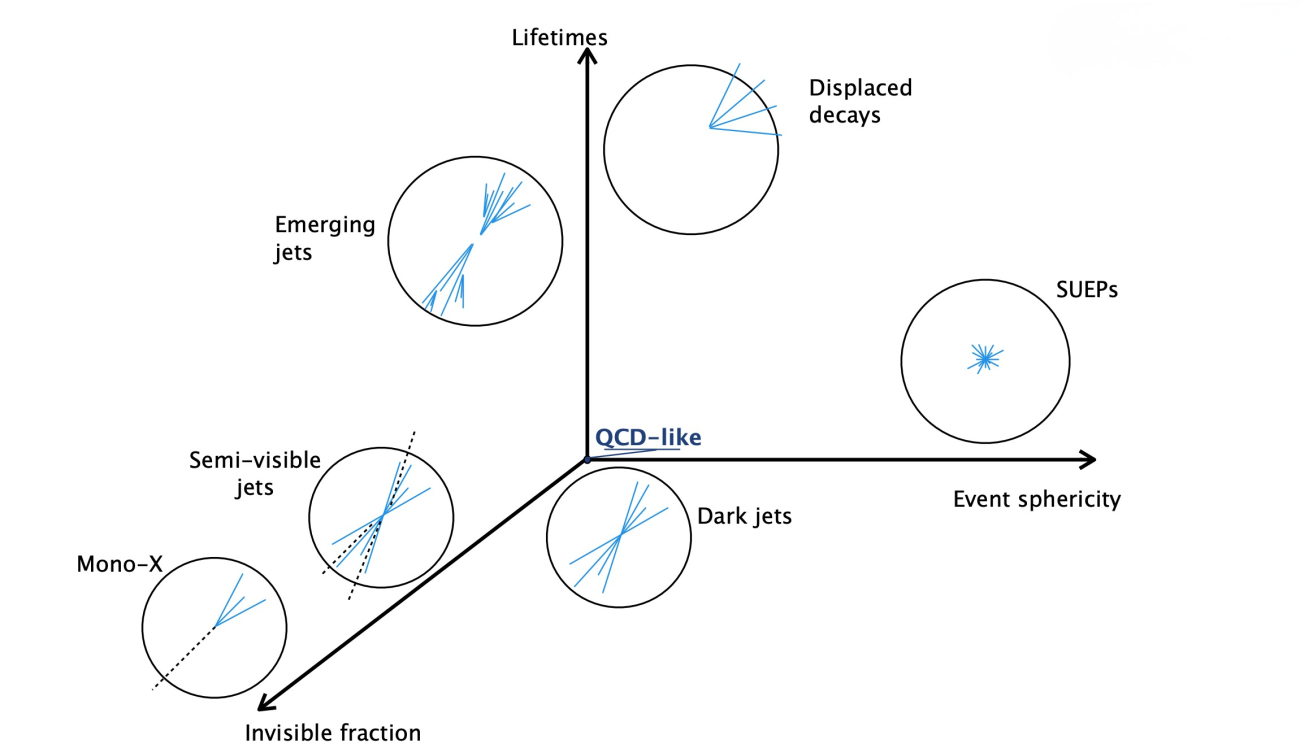
The search for new physics at the LHC increasingly pushes beyond traditional signatures. Among the most intriguing possibilities are dark showers—complex cascades of particles emerging from dark-sector dynamics, capable of producing rich, unconventional final states. These scenarios naturally arise in models where dark matter interacts through a confining hidden sector, leading to high-multiplicity, diffuse, and often displaced signatures that challenge standard reconstruction and analysis techniques.
Run-3 provides a uniquely timely opportunity to advance this frontier. With upgraded detectors and trigger systems now operational, and with powerful machine-learning tools becoming mainstream across CMS and ATLAS, the community is better equipped than ever to tackle dark-shower phenomenology. The LHC Dark Shower Workshop, held at CERN on 27-30 October 2025, brought together experts from theory and experiments to consolidate progress, define shared benchmarks, and coordinate strategies for current and future searches.

Clarifying the landscape: achievements of the Dark Showers workshop
A central achievement of the workshop was the agreement on the need for a shared framework for navigating the increasingly rich landscape of dark-shower phenomenology at the LHC. Rather than introducing yet another taxonomy of models, the discussions converged on the need for a coherent and minimal set of benchmark scenarios able to capture the essential features driving experimental sensitivity, while remaining flexible enough to span a broad class of dark-sector dynamics.
Existing benchmark proposals—including semi-visible jets, emerging jets, soft and unclustered energy signatures, as well as scenarios involving glueballs and quirks—were reviewed in terms of their relevance for Run-3 and near-term analyses. This comparison helped identify which physical ingredients (e.g. lifetime hierarchies, visible–invisible energy fractions, multiplicity and angular structure) are most impactful experimentally, independent of specific UV realizations.
Across experiments, several common priorities emerged clearly:
- Benchmark definition as the foundation for a shared interpretation strategy, enabling meaningful comparison and reinterpretation of searches across ATLAS, CMS, and LHCb.
- Identification and refinement of genuinely new experimental signatures, particularly in regions not well covered by traditional jet- or LLP-based searches.
- Control and understanding of systematic uncertainties, with special emphasis on modelling choices for non-perturbative dark-sector dynamics and their impact on detector-level observables.
A further concrete outcome was the formation of dedicated working groups tasked with advancing benchmark definitions and associated simulation strategies. This coordinated approach is expected to significantly reduce duplicated effort, promote cross-experiment coherence, and accelerate the development of robust, interpretable dark-shower searches at the LHC.
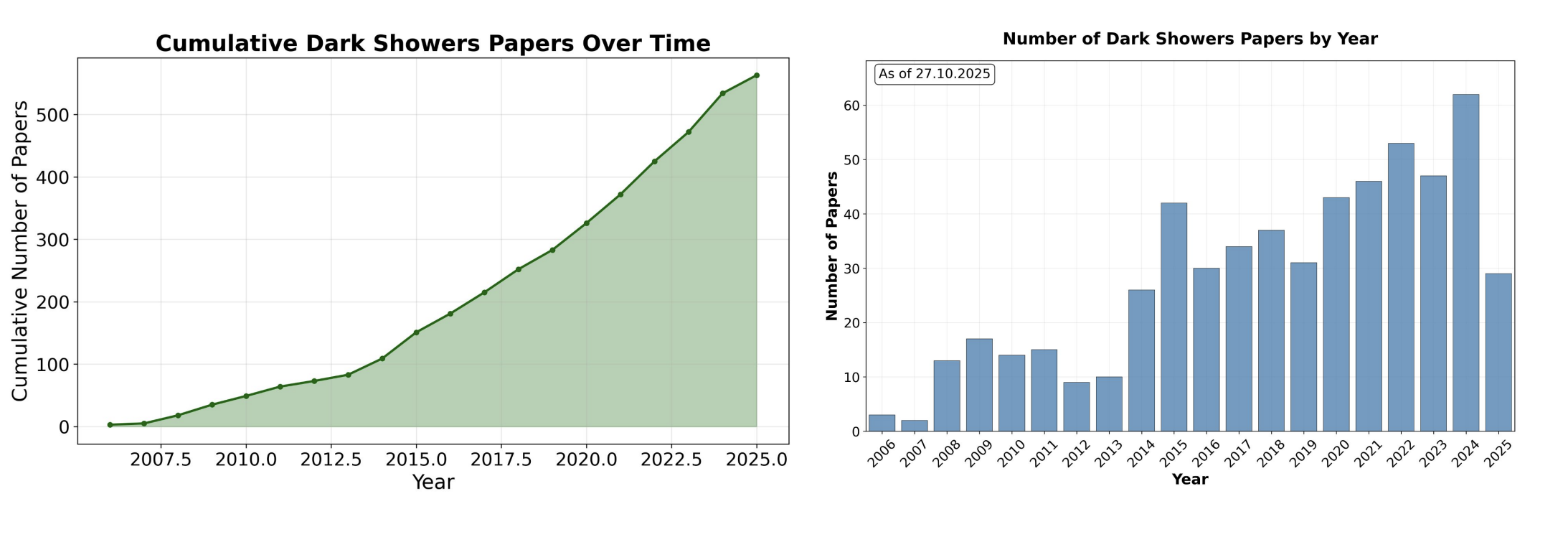
Within the context of the workshop the Dark showers living review was launched, an initiative started by S. Kulkarni to collect and categorize dark showers references automatically. This effort is currently a work in progress but is expected to benefit significantly from community feedback.
Methods that moved the needle: machine learning in the spotlight
Machine-learning–based approaches emerged as one of the most transformative elements of the workshop, with multiple contributions illustrating how modern ML techniques can qualitatively extend the experimental reach for dark-shower signatures. Graph neural networks, autoencoders, and weakly supervised or anomaly-based methods were shown to be particularly well-matched to the high dimensionality, heterogeneity, and non-standard correlations characteristic of dark-sector final states.
Several methodological directions stood out as especially impactful:
- Displaced-object reconstruction using learned representations of track–cluster and track–vertex relationships, enabling sensitivity to complex decay topologies that challenge traditional reconstruction paradigms.
- Jet-level, physics-informed classification strategies, designed to capture the internal structure and energy-flow patterns of dark showers beyond what is accessible with standard jet observables.
- Data-driven background estimation schemes augmented by ML, including novel control-region definitions that reduce reliance on potentially fragile simulation assumptions.
Crucially, these approaches are no longer purely exploratory. Many are already being deployed or validated in active Run-2 reinterpretations and Run-3 analyses, signalling a concrete shift from ML as a proof-of-concept tool to a core component of the experimental strategy for dark-shower searches at the LHC.
From ideas to Run-3 implementation
With the conceptual groundwork established, the workshop highlighted the need to translate ideas into concrete Run-3 analysis strategies. A key priority is the development of coordinated benchmark programmes, enabling systematic evaluation of reconstruction and analysis performance across experiments and across classes of dark-shower signatures.
Dedicated working groups are in the process of coordinating these efforts, aiming to deliver shared benchmarks and validated tools on a timescale compatible with Run-3 analyses. The outcome of the working groups work will be summarised in a White Paper, the first of the newly built LHC BSM WG. This coordination is expected to accelerate implementation while enabling robust and consistent interpretation of emerging results.
Outlook: a coordinated path to discovery
Looking ahead, the coming year offers a decisive window to consolidate the dark-shower search programme at the LHC. Success will mean not only improved sensitivity in individual analyses, but also the establishment of a cohesive, community-wide framework for interpreting the results. The workshop made clear that coordination—across experiments and theory—will be essential.
If the momentum built at this workshop continues, Run-3 could mark the first comprehensive exploration of dark-sector showering at the LHC, opening new territory in the search for physics beyond the Standard Model.
Note: Cover image from Cesare Cazzaniga's presentation, adapted from M. J. Strassler.


