
Doubly charmed baryon doublet completed with upgraded LHCb
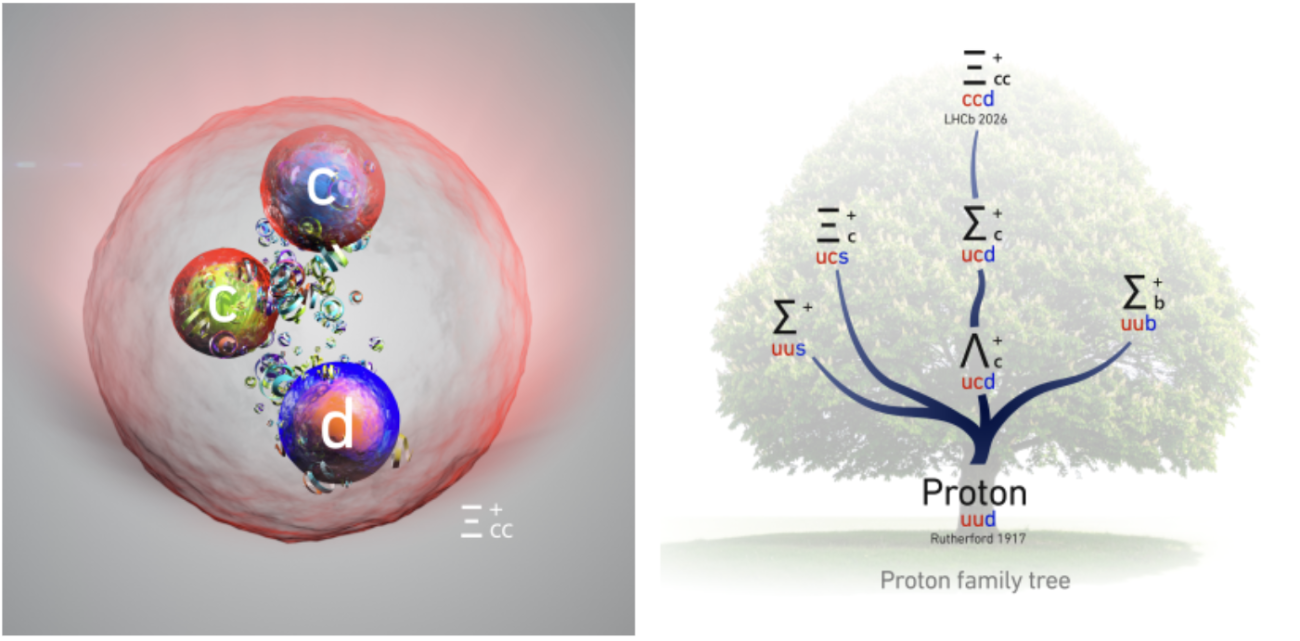
The image on the left presents an artist’s impression of this exotic particle, while the diagram on the right shows a kind of “family tree” of the proton, illustrating how heavier relatives emerge when its quarks are replaced by strange (s), charm (c), or bottom (b) quarks. In this hierarchy, the Ξcc⁺ appears near the top, where both of the proton’s light up quarks have been replaced by charm quarks.
The spectroscopy of baryons containing multiple heavy quarks provides a valuable testing ground for quantum chromodynamics at the boundary between its perturbative and non-pertative regimes. Among these systems, doubly heavy baryons are especially interesting because they contain two heavy quarks bound together with a lighter quark. In such states, the two heavy quarks form a compact diquark, while the lighter quark moves in the colour field generated by that heavy pair. This gives rise to a baryonic system that in some respects resembles a heavy–light bound state.
Within this framework, the baryons Ξcc⁺⁺ (ccu) and Ξcc⁺ (ccd) form an isospin doublet whose masses, lifetimes and decay patterns can be addressed in lattice QCD, potential models and the heavy-quark expansion. The first member of this doublet, Ξcc⁺⁺, was observed by the LHCb Collaboration in 2017 in the decay mode Λc⁺K⁻π⁺π⁺, establishing the existence of baryons containing two charm quarks. The second state, Ξcc⁺, however, remained elusive. A long-standing claim by the SELEX experiment placed such a candidate at a much lower mass, but that result was never confirmed and remained controversial. The new Run-3 measurement with the upgraded LHCb detector now establishes the observation of the Ξcc⁺ baryon in the mass region expected from modern QCD-based calculations.
Doubly charmed baryons as probes of heavy-quark dynamics
The importance of this result goes well beyond the addition of a new state to the hadron spectrum. Doubly charmed baryons occupy a particularly revealing corner of QCD because they combine two different dynamical regimes in a single system. The charm quarks move relatively slowly with respect to one another and can, to a good approximation, be treated as a tightly bound colour-antitriplet diquark. At the same time, that diquark is embedded in a baryon together with a light quark, whose dynamics are governed by the colour field of the heavy pair. These states therefore provide an unusually clean laboratory for probing how QCD organises itself when two heavy quarks and one light quark coexist in the same bound state.
Their weak decays are equally instructive. In the idealised leading-order picture of the heavy-quark expansion, one would expect only modest lifetime differences among charm hadrons. In reality, however, subleading effects play a major role. Spectator processes, in which the other quarks inside the baryon actively influence the decay, become essential. For doubly charmed baryons, the dominant contributions come from Pauli interference and W-exchange, and the balance between them differs markedly from one state to another. This leads to a distinctive and highly non-trivial lifetime pattern: the Ξcc⁺ is expected to be the shortest-lived member of the family, the Ξcc⁺⁺ the longest-lived, and the Ωcc⁺ in between. In this sense, establishing both members of the Ξcc isospin doublet is particularly important, because it turns doubly charmed baryons from isolated discoveries into a genuine precision laboratory for heavy-quark dynamics. Their masses probe how QCD binds the quarks together, while their lifetimes test whether the calculated spectator effects really capture the physics of weak decays in a strongly bound multiquark environment.
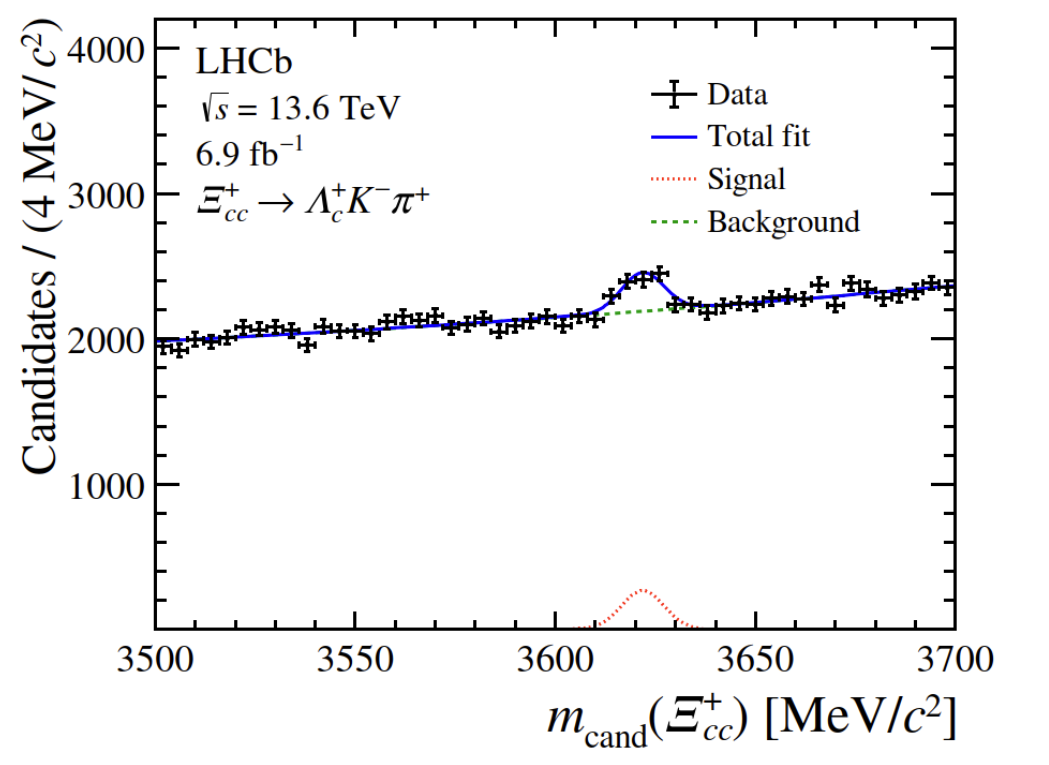
Invariant-mass distribution of Λc⁺K⁻π⁺ candidates showing a clear signal peak corresponding to the newly observed state, with fits separating signal and background contributions.
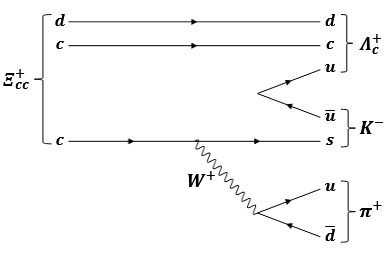
Decay chain of the particle into Λc⁺K⁻π⁺, with the Λc⁺ further decaying into pK⁻π⁺, illustrating the topology used to reconstruct the signal.
The upgraded LHCb detector and the Run-3 dataset
Experimentally, the observation of Ξcc⁺ became feasible only with the advent of the upgraded LHCb detector at the start of Run 3. This upgrade represented a profound transformation of the experiment. Roughly ninety percent of the detector’s sensitive elements were replaced, allowing LHCb to operate efficiently at significantly higher luminosity while maintaining the precision tracking and particle-identification performance that are essential for heavy-flavour physics.
Among the most important improvements was the new silicon-pixel Vertex Locator (VELO), which provides extremely precise measurements of the positions at which particles are produced and decay. Since charm and beauty hadrons travel measurable distances before decaying, the ability to reconstruct their decay vertices with high precision is critical. Complementing this capability are upgraded ring-imaging Cherenkov detectors that enhance the experiment’s ability to distinguish between different species of charged hadrons. Together with improvements in tracking and reconstruction, these systems greatly improve the identification of the complex decay chains typical of charm baryons.
The trigger architecture was also fundamentally redesigned. The hardware trigger used in previous runs was replaced by a fully software-based system capable of reconstructing events at the full bunch-crossing rate of the LHC. This change is especially important for hadronic final states, many of which would previously have been discarded at an early stage. For decays involving several charged particles, the gain in efficiency is substantial. The analysis presented at Moriond exploits one of the first large datasets recorded with this upgraded detector: about 6.9 inverse femtobarns of proton–proton collisions at a centre-of-mass energy of 13.6 TeV, collected in 2024. As such, it already serves as a striking demonstration of the upgraded experiment's physics reach.
Strategy for the search
The search targets a decay mode in which the Ξcc⁺ baryon decays into a Λc⁺ baryon accompanied by a kaon and a pion. The Λc⁺ itself subsequently decays into a proton, kaon and pion. This decay chain is particularly attractive experimentally because it produces a distinctive topology with multiple charged particles whose tracks can be reconstructed with high precision in the LHCb detector.
Extracting a signal from the overwhelming combinatorial background requires sophisticated selection techniques. The analysis therefore employs multivariate methods that combine information from many observables simultaneously. Variables describing the kinematics of the particles, the quality of reconstructed decay vertices and the compatibility of the tracks with specific particle hypotheses are combined into a boosted decision-tree classifier trained to distinguish signal candidates from background.
To ensure that the selection is optimised in an unbiased way, the mass region where the signal is expected is kept hidden while the analysis strategy is developed. This “blinding” procedure prevents subconscious tuning of the selection to statistical fluctuations in the signal region.
A crucial ingredient in the strategy is the use of the well-established decay of the Ξcc⁺⁺ baryon as a control channel. Because this decay has a topology very similar to the one used to search for Ξcc⁺, it provides an ideal benchmark for validating the analysis chain and verifying that the detector and reconstruction algorithms behave as expected.
Emergence of the signal
Once the selection strategy had been finalised and the blinded region opened, a clear structure emerged in the invariant-mass distribution of the selected Λc⁺K⁻π⁺ candidates. The peak appears close to the mass of the known Ξcc⁺⁺ baryon and in the region anticipated by theoretical predictions for the Ξcc⁺. A statistical analysis shows that the probability for such a structure to arise from a background fluctuation is extremely small, with a significance exceeding the conventional discovery threshold used in particle physics.
The established Ξcc⁺⁺ decay mode plays an essential role as a control channel. Because its topology is very similar to that of the Ξcc⁺ search mode, it provides an ideal benchmark for validating the reconstruction, checking systematic effects and ensuring that the detector and selection algorithms perform as expected. It also makes the impact of the upgrade immediately visible: compared with Run 2, the control channel shows a dramatic increase in signal yield per unit luminosity, reflecting the combined effect of improved tracking, particle identification and trigger efficiency.
Equally important are the robustness checks: no similar peak is seen in wrong-sign control samples, and no evidence appears near the mass once reported by SELEX. Instead, the observed signal is fully consistent with the modern theoretical picture and with the expected small mass splitting relative to Ξcc⁺⁺.
Having established the signal, the collaboration proceeds to determine the properties of the new state. Measuring the mass accurately requires careful control of several subtle effects. The event selection tends to favour candidates with larger apparent flight distances, which can bias the reconstructed mass, especially for a short-lived particle. Final-state radiation can also slightly modify the measured energies of the decay products. These effects are corrected using simulation and control studies. After the relevant corrections are applied, the mass of the Ξcc⁺ is found to lie very close to that of the Ξcc⁺⁺, differing by only a small amount consistent with theoretical expectations for the isospin splitting. At the same time, the analysis highlights one of the central physics issues that will drive future work: because the Ξcc⁺ is expected to be significantly shorter-lived than its Ξcc⁺⁺ partner, the still-uncertain lifetime enters as an additional source of uncertainty in the mass determination. Larger data samples will therefore be needed not only to sharpen the mass measurement but also to determine the lifetime directly.
Opening a new chapter in doubly heavy baryon spectroscopy
The broader significance of the result is clear. The observation of Ξcc⁺ completes the doubly charmed isospin doublet and marks an important step forward in heavy-flavour spectroscopy. Until now, the field rested on a single confirmed doubly charmed baryon. With this second state established, direct comparisons between masses, lifetimes and decay properties become possible, opening the way to much more stringent tests of theory. At the same time, the result is an early and compelling demonstration of what the upgraded LHCb detector can achieve. Rare hadrons that previously lay at the edge of observability can now be studied with sizeable samples, and with continued Run-3 data taking, the collaboration expects to collect thousands of doubly charmed baryons. This will enable more precise studies of lifetimes, branching fractions, production mechanisms and additional decay channels, while also strengthening the prospects for searches for further doubly heavy states, including Ωcc⁺ and perhaps, eventually, even triple-charm baryons.
In this sense, the observation of Ξcc⁺ is both the resolution of a long-standing search and the starting point of a broader programme aimed at exploring how QCD binds heavy quarks into baryonic matter.
The author gratefully acknowledges the LHCb spokesperson for valuable comments and constructive feedback on the manuscript.
Further information
LHCb presentation at Moriond is available here and in the LHCb news article.


