
EP R&D Day 2026: technologies for the next generation of experiments
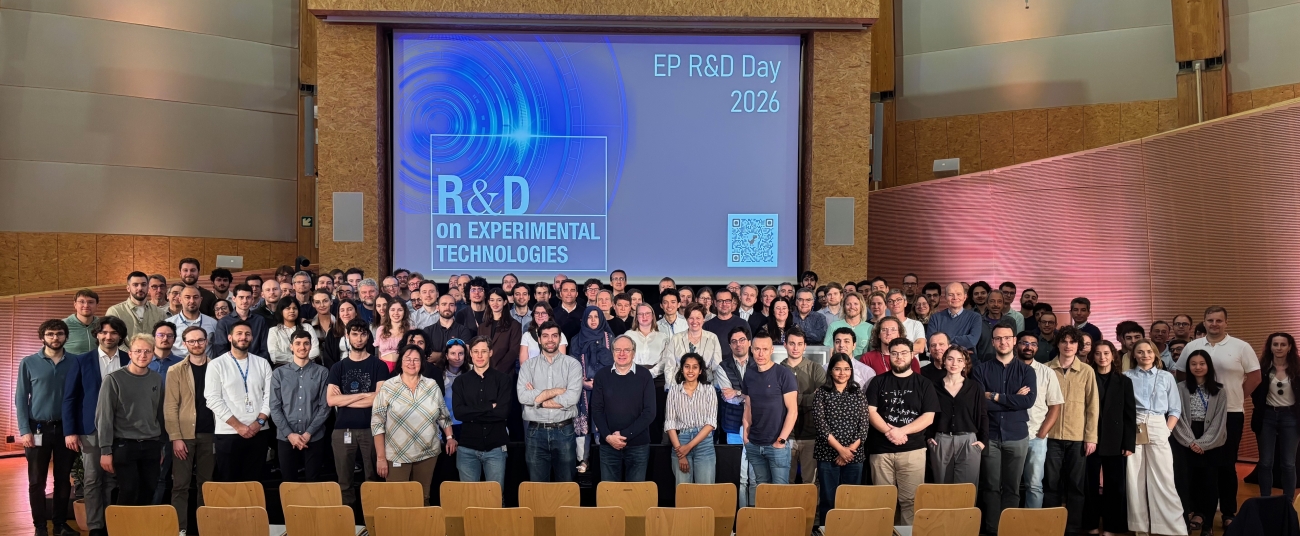
On 29 April 2026, colleagues from across CERN’s Experimental Physics Department gathered for the annual meeting dedicated to the strategic EP R&D programme on technologies for future experiments. The programme offered a broad update on progress achieved over the past year, bringing together developments in detector sensors, mechanics, electronics, data links, software, cooling and magnet technologies.
More than a sequence of technical reports, the meeting provided an opportunity to look across the programme and assess how different lines of R&D are converging towards future detector concepts. Many of the technologies presented are still at the level of demonstrators, prototypes or qualification studies, but together they show how the department is preparing the foundations for future experiments at the HL-LHC and beyond.
Launched in 2020, the strategic EP R&D programme aims to develop key detector technologies before they are incorporated into experiment-specific designs. Its role is to advance the building blocks that future detectors will require: sensors with higher granularity and better timing, radiation-hard electronics, low-mass structures, efficient cooling, fast readout, advanced software frameworks and magnet technologies adapted to future experimental needs.
This long-term perspective is essential. The High-Luminosity LHC remains the immediate priority for the field, while studies of possible post-LHC facilities, including FCC-ee, FCC-hh and CLIC, are already defining demanding requirements for detector performance. Future experiments will need to combine precision, radiation tolerance, low material budget, high bandwidth and increasingly sophisticated reconstruction and analysis capabilities. These requirements cannot be met by incremental improvements alone; they call for sustained and coordinated R&D across many domains.
A broad programme across detector technologies
The 2026 edition reflected the breadth of the programme. Presentations covered silicon detectors, gaseous detectors, calorimetry and light-based systems, detector mechanics, integrated-circuit technologies, high-speed links, data acquisition, software and detector magnets. This scope is deliberately wide because modern detector design is increasingly system-driven. Sensors, electronics, cooling, mechanics, readout and software must be developed together rather than as independent layers.
The silicon activities offered a clear example of this integrated approach. Work presented during the workshop ranged from hybrid sensor concepts and 3D silicon devices to wafer-scale monolithic CMOS sensors, radiation-damage studies and module-level integration. These developments address some of the most demanding requirements for future vertex and tracking detectors, including small pixel pitches, fast timing, high hit rates and operation in harsh radiation environments.
A major highlight was the progress on MOSAIX, the wafer-scale Monolithic Active Pixel Sensor prototype developed for the ALICE ITS3 upgrade. MOSAIX builds on earlier work in 65 nm CMOS imaging technology and stitching, aiming to integrate a full detector stave segment on a single silicon die. The broader ITS3 concept, based on thin, bent silicon sensors and ultra-light support structures, illustrates how detector R&D is moving towards radically reduced material budgets and more integrated detector architectures.
At the same time, work on hybrid silicon sensors, radiation-damage characterisation and module technologies showed how much remains to be understood and validated before such concepts can be generalised. Future silicon detectors will depend not only on sensor performance, but also on reliable characterisation tools, radiation models, interconnection techniques, power distribution and mechanical integration. The solid state detectors work packages, therefore, form a feedback loop: sensor studies inform ASIC and module requirements, irradiation campaigns refine performance predictions, and integration studies reveal the constraints to be addressed in the next design iteration.
Electronics, links and data close to the detector
Several presentations focused on the electronics and readout technologies needed to cope with future data rates and detector complexity. Integrated-circuit technologies are becoming central to detector performance, as more functionality moves closer to the sensor. Work on radiation-tolerant system-on-chip architectures, virtual prototyping, point-of-load power conversion and 3D interconnects shows how the EP R&D programme is addressing this shift.
In WP5, the development of radiation-tolerant RISC-V-based systems-on-chip, virtual prototyping frameworks for pixel detector electronics, and advanced power conversion schemes points towards a future in which front-end electronics are not only faster and more radiation-hard but also more configurable. This is particularly relevant for pixel detectors operating at high occupancy and subject to complex readout constraints. The ability to explore architectures before committing to silicon and to integrate power, processing, and interconnects into compact systems will become increasingly important.
High-speed links were another strong theme. Future detectors will require optical readout systems capable of moving very large data volumes with minimal mass and power. Developments in silicon photonics, serializers, high-speed drivers, micro-ring modulator control and timing distribution are therefore central to next-generation readout architectures. The work presented showed progress towards compact, low-mass and radiation-tolerant optical links, with clear synergies with hybrid pixel readout chips and future vertex detector concepts.
These activities underline a broader trend: detector electronics can no longer be treated as a service layer added after the sensor design. They are part of the detector concept itself, influencing what can be built, how much data can be extracted, how much power can be dissipated and how much material can be tolerated.
Mechanics, cooling and integration
Detector mechanics and cooling received significant attention, reflecting their decisive role in physics performance. WP4 presented work on low-mass structures for tracking detectors, carbon-composite beam pipes and cryostats, robotics for detector interfaces, and new high-performance coolants for future detectors.
For tracking detectors, the challenge is to reduce material while preserving mechanical stability and efficient thermal management. Concepts such as carbon-foam supports for curved sensors, pipeless cold plates with embedded cooling channels, and corrugated sandwich panels address different detector needs, from ultra-light vertex systems to large-area tracking structures. These studies combine mechanical design, thermal simulation, airflow modelling, coolant compatibility and prototype validation.
Cooling is a particularly important part of this effort. Future detectors will require efficient thermal management under tight material and space constraints, while also accounting for environmental considerations and the availability of refrigerants. Studies of CO₂, krypton, and other natural refrigerants, as well as coolant–material interactions in composite structures, illustrate how engineering, sustainability, and detector performance are becoming increasingly interconnected.
Carbon-composite beam pipes and cryostats add another important dimension. Reducing the material seen by particles can directly improve tracking, vertexing and calorimeter performance. For future collider detector concepts, advanced composite structures may therefore become an enabling technology rather than a purely mechanical choice.
Software as a detector R&D
The workshop made clear that software is now an integral part of detector R&D. WP7 addressed the growing computing challenges of the HL-LHC and future experiments, where event rates, event complexity, simulation needs and analysis workloads will continue to increase.
Fast simulation was a prominent theme. Detailed detector simulation, especially for calorimeters, remains one of the major computing bottlenecks in high-energy physics. Machine-learning-based approaches, including generative models for calorimeter simulation, are being developed to reduce computing costs while preserving physics fidelity. These tools are relevant not only to current experiments but also to future detector studies, where many geometries and design options must be evaluated efficiently.
Shared software infrastructure is also maturing. The Key4hep stack has moved into production and is being used as a baseline framework for FCC detector studies, while continuing to serve as a testbed for further developments. Work on analysis tools, storage formats, reconstruction algorithms and core libraries reflects the need to make HEP software faster, more scalable and more ergonomic.
This software effort is not separate from detector design. Simulation, reconstruction, data formats, and analysis frameworks influence which detector concepts can be studied, optimised, and eventually operated. In this sense, software is one of the enabling technologies for future experiments, alongside sensors, electronics and mechanics.
https://indico.cern.ch/event/1653495/contributions/6949996/attachments/…
Detector magnets and large-scale systems
WP8 focused on detector magnets, another area where long-term R&D is essential. Future experiments will require large-bore magnets with high stored energy, low material impact and reliable cooling. The work presented covered aluminium-stabilised Nb-Ti/Cu conductors, high-temperature superconducting conductors, cryocooler-based technologies, conduction-cooled demonstrator magnets and magnetic-field sensing.
One important line of work concerns the availability and qualification of aluminium-stabilised low-temperature superconductors, a baseline technology for large detector magnets. Restoring and validating industrial coextrusion capabilities is a strategic issue for future magnet projects. In parallel, studies of high-temperature superconducting conductors such as REBCO explore new possibilities for more thermally stable and potentially more flexible detector magnet designs.
The development of cryocooler-based and conduction-cooled demonstrator magnets also reflects broader concerns about operational complexity, helium use and long-term sustainability. As with other parts of the programme, the aim is not only to demonstrate individual technologies but also to assess whether they can become realistic options for future experimental systems.
A dedicated space for posters and young researchers
The dedicated poster session formed a central part of the programme, giving students, fellows and early-career researchers the opportunity to present their work in detail. The posters covered a wide range of topics, from sensor characterisation and radiation-damage studies to silicon photonics, detector mechanics, cooling, power conversion, fast simulation and superconducting magnet technologies.
Beyond showcasing individual results, the session created space for technical discussions that are difficult to accommodate in plenary presentations. It gave visibility to the people carrying out much of the hands-on R&D and reflected one of the programme’s key missions: training the next generation of detector experts. Many of the skills required for future experiments — test-beam work, ASIC design, simulation, irradiation campaigns, mechanical prototyping, software development and system integration — are being developed through direct involvement in these projects.
As in previous editions, poster awards recognised particularly strong contributions. More broadly, the session demonstrated the depth of expertise being built across the programme and the importance of maintaining a vibrant R&D environment within the department.
Looking ahead
Across the different work packages, a common direction is visible: moving from individual technology studies towards demonstrators, qualification campaigns and system-level integration. The programme is technically diverse, but increasingly coherent.
The next generation of experiments will not depend on a single breakthrough. They will require many advances to come together: precise and radiation-tolerant sensors, compact electronics, low-mass mechanics, efficient cooling, high-speed links, scalable software and robust magnet technologies. The strategic EP R&D programme provides a framework in which these developments can be pursued with continuity, shared infrastructure and critical mass.
CERN’s Experimental Physics Department has a specific role in this landscape. EP brings together detector expertise, engineering capabilities, software know-how, technical infrastructure and links to current and future experiments. This combination allows the department to support R&D that is too broad, long-term or infrastructure-dependent to be sustained by individual groups alone.
As discussions continued during the poster session, coffee breaks and informal exchanges, one message emerged clearly: future experiments are already being shaped by the detector technologies under development today. The EP R&D programme is helping ensure that, when the next experimental opportunities arrive, the tools, expertise and people needed to seize them will be ready.
Read more
CERN Experimental Physics Department. Strategic R&D Programme on Technologies for Future Experiments – Annual Report 2025. CERN Document Server, 2026. Report number: CERN-EP-RDET-2026-001. Available at: https://cds.cern.ch/record/2955137/


