
Highlights from the 2nd NGT Technical Workshop

From 19 to 21 November 2025, the Next Generation Triggers (NGT) project held its 2nd Technical Workshop at CERN’s Globe of Science and Innovation, welcoming more than one hundred participants each afternoon both in person and online. The three-day event brought together experts from across the project to share progress, discuss technological advances, and outline the future of trigger and data acquisition systems as the High-Luminosity LHC (HL-LHC) era approaches.
This year’s workshop introduced a new structure with three keynote sessions—one each day—setting the stage for the in-depth presentations of the four Work Packages (WP1–WP4).
Day 1 — Advancing Infrastructure, Algorithms, and Theory
The first afternoon focused on Work Package 1 (WP1) and its broad portfolio of developments in computing infrastructure, machine learning, theoretical modelling, and quantum technologies. The session opened with the first keynote, delivered by Benedikt Maier.
All tasks presented their progress throughout the year. In particular, Task 1.1 reported major progress in establishing the heterogeneous computing foundations of NGT, including new on-premises GPU and CPU clusters, low-latency networking, curated “lxplus-like” environments, and automated machine-learning workflows (MLOps) that help manage data, training, and evaluation at scale to support large-scale optimisation and simulation activities.
The team also introduced the first prototype of an NGT machine-learning challenge platform based on codabench, aiming to enable collaborative benchmarking and community-wide competitions.
Task 1.4 highlighted advances in quantum and quantum-inspired simulation for high-energy physics, including studies of gauge-theory dynamics such as string breaking and flux-string roughening, hybrid qubit–qumode approaches for simulating QED, and benchmarking of multiple quantum hardware platforms ranging from superconducting processors to trapped ions and qudits. These efforts were complemented by algorithmic developments—such as enhanced Krylov methods and real-time simulation frameworks—and sustained progress in tensor-network techniques capable of simulating systems up to O(100) qubits. Meanwhile, Task 1.6 reported on a coordinated effort to identify new physics benchmarks relevant for next-generation trigger capabilities. Through dedicated workshops and follow-up meetings, theorists and experimentalists converged on three promising directions: flavour-physics signatures involving soft leptons and low-mass resonances; dark-sector scenarios producing emerging or displaced jets where track-based triggers may offer gains; and long-lived particles with disappearing or late-appearing tracks, where additional tracking information at trigger level could enhance sensitivity.
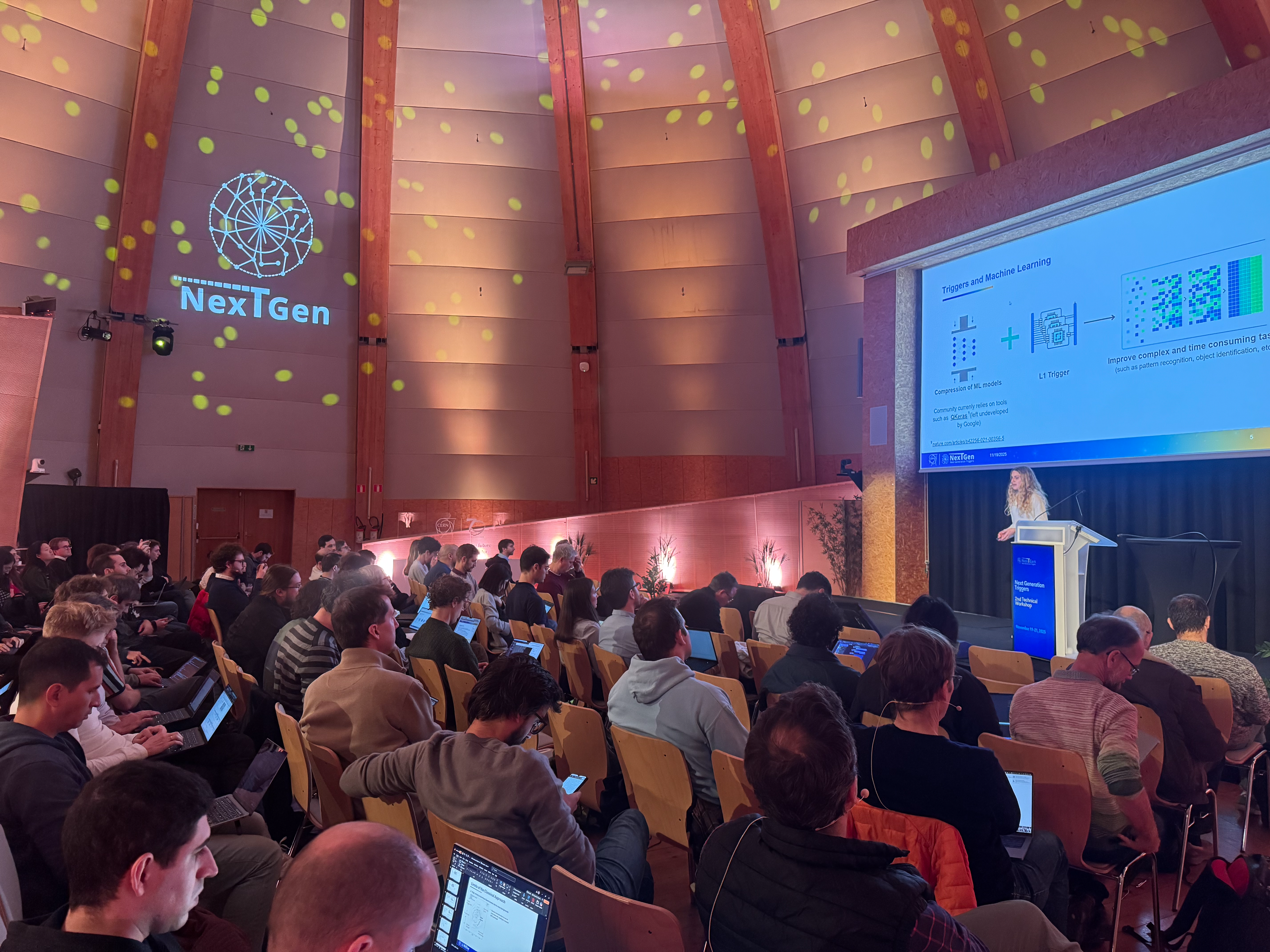
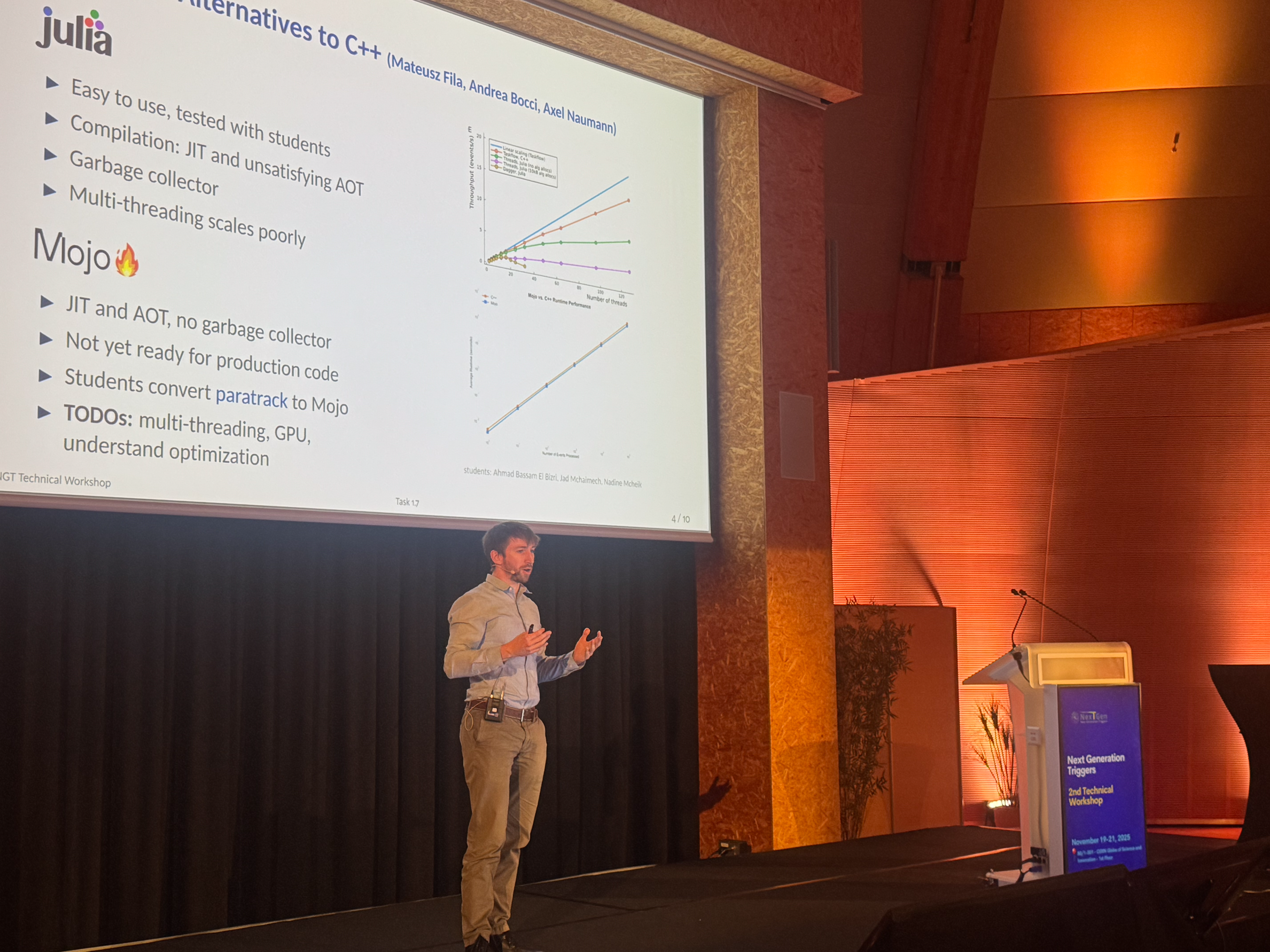
Anastasiia Petrovych and Oliver Rietmann during WP1 presentations
Task 1.7 presented progress on heterogeneous software developments, including work on C++ coroutines for efficient CPU–GPU scheduling, exploratory studies of modern programming languages such as Mojo and Julia, expanded support for ML model formats through SOFIE and PyTorch adapters, and new libraries for structure-of-arrays memory layouts using both current (C++17) and future (C++26) features. In response to evolving GPU hardware trends toward lower-precision arithmetic, the task also initiated efforts to improve the numerical stability of key reconstruction and simulation algorithms. Together, these developments illustrate the breadth of WP1 activities and the strong integration between infrastructure, software, and theory.
These are just some examples of all the advancements done in the Work Package 1 during the year. If you want to access all the information with the recordings of all the presentations, you can do it by clicking here.
Days 2 & 3 — Low-Level and High-Level Trigger Innovations for ATLAS and CMS
The second and third afternoons focused on Work Packages 2 and 3, covering both the low-level triggers (Day 2) and the high-level trigger and software systems (Day 3) for ATLAS and CMS. Together, these two days showcased the progress across the full real-time data processing chain, from the earliest hardware-based decisions to the software-driven high-level event reconstruction.
Day 2 opened with the second keynote, delivered by Anna Sfyrla. Here is her presenation.
Day 3 began with the third keynote, delivered by Aaron Bundock. Here is his presentation.
WP2 — Enhancing the ATLAS Trigger and Data Acquisition
Work Package 2 (WP2) plays a central role in preparing the ATLAS trigger and data acquisition system for the challenges of the High-Luminosity LHC (HL-LHC). During the workshop, WP2 presentations highlighted a strong, coordinated effort across the NGT project to support ATLAS’s evolving trigger upgrade strategy.
Key developments included new software frameworks and advanced tracking algorithms designed to run efficiently on modern computing architectures, such as GPUs, FPGAs, and high-core-count CPUs. These technologies are essential to cope with the increased data rates and complexity expected at the HL-LHC.
Machine-learning techniques featured prominently, with dedicated efforts to improve the robustness of the Level-0 Muon Trigger under extreme pile-up conditions. In parallel, significant progress was reported in adapting machine-learning frameworks for deployment on FPGAs, targeting the ultra-low-latency environments required by future trigger systems.
A major milestone for WP2 was the contribution of NGT studies to the ATLAS Phase-2 readout architecture baseline—marking the first time that an NGT-led study has been formally adopted by an LHC experiment. In addition, WP2 explored new trigger signatures for physics beyond the Standard Model, expanding the physics reach of ATLAS in the HL-LHC era.
Together, these developments lay a critical foundation for a resilient, adaptive, and high-performance ATLAS trigger system capable of meeting the demands of future LHC operations.
WP3 — Rethinking CMS Real-Time Processing and High-Level Triggering
Work Package 3 (WP3) addresses the evolution of the CMS trigger and high-level data-processing systems in preparation for the High-Luminosity LHC. Presentations over two workshop sessions highlighted progress spanning the full real-time processing chain, from low-level trigger decisions to software-based high-level triggering.
A major focus was on Level-1 (L1) scouting strategies, which aim to identify and record key event information in real time while keeping data volumes manageable. Complementing this, several contributions demonstrated the growing role of artificial intelligence and machine learning at L1, improving both the accuracy and latency of trigger decisions under increasingly challenging conditions.
The sessions also showcased advances in data-compression techniques and anomaly-detection methods, enabling efficient high-rate data acquisition and enhanced sensitivity to rare or unexpected physics signatures. On the software side, WP3 reported progress on client–server architectures for the CMS High-Level Trigger, providing a more flexible and scalable framework suited to heterogeneous computing environments.
Finally, significant effort has been devoted to the optimisation of real-time reconstruction algorithms for GPUs and other accelerators, a key requirement for sustaining CMS trigger performance at the data rates foreseen for HL-LHC operation.
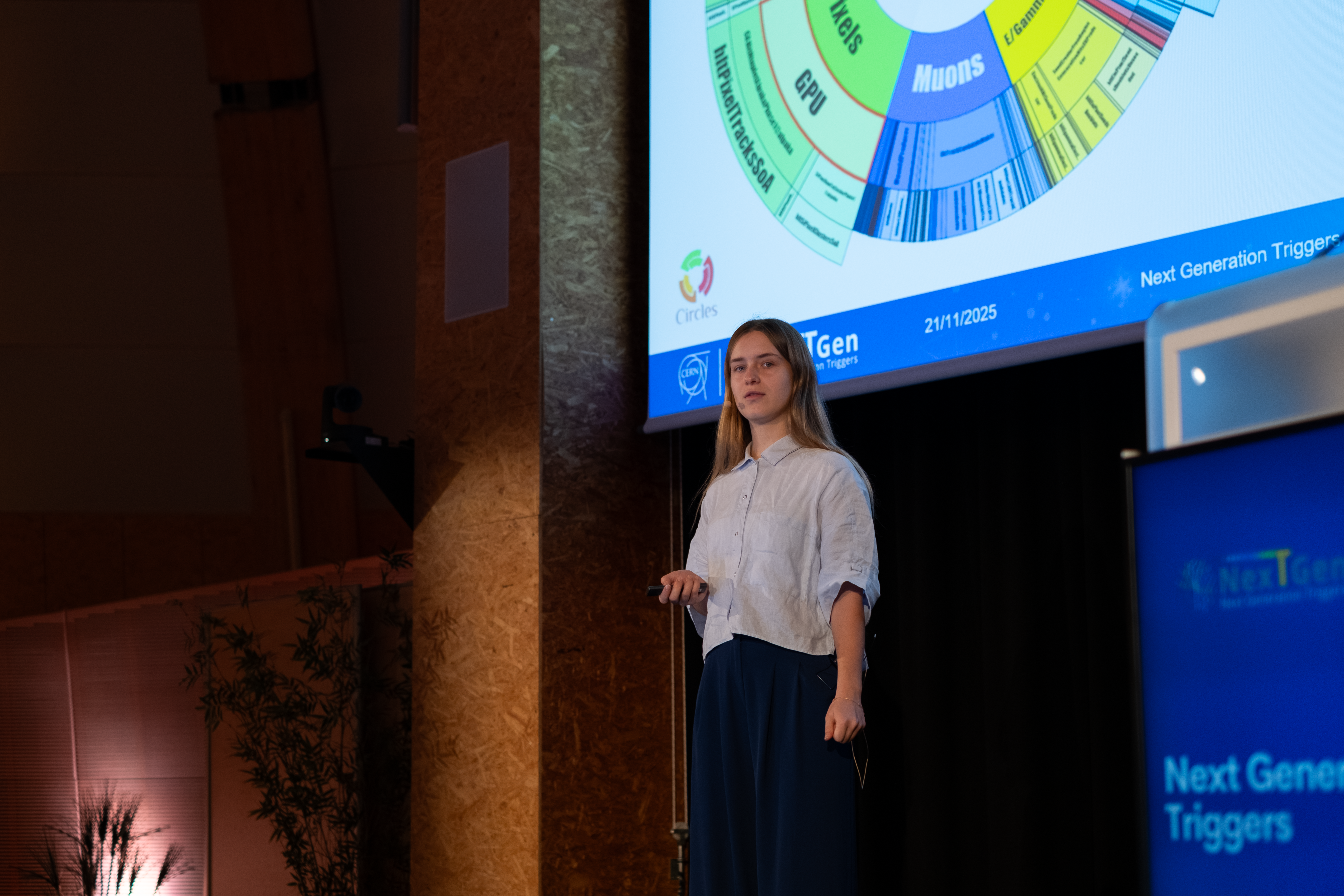
Anna Polova during her presentation of Task 3.2 “Evolving the CMS experiment software into a client-service distributed application for HLT”.
The CMS L1 Trigger team demonstrated the feasibility of acquiring and processing Phase-2 L1 Trigger particle-level objects at 40 MHz using simple cut-based analyses. New ML-based algorithms for calorimeter-cluster identification and jet tagging have been integrated into the baseline Phase-2 L1 Trigger reconstruction. The team also presented improvements to the Run-3 ML-based anomaly-detection trigger—enhancing its performance, operational robustness, and anomalous-event characterisation ahead of Phase-2.
And these are just some examples. For more information, you can access all presentations from Days 2 & 3 here.
WP4 — Training the Next Generation: The STEAM Academy
The final day also featured updates from Work Package 4, with a strong emphasis on NGT’s flagship training initiative: the CERN STEAM Academy.
Launching in June 2026, the STEAM Academy is a 10-week advanced programme hosted at CERN, offering postgraduate students, PhD candidates, and early-career researchers hands-on training in:
- Software technologies
- Edge computing
- Analytics and modern ML algorithms
- Trigger and data acquisition
- Heterogeneous computing and high-performance workflows
Participants will work alongside NGT experts, gain experience with cutting-edge hardware and real experimental workflows, and build skills required for future innovations in particle physics computing.
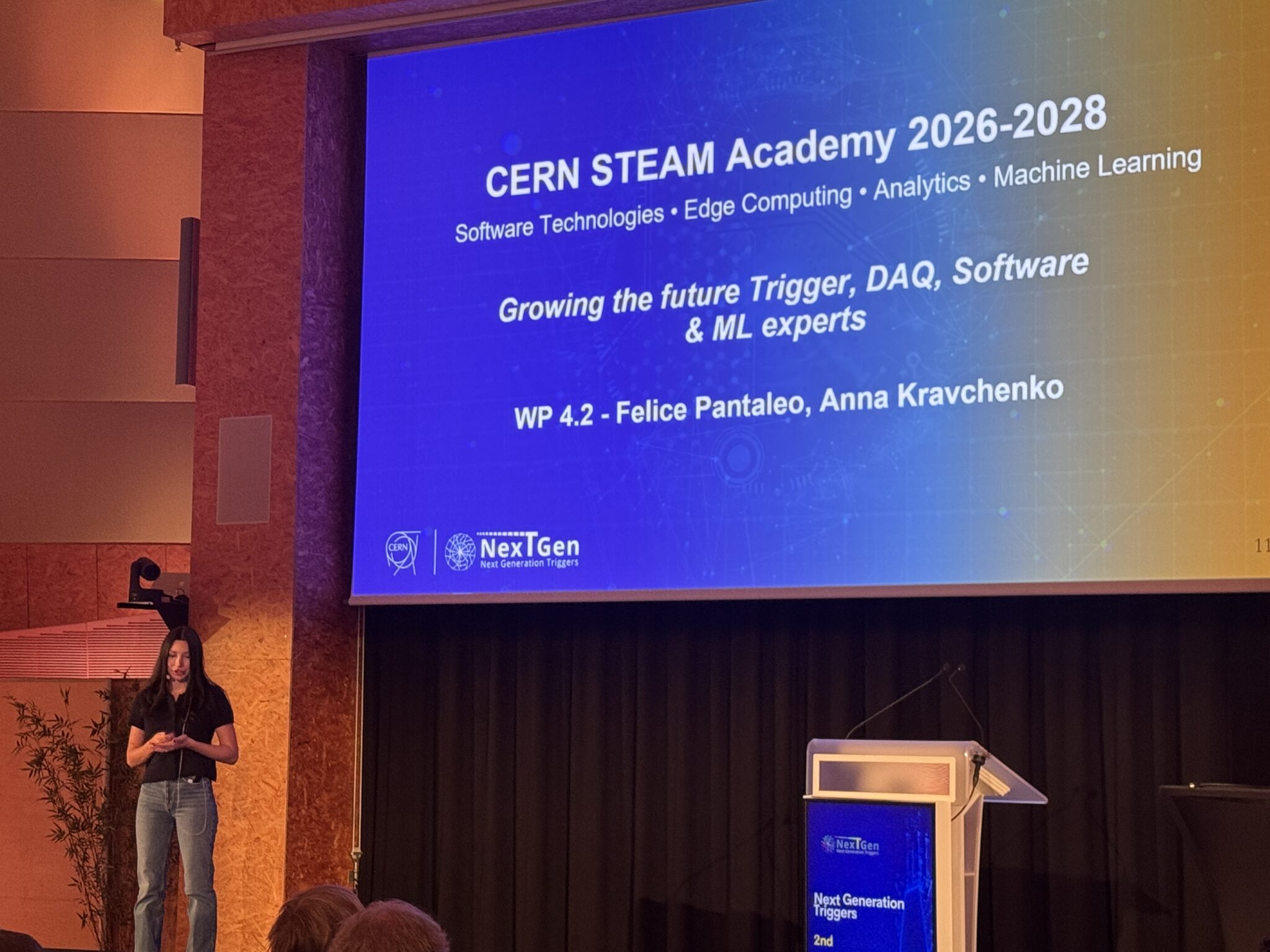
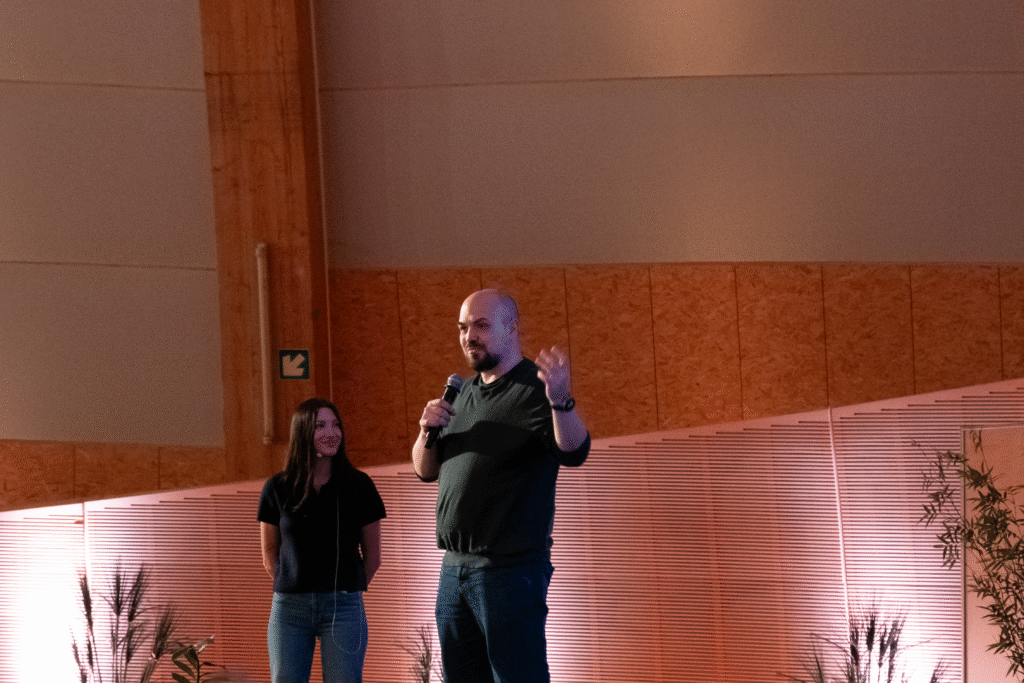
Anna Kravchenko and Felice Pantaleo presenting the future CERN STEAM Academy
WP4 also reported progress on exchange programmes, future events and schools that NGT will continue supporting, strengthening links with universities and international partners, and upcoming outreach activities to disseminate project results from 2026 onward
Across the three afternoons, the 2nd NGT Technical Workshop showcased the remarkable progress achieved across all four Work Packages. Participants exchanged ideas, forged new collaborations, and addressed the technical challenges of preparing trigger and data-acquisition systems for the HL-LHC.


