
Understanding the formation of fragile light nuclei with ALICE

Light nuclei such as the deuteron are surprisingly fragile. A deuteron is bound by only a few mega-electronvolts, yet at the Large Hadron Collider it is produced in environments that are tens of trillions of degrees – about 100,000 times hotter than the centre of the Sun. For years, this has raised an uncomfortable question: how can such loosely bound objects form and survive under such extreme conditions?
A new result from the ALICE collaboration, recently published in Nature, finally provides a microscopic answer. By studying correlations between deuterons (and antideuterons) and pions in proton–proton collisions at 13 TeV, ALICE shows that the vast majority of these light nuclei do not form directly in the hottest phase of the collision. Instead, about 90% of them are created later, in nuclear reactions triggered by the decay of short-lived resonances such as the Δ(1232).
This insight closes an important gap in our understanding of light-nucleus production at colliders and sharpens the modelling of light and heavy nuclei in cosmic rays and in possible dark-matter signals.
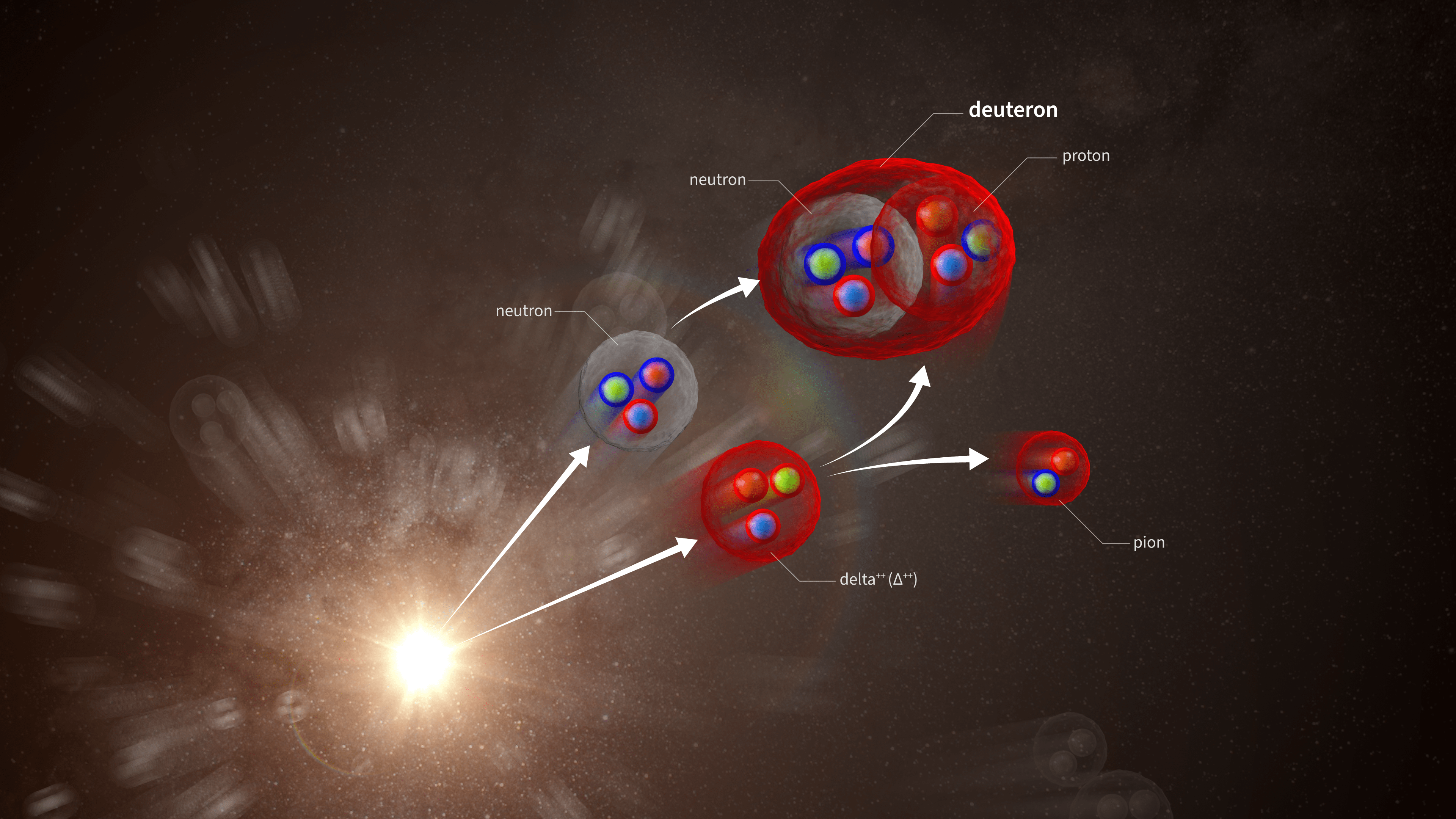
Illustration of how deuterons can be produced from a high-energy collision at the LHC. A delta particle emerging from the collision decays into a proton and a pion. The proton undergoes nuclear fusion with a neutron to form deuteron (Image: CERN)
Measuring how often anti-nuclei are produced
ALICE has been studying light nuclei and antinuclei for more than a decade. Earlier measurements determined production rates of deuterons, helium nuclei and their antiparticles in proton–proton and heavy-ion collisions, establishing how yields decrease steeply with each additional nucleon — the so-called “penalty factor”. These measurements, presented previously in the EP Newsletter article “Anti-nuclei in the cosmos and at the LHC”, are essential inputs to astrophysics.
When high-energy cosmic rays traverse the Galaxy, they collide with interstellar gas and produce secondary particles. Among them are antideuterons and antihelium nuclei, which are extremely rare yet powerful probes. To interpret cosmic-ray measurements, experiments such as AMS-02 rely on accelerator data to predict how frequently ordinary collisions produce such antinuclei. This is important because exotic sources such as dark-matter annihilation could also enhance their abundance above the expected background.
While ALICE established the production rates with impressive precision, an important question remained unanswered. The yields could be described by both statistical models, in which nuclei emerge from a thermal medium, and coalescence models, in which nucleons merge if they are sufficiently close in phase space. But neither approach explained how loosely bound nuclei could physically exist in such extreme temperatures.
A long-standing puzzle
The formation of light (anti)nuclei in hadronic collisions has been described successfully at the level of yields by two broad classes of models. Statistical hadronisation models treat all hadrons and nuclei as being produced in thermal equilibrium at a chemical freeze-out temperature of around 155 MeV. Coalescence models, by contrast, picture light nuclei as being formed when nucleons with similar positions and momenta “stick together” as the system expands and cools.
While both approaches can reproduce the observed production rates across a wide range of collision systems and energies, neither alone tells us where and when in the space–time evolution these fragile bound states appear. Given their tiny binding energies, it is difficult to reconcile their survival with the very high temperatures inferred from other hadronic observables.
For experiments such as ALICE, this is not merely a conceptual issue. Light (anti)nuclei produced at the LHC are used as input to calculations of cosmic-ray production of anti-deuterons and heavier antinuclei, which in turn set the expected astrophysical background for indirect dark-matter searches in space. To make the most of these connections, a more microscopic picture of the formation mechanisms is needed.
Using pion–deuteron femtoscopy as a microscope
To address this, ALICE uses a technique borrowed from the study of femtometre-scale source sizes in heavy-ion collisions: two-particle femtoscopy. The collaboration analyses high-multiplicity proton–proton collisions at √s = 13 TeV and constructs correlation functions between deuterons (and antideuterons) and charged pions, as a function of their relative momentum in the pair rest frame.
If pions and deuterons were emitted independently from a common source, their correlation function would be shaped mainly by final-state interactions – Coulomb attraction or repulsion, and (where relevant) the strong interaction. However, if a sizeable fraction of deuterons originates from the decay products of a resonance that also emits a pion, such as a Δ decaying into a pion and a nucleon, this will imprint a distinct structure in the pion–deuteron correlation.
The ALICE team therefore constructs and compares several scenarios. In one extreme picture, deuterons are produced “primordially” in a thermalised source, and the pion–deuteron correlation is driven only by Coulomb effects. In another, deuterons and pions can also scatter elastically and inelastically after formation, which modifies the correlation around the momentum where the relevant cross-sections peak. In the third and most interesting scenario, deuterons are formed in nuclear reactions involving nucleons that themselves come from the decay of Δ resonances. That path naturally introduces a characteristic signature at the relative momentum corresponding to the Δ mass.
By simulating these scenarios, and carefully propagating the effects of Coulomb and strong final-state interactions as well as detector acceptance, the collaboration obtains model correlation functions that can be confronted with the data. The analysis combines particles and antiparticles, taking advantage of the fact that the same interactions govern hadron–hadron and antihadron–antihadron pairs.
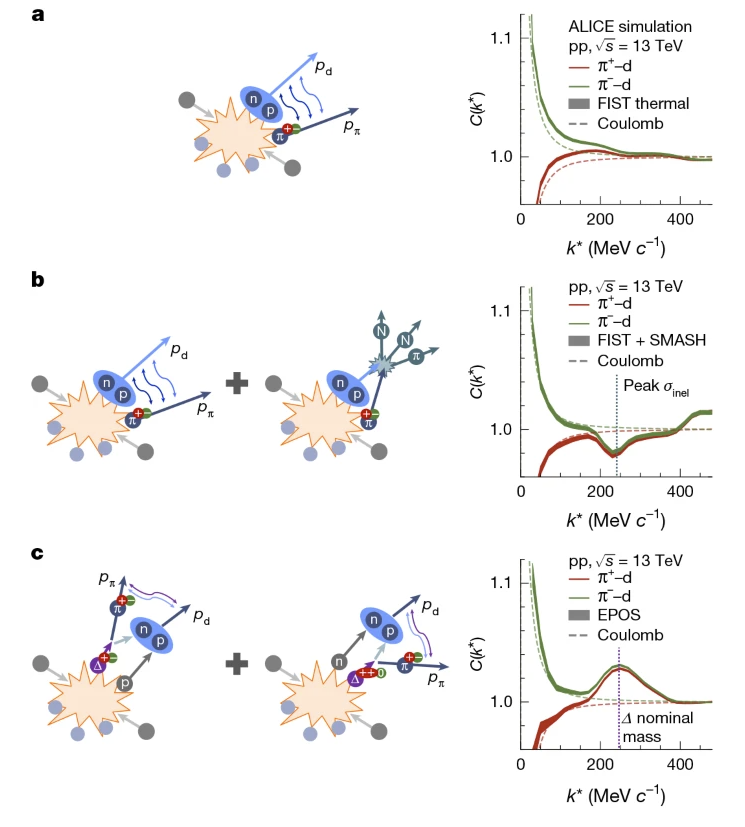
Three different scenarios for deuteron formation – purely thermal production, thermal production with scattering, and formation from resonance-decay nucleons – together with the predicted pion–deuteron correlations for each case. Source: The ALICE Collaboration. Observation of deuteron and antideuteron formation from resonance-decay nucleons. Nature 648, 306–311 (2025). https://doi.org/10.1038/s41586-025-09775-5
About 90% from resonance decays
When the measured π- –d and π⁺–d correlation functions are fitted with this decomposition, the result is striking. A purely thermal scenario without resonances cannot reproduce the detailed shape of the data. Even when elastic and inelastic scattering are included, the description remains incomplete. Only when deuteron formation from resonance-decay nucleons is allowed does the model capture the observed correlation pattern.
From the fit, ALICE extracts the fraction of deuterons that originate from Δ decays and corrects for acceptance effects and for contributions from heavier resonances. The final result is that roughly 89% of the observed deuterons and antideuterons are produced in nuclear reactions following the decay of short-lived resonances. The quoted uncertainty is of order a few percent, reflecting both statistical and systematic contributions.
Physically, this means that most deuterons do not “freeze out” directly from the hottest fireball. Instead, they are assembled later, when the system has expanded and cooled, and when nucleons produced in resonance decays can meet and bind in a comparatively gentler environment. In this way, the fragile bound state is largely shielded from the most violent early stages of the collision.
Implications for cosmic rays and dark matter
Beyond clarifying a fundamental aspect of light-nucleus formation in collider environments, the result feeds directly into astrophysical applications. Models of cosmic-ray propagation and interaction in the Galaxy rely on hadronic production cross-sections for (anti)nuclei, which are often tuned to LHC data. However, until now these models had to make assumptions about the microscopic mechanism and space–time distribution of (anti)nucleus formation.
By demonstrating that resonance decays dominate deuteron production in proton–proton collisions at the LHC, ALICE provides a concrete mechanism that can be implemented in event generators and transport codes. This can improve predictions for the flux of anti-deuterons and heavier antinuclei produced when high-energy cosmic rays interact with the interstellar medium, and therefore sharpen the estimates of the astrophysical background for experiments searching for exotic contributions, such as those from dark-matter annihilation or decay.
The recent result strengthens the light-nucleus programme of ALICE itself. It complements earlier measurements of light (anti)nucleus yields, their “penalty factors” and their role as a probe of the hadrochemical conditions in heavy-ion collisions. The femtoscopic approach developed here can be extended to other systems, heavier nuclei and different collision systems, offering a rich avenue for future work in Run 3 and beyond.


