
Moving antimatter beyond the lab
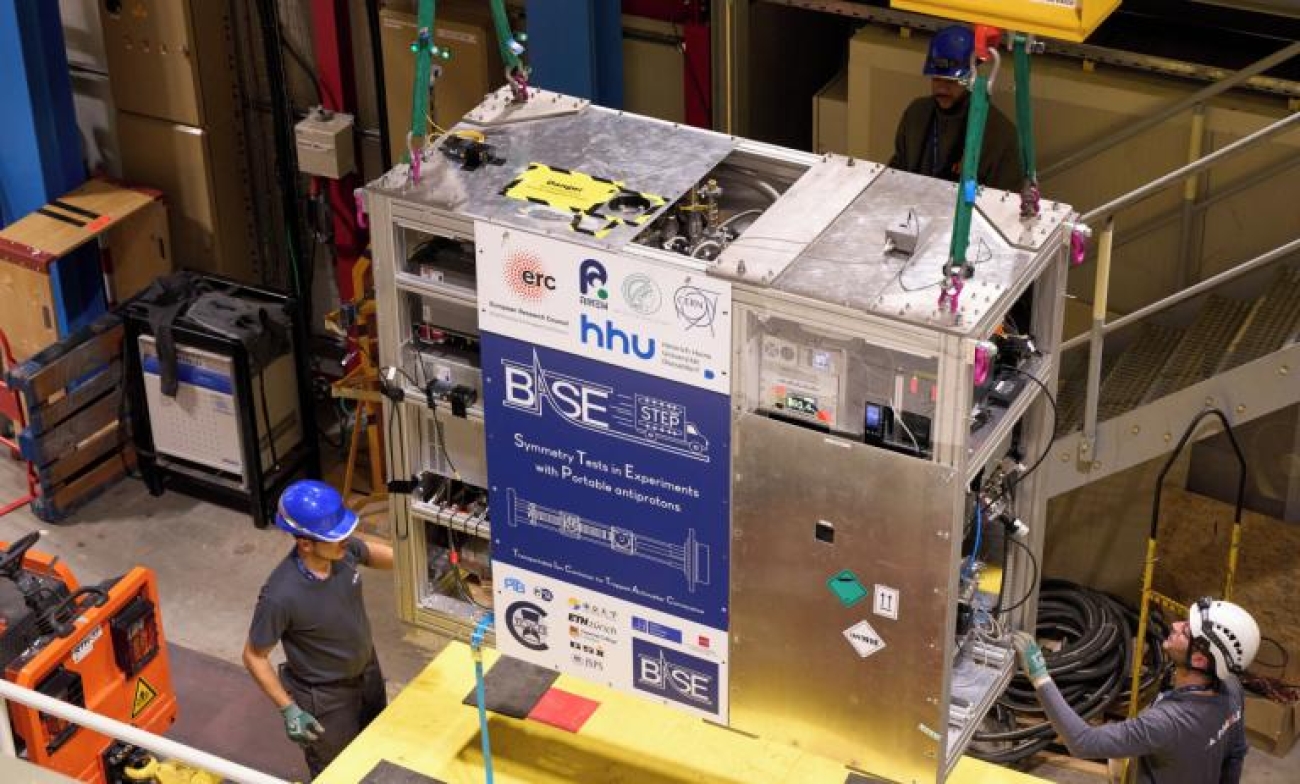
For decades, antimatter experiments have been bound to a single place: the laboratory in which the particles are produced and trapped. At CERN’s Antimatter Factory, antiprotons are routinely produced, decelerated and confined in Penning traps, where electric and magnetic fields are used to store charged particles for high-precision studies. Yet the very environment that makes these experiments possible also limits them. Magnetic-field fluctuations, infrastructure constraints and the operational conditions of a shared experimental area place practical limits on the ultimate precision that can be achieved on site.
A new development from the BASE collaboration is now set to change this paradigm. With the successful demonstration of BASE-STEP, a transportable cryogenic Penning-trap system, CERN has taken the first step toward making antimatter mobile. In a recent milestone, researchers accumulated a cloud of 92 antiprotons and transported them for about 24 minutes over 7.5 kilometres across CERN’s main site in the portable trap, before successfully resuming operations after the journey. This marks the first time antimatter has been transported in a fully controlled and reversible way, opening a path toward a new experimental model.
This achievement builds on earlier work by the collaboration, which demonstrated the transport of a cloud of protons across CERN’s site as a full-system rehearsal, as reported in a previous EP News article. That test validated the stability and robustness of the setup under real transport conditions; the latest result shows that the same approach now works with antimatter.
Prof. Dr. Stefan Ulmer, spokesperson for BASE and Chair of Quantum Technology and Fundamental Symmetries at Heinrich Heine University (HHU) Düsseldorf: “Capturing antiprotons and storing them for extended periods requires considerable expertise. Antimatter annihilates immediately upon contact with matter. Therefore, the antiparticles must be stored under extremely high vacuum using electric and magnetic fields to prevent them from coming into contact with gas particles or the storage vessel.”
At the heart of this advance lies an intricate piece of engineering. BASE-STEP is a compact, autonomous system weighing around one tonne, built around a superconducting magnet, a liquid-helium cryogenic system, energy reserves and an ultra-high-vacuum chamber. Within this chamber, antiprotons are confined by carefully controlled electric and magnetic fields that prevent them from ever coming into contact with matter. The magnet operates in persistent-current mode, allowing stable trapping conditions without continuous external power, while onboard systems maintain the trap voltages and monitoring functions during transport. Compact enough to pass through standard laboratory doors, the device is nevertheless robust enough to withstand the mechanical stresses and vibrations of transport.
“We developed the portable trap BASE-STEP to transport the captured antiprotons to various precision laboratories – within CERN, to Heinrich Heine University Düsseldorf (HHU), Leibniz University Hannover, and potentially other laboratories. There, the extremely precise antiproton measurements will be carried out,” explains Dr. Christian Smorra, a member of Ulmer’s Düsseldorf research group and head of the European Research Council (ERC)-funded project STEP (Symmetry Tests in Experiments with Portable antiprotons). “Two years ago, we confirmed the feasibility of our concept with protons. Now we have achieved the same with antiprotons, a huge leap towards our goal.”
“So far, we have stored antiprotons in BASE-STEP for two weeks without loss, and we can transport the trap autonomously for four hours,” says Smorra. “But to reach our laboratory at HHU, we need at least ten hours. This means we have to keep the trap’s superconducting magnet at a temperature below 8.2 K (-265 °C) for that long.” Instead of liquid helium, which can run out, a generator would be needed to power a cryocooler on the truck.
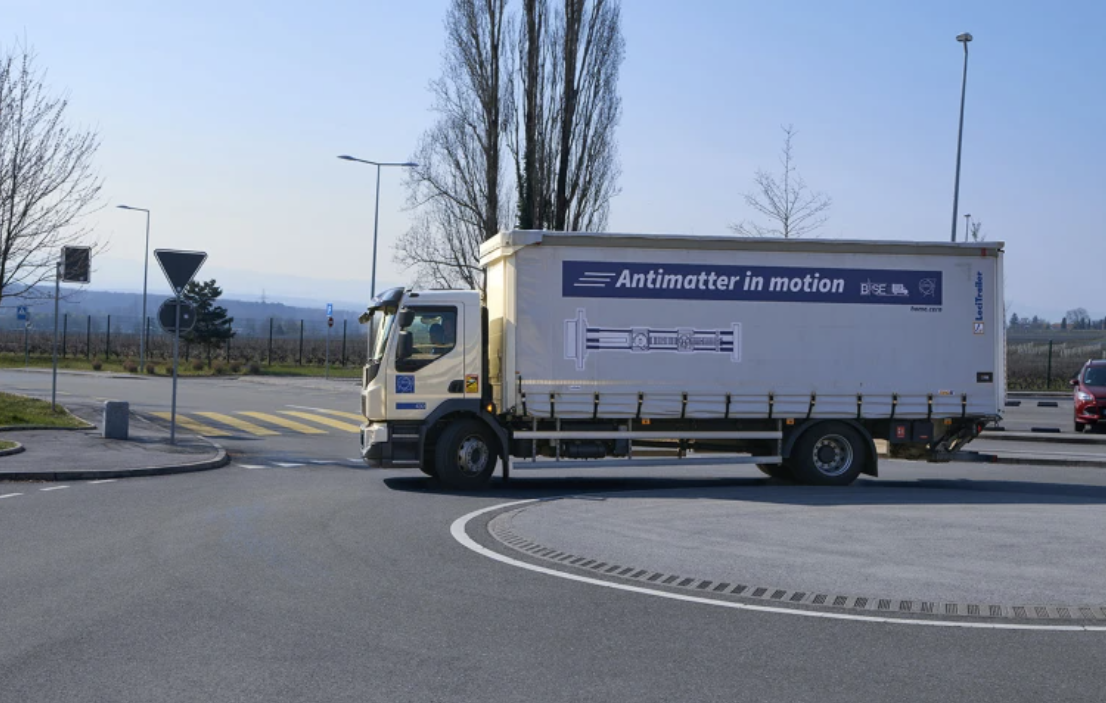
A cloud of 92 antiprotons was successfully transported across CERN’s site in the BASE-STEP portable Penning trap, designed to keep antimatter confined without contact with matter.
The motivation for this effort is fundamentally scientific. The BASE collaboration aims to measure the properties of antiprotons with extreme precision, in particular their magnetic moment, and compare them with those of protons. Such comparisons are among the most sensitive tests of fundamental symmetries in physics, including CPT invariance. To push these measurements further, however, researchers need exceptionally quiet experimental environments. By transporting antiprotons to dedicated precision laboratories, such as the BASE facilities at Heinrich Heine University Düsseldorf, they aim to reduce environmental magnetic noise and improve measurement precision by up to two orders of magnitude.
In this sense, BASE-STEP represents more than a technical success. It introduces a conceptual shift: antimatter experiments no longer need to be confined to the production site. Instead, antiprotons can, in principle, be delivered to specialised laboratories optimised for specific measurements. This decoupling of production and precision measurement opens the door to new experimental strategies and greater flexibility in how antimatter is studied.
The implications extend beyond a single experiment. Transportable antimatter could enable a broader ecosystem of precision studies, allowing different research groups to access antiprotons without requiring permanent infrastructure at CERN. It also opens the possibility of tailoring experimental environments to specific scientific goals, whether that involves ultra-stable magnetic fields, novel detection techniques or integration with other facilities.
At the same time, the approach remains carefully controlled. The number of particles involved is extremely small, and the total stored energy is negligible. Even in the unlikely event of complete annihilation, the released energy would be far below everyday environmental levels. From a safety perspective, the transport is handled within the framework of standard scientific equipment logistics.
“The transport of antimatter is a groundbreaking and ambitious project, and I congratulate the BASE collaboration on this impressive milestone. We are at the beginning of an exciting scientific journey that will allow us to further deepen our understanding of antimatter,” says Dr. Gautier Hamel de Monchenault, Director of Research and Data Processing at CERN.
The BASE-STEP programme has progressed steadily over recent years, from initial design and construction to proton validation and, most recently, successful antiproton transport. The next phase will likely involve transporting antiprotons to another building at CERN and practising their transfer into a second trap after arrival. Looking further ahead, the longer-term goal is to deliver antimatter to dedicated precision laboratories outside CERN, including facilities under development in Düsseldorf and potentially elsewhere in Europe.
This work also sits alongside complementary initiatives at CERN, including the PUMA project, which is exploring the transport of antiprotons over shorter distances within CERN’s experimental complex to enable studies of unstable nuclei. Together, these efforts point toward a future in which antimatter is no longer a static resource, but a distributed one.
As CERN prepares for the next generation of precision measurements, BASE-STEP demonstrates that innovation in experimental infrastructure can be just as transformative as advances in theory or detector technology. By taking antimatter beyond the confines of the laboratory, it opens a new frontier—one in which the most elusive form of matter can be studied with unprecedented clarity.


