MUonE: A new path to hadronic vacuum polarization and the running of α
The MUonE Collaboration [1] is making excellent progress towards developing a final proposal for an experiment that will measure the running of the electromagnetic coupling (alpha) by mapping out the differential cross section for muon–electron elastic scattering. The effective coupling strength increases with the momentum transferred to the electron because of the introduction of higher-order corrections, due to a virtual photon producing an intermediate hadronic state before being reabsorbed (the topology shown in the Feynman diagrams in Figure 1). These same processes contribute to the muon’s anomalous magnetic moment. Consequently, the MUonE result will be used to estimate the HVP that can be compared to the recently published final results from the Fermilab Muon g − 2 experiment [2].
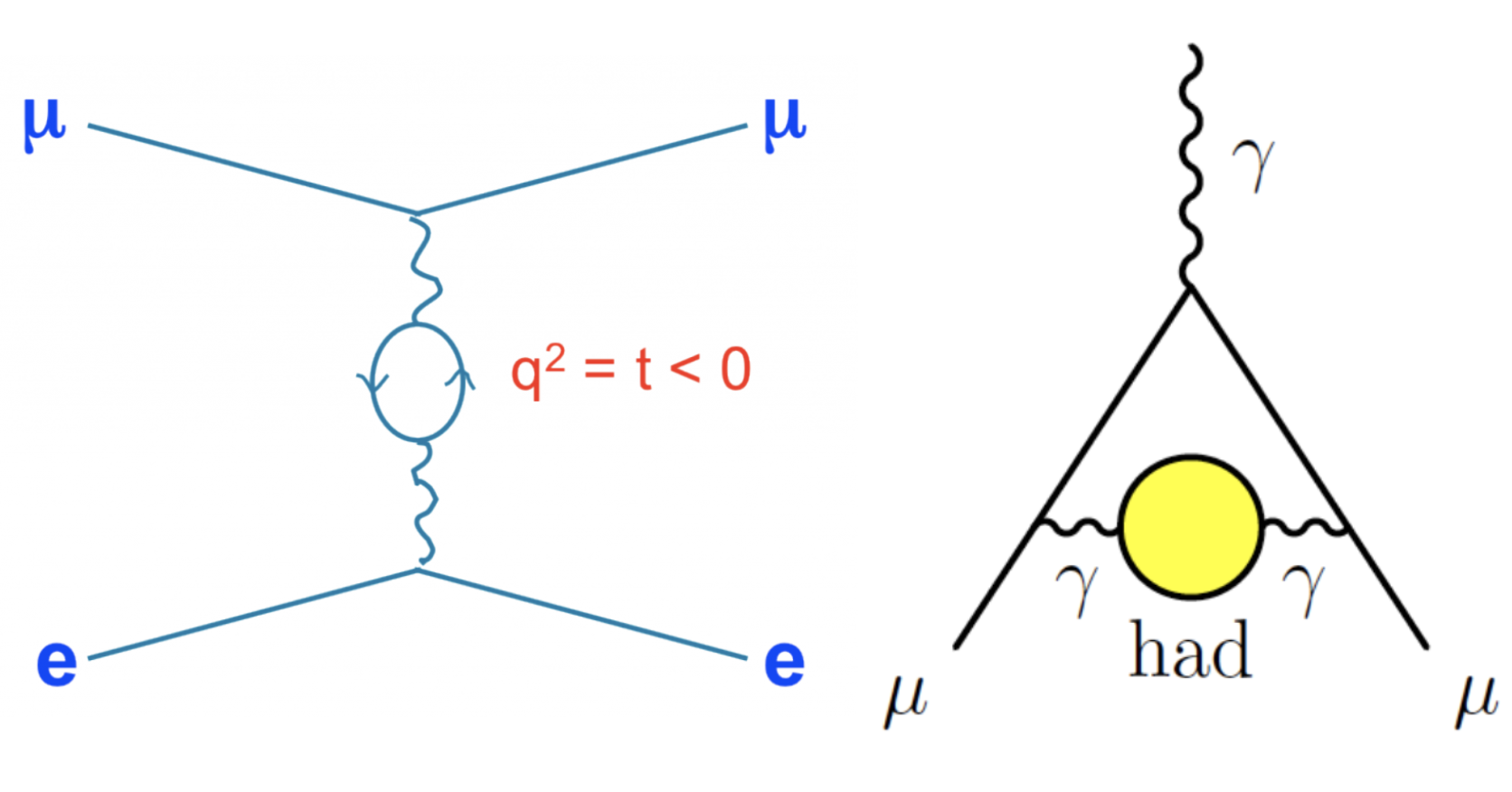
Figure 1. Feynman diagrams illustrating hadronic vacuum polarization topology contributing to the running of α in μ-e elastic scattering (left) and to (g − 2)μ (right).
The Muon g − 2 result has intensified interest in improving the precision of the Standard Model prediction it is compared to, which is currently limited by the HVP contribution [3]. While lattice QCD calculations now seem to describe correctly the experimentally measured magnetic moment, significant discrepancies remain with values inferred from hadron production in electron–positron collision data. The method used by MUonE can effectively verify the lattice calculations, and—in contrast to the function integrated in current data-driven evaluations—the spectrum MUonE measures is smooth and free of resonance features.
Detector concept and location in the North Area
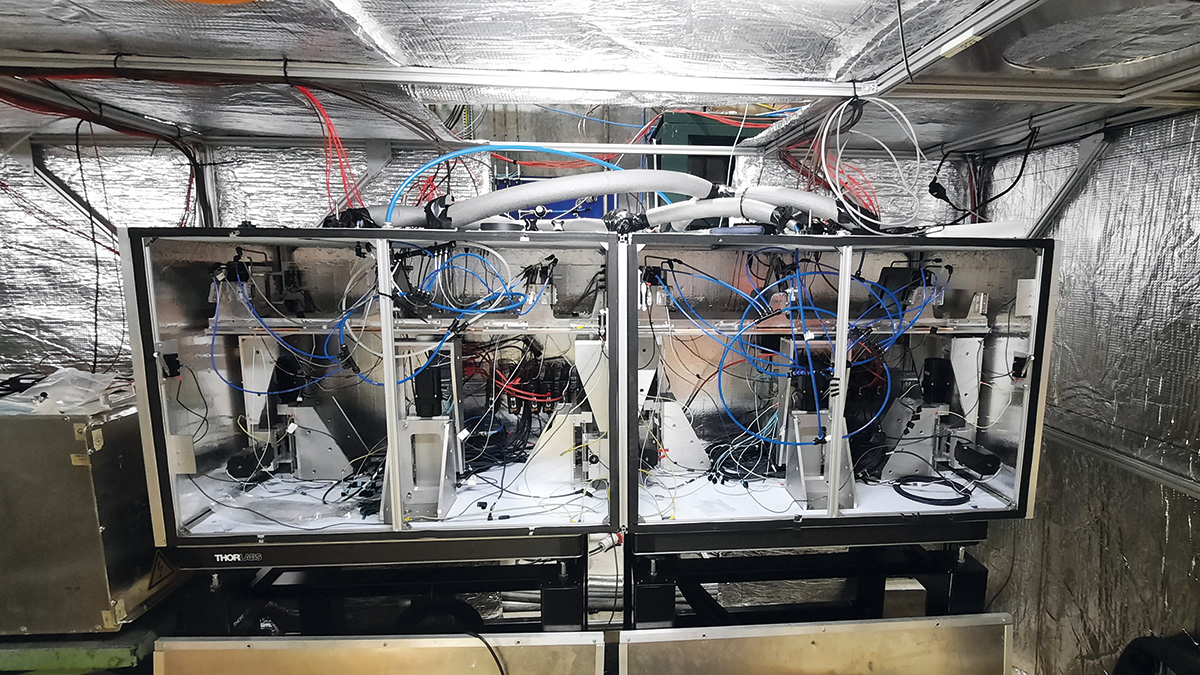
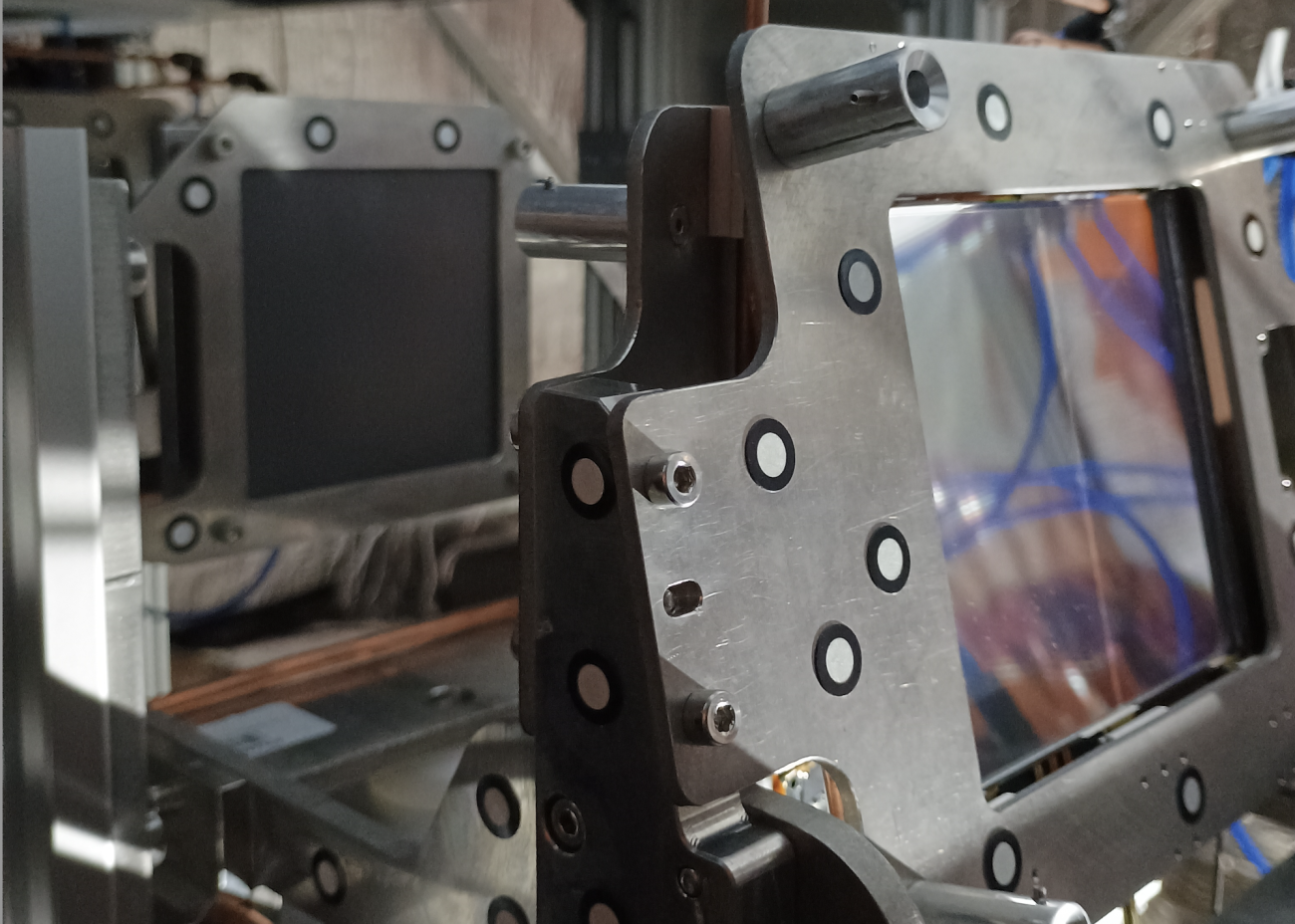
MUonE will be positioned just before the AMBER detector in the M2 beamline in CERN’s North Area (Figure 2). It is a modular, extensible detector consisting principally of a sequence of scattering targets and tracking stations. These are preceded by a beam momentum spectrometer, and an electromagnetic calorimeter and muon tracker are placed at the end. Each tracking station contains six silicon strip modules developed by the CMS Collaboration for the Phase-2 High-Luminosity upgrade of the outer tracker [4].
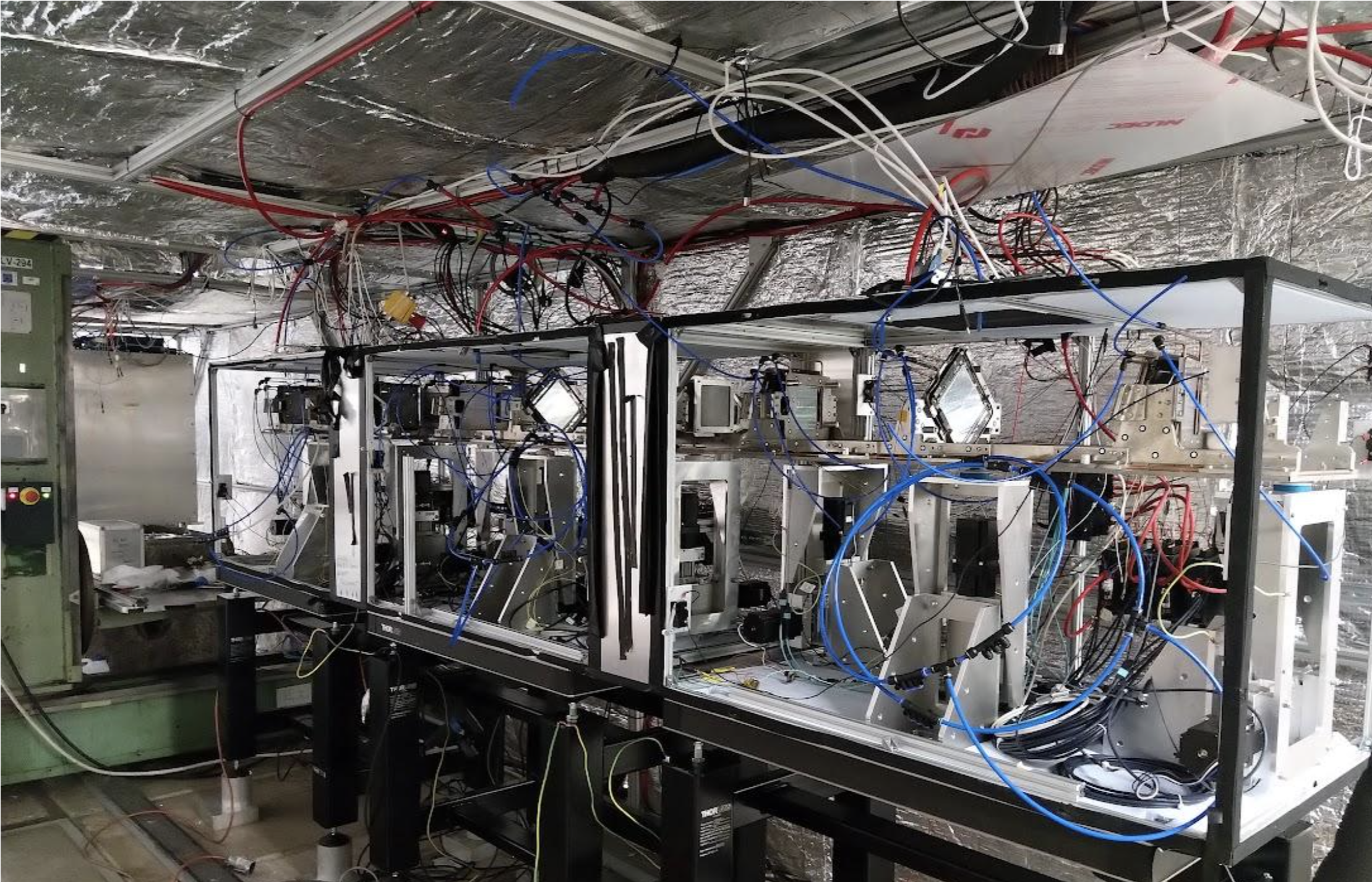
Figure 2. The MUonE 2025 apparatus in the M2 beamline, upstream of AMBER in CERN’s North Area. The beam moves from right to left.
Real-time selection and precision angle measurements
Data are collected and filtered in real time by a data acquisition system based on the Serenity FPGA board [5], also developed for CMS. The filter searches for interactions in the targets where one incoming muon track becomes two outgoing tracks: the muon and a scattered electron. Although the muon beam rate is about 50 million muons per second, the rate of interactions is “only” about 400,000 events per second — still demanding a very high-throughput DAQ system for storage and data management.
The key experimental observables are the scattering angles, measured with very high precision. The angles carry the information about the momentum transfer, and elastic kinematics tightly relates the two angles, enabling strong suppression of backgrounds.
Phase-1 test run: performance and first physics targets
MUonE carried out an extended test run (Phase 1) from May through August of this year, featuring three tracking stations with two 20 mm graphite targets. The run demonstrated excellent performance across all elements of the apparatus. The calorimeter and muon filter showed strong discrimination between muon and electron tracks (Figure 3), particularly in the angular region where the two emission angles are very similar. This provides further background suppression and reliable identification of the outgoing muon in a kinematic range crucial for determining the HVP correction. Tracker operation was also excellent, with alignment achieving track residuals at the level of tens of microns.
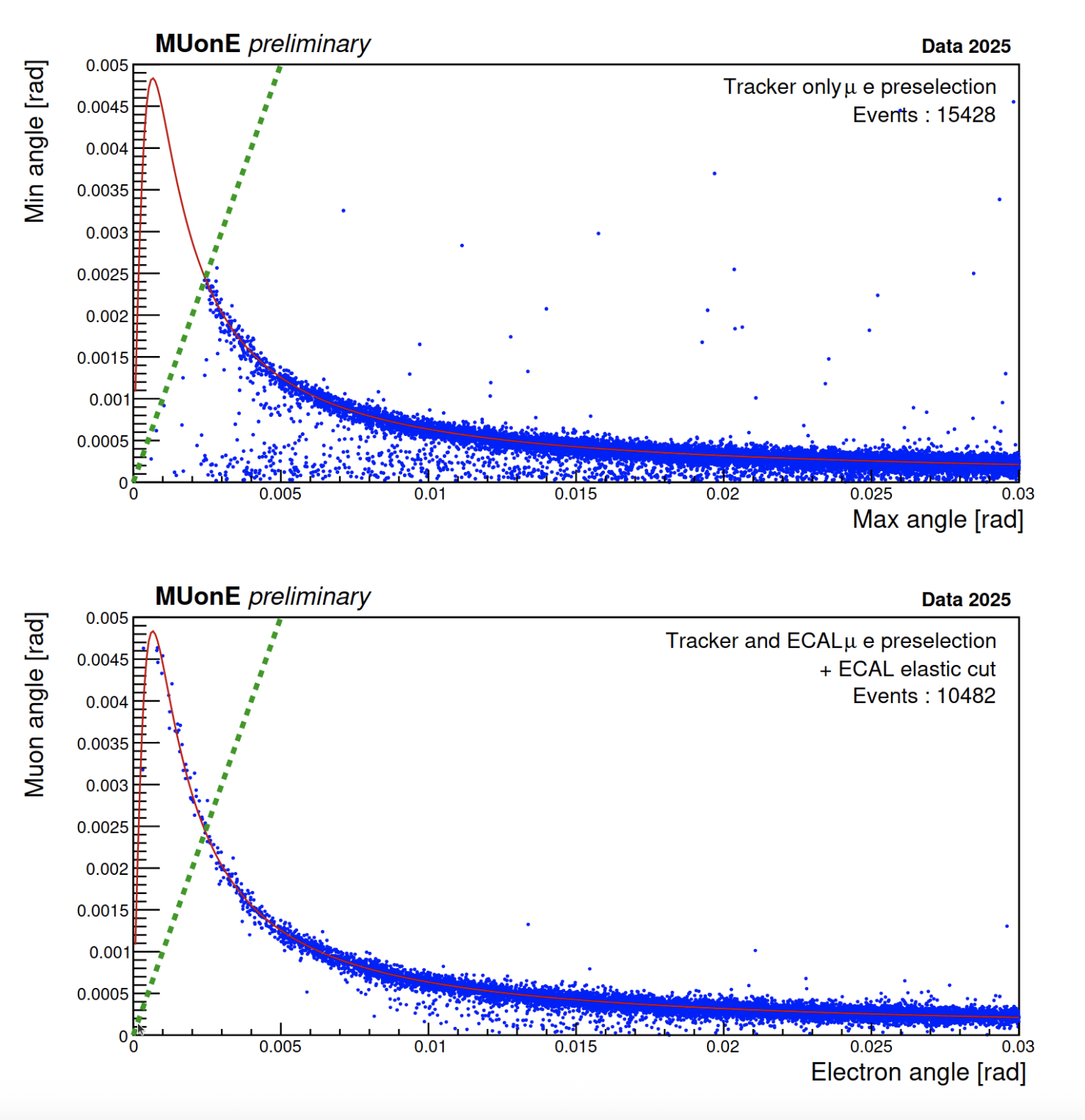
Figure 3. Example of muon/electron discrimination performance in the calorimeter and muon filter. The red contour shows the expected relationship between muon and electron angles for elastic kinematics. The particle identification is ambiguous for events to the left of the green line and requires information from additional detector elements.
The Phase-1 physics goals are to confirm the known value of the leptonic part of the running of alpha and to measure the hadronic contribution with a precision of about 20%. While the physics analysis is only beginning, the collected data set is expected to allow these goals to be reached—and potentially surpassed.
Looking ahead: full-scale MUonE and broader physics opportunities
In the coming years, MUonE aims to finalize plans for a full-scale experiment comprising 40 tracking stations and several years of data taking. This configuration would enable sensitivity at the level of about 0.3% for the hadronic vacuum polarization—substantially better than the roughly 0.9% precision now achieved by lattice calculations. In parallel, the detector concept is also well suited for searches for dark matter via displaced vertices.
The collaboration is now at a stage where it needs to grow substantially, and expressions of interest from prospective collaborators are welcome as MUonE advances these ambitious plans.
References
- Komijani, J. et al. (MUonE Collaboration), Proposal for phase 1 of the MUonE experiment. CERN-SPSC-2024-015. https://cds.cern.ch/record/2896293. General information is available from https://web.infn.it/MUonE/.
- Aguillard, D.P. et al. (Muon g − 2 Collaboration), Measurement of the Positive Muon Anomalous Magnetic Moment to 127 ppb. Phys. Rev. Lett. 135 101802. https://journals.aps.org/prl/abstract/10.1103/7clf-sm2v
- Aliberti, R. et al. (Muon g − 2 Theory Initiative), The anomalous magnetic moment of the muon in the Standard Model: an update. Physics Reports 1143 1–158. https://www.sciencedirect.com/science/article/pii/S0370157325002157
- CMS Collaboration, The Phase-2 Upgrade of the CMS Tracker. CERN-LHCC-2017-009. https://cds.cern.ch/record/2272264
- Rose, A.W. et al., Serenity: An ATCA prototyping platform for CMS Phase-2. PoS TWEPP2018 115. https://pos.sissa.it/343/115