Understanding the nuclear structure of atomic nuclei away from the valley of stability remains one of the central challenges of nuclear physics and astrophysics. In particular, the dilute outer regions of neutron-rich nuclei can exhibit phenomena such as neutron halos and neutron skins, where the neutron density significantly exceeds the proton density. These phenomena are not only fascinating manifestations of quantum many-body systems but also rare examples of neutron-rich matter, making them a unique environment to examine the behaviour of matter in neutron stars.
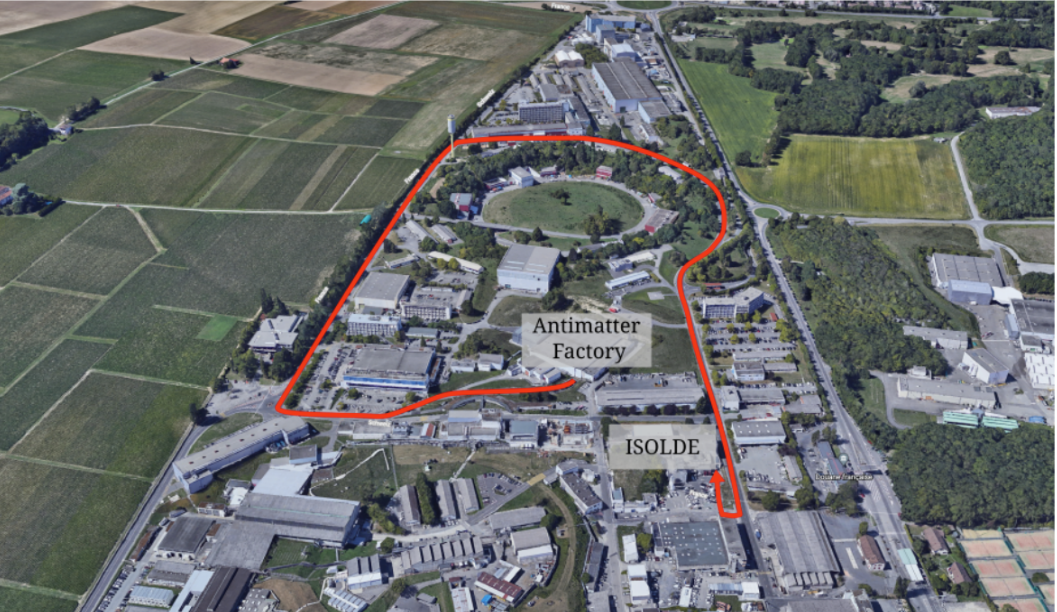
Figure 1: Foreseen path for the transport to ISOLDE
The PUMA experiment (antiProton Unstable Matter Annihilation) aims to probe this region using antiprotons. Low-energy antiprotons confined together with nuclei of interest form antiprotonic atoms, in which the antiprotons are captured in excited atomic orbitals. Subsequently, the antiprotons cascade down towards the nucleus emitting Auger electrons and X-rays. As they approach the nucleus, the likelihood of antiprotons annihilating with one of the outermost protons or neutrons increases, eventually leading to an annihilation and emission of annihilation products. By measuring the tracks of the energetic charged particles among these products - mostly pions - in a magnetic field, the total charge of the annihilating system can be determined and therefore whether the annihilation took place with a proton or a neutron. This allows PUMA to determine the neutron-to-proton density ratio in the outermost region of the nucleus - the tail of nuclear density.
The strong sensitivity to the very edge of nuclear matter, where skins and halos occur, is a unique feature of the PUMA technique over others. This leads to more constrained theoretical models for calculating neutron densities. The precise determination of neutron densities allows for improved constraints on the equation of state of nuclear matter.
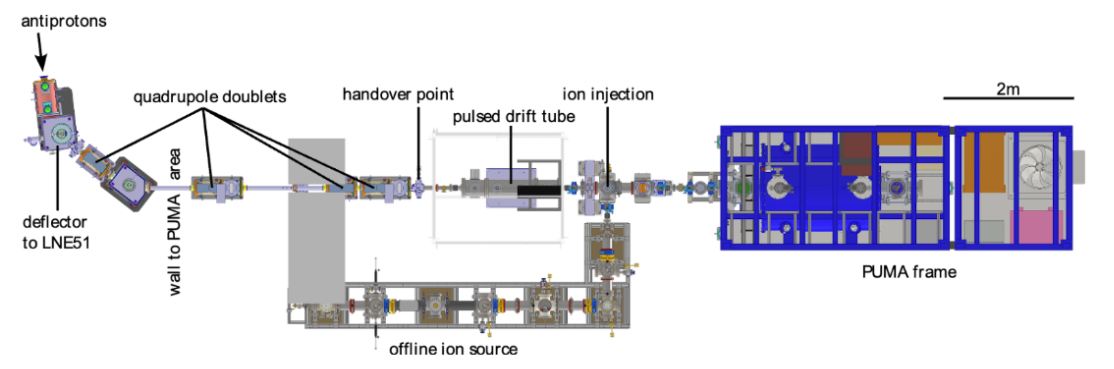
Figure 2: Schematic drawing of the PUMA zone at the AD
Historical development
The idea of using antiprotons for probing nuclear density distributions dates back to the 1970s, when the first nuclear structure experiments were carried out at Brookhaven National Laboratory. Antiprotons were scattered on solid targets, which provided an early indication of neutron-rich regions in heavy, stable nuclei. Limited statistics and the complexity of modelling annihilation processes made it difficult to extract reliable information about neutron density distributions.
Later experiments at the end of the 20th century at CERN’s Low Energy Antiproton Ring (LEAR) refined the technique with precision spectroscopy of the X-rays from the decay cascade before the annihilation. This significantly improved our understanding of the antiproton-nucleon interaction, but the technique remained limited to stable targets.
In 2004, Wada and Yamazaki proposed applying this method to radioactive nuclei by trapping an antiproton plasma in a particle trap and mixing it with exotic ions. At that time, the required experimental infrastructure did not exist yet, and PUMA, accepted in 2021 as a CERN experiment, is the practical implementation of this proposal.
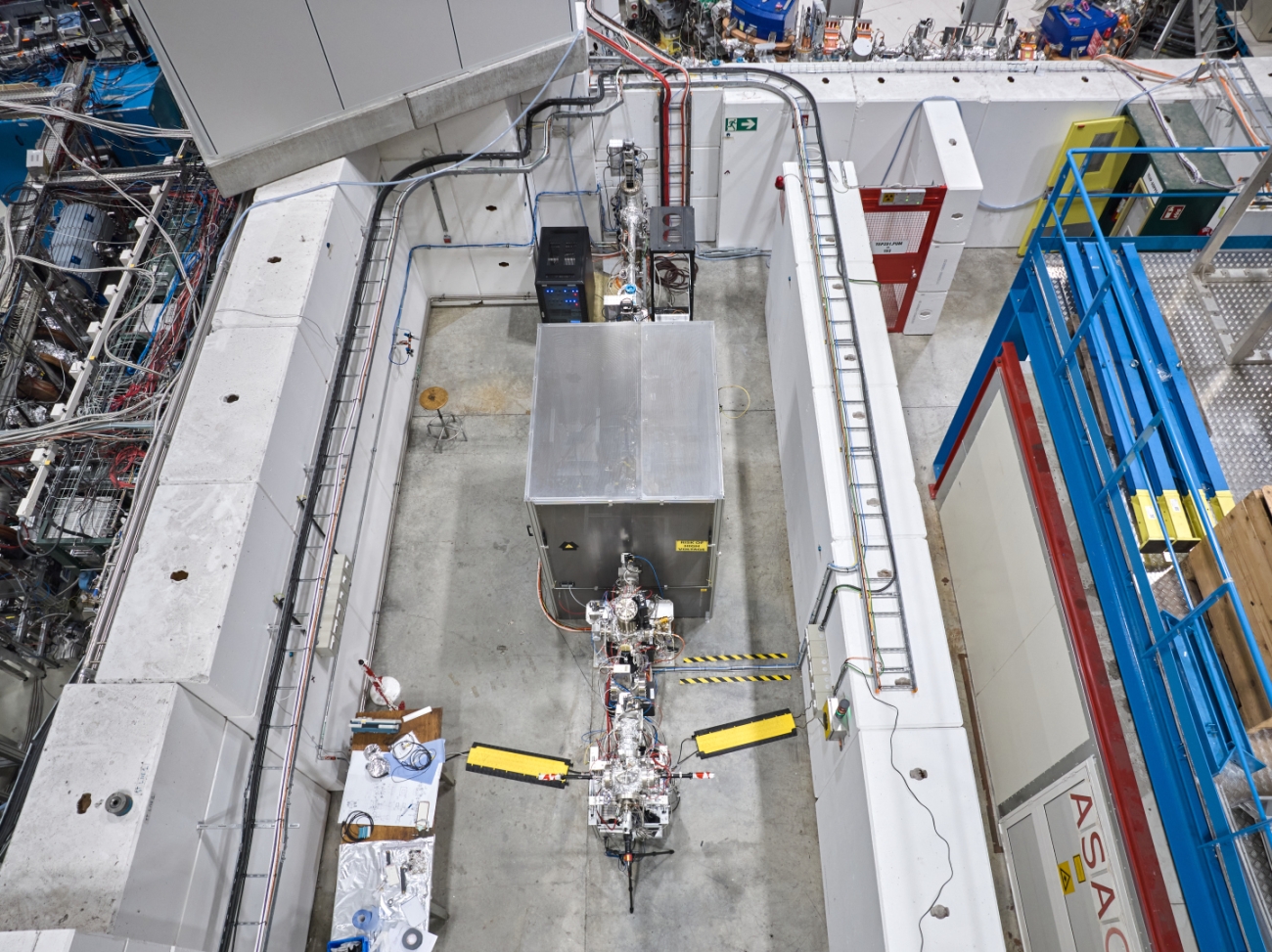
Figure 3: Gentner-program doctoral student Clara Klink in front of the antiproton beamline. In the background, the Faraday cage shields a 96kV Pulsed-Drift-Tube used to decelerate the antiprotons from 100 keV to 4 keV.
The PUMA experimental implementation
Instead of impinging antiprotons on a fixed target, PUMA traps antiprotons in a particle trap under carefully controlled conditions. Initially, the experiment will focus on stable nuclei produced in an ion source at CERN's Antimatter Factory. Then, measurements with radioactive ion beams will be performed at CERN's Isotope Separator On Line Device (ISOLDE). To use antiprotons with radioactive beams from ISOLDE, the PUMA apparatus will be transported with the antiproton plasma from the Antimatter Factory to ISOLDE. To make this work, several technical challenges had to be overcome.
Because no direct beamline connects the Antimatter Factory and ISOLDE, the particles must be physically transported while still confined in their trap. Antiprotons are stored in a Penning trap in ultra-high vacuum conditions, where a combination of magnetic and electric fields keeps the charged particles confined. The magnetic field is created by a 4 Tesla superconducting magnet. The trap is designed to be fully transportable and will be powered by a diesel generator during transport.
PUMA initially plans to trap around 107 antiprotons for the first physics cases, with up to 109 as a long-term goal. Therefore, a sufficiently long lifetime of the antiprotons - mostly dominated by the vacuum in the trap - must be achieved. In the PUMA trap extremely high vacuum conditions are required, while the LHC vacuum reaches 10-12 mbar, PUMA aims for 10-17 mbar. This can only be reached in cryo-cooled setups, benefitting from cryosorption, whereby residual gas particles are trapped on cold surfaces at 5K. This approach builds on techniques developed by the BASE experiment and implemented in close collaboration with the CERN vacuum TE-VSC vacuum group.
To produce antiprotonic atoms of interest, the trapped antiprotons are merged with ions to study their annihilation products. In the PUMA experiment, antiprotons will interact with positively charged ions, and bringing these species together efficiently requires careful control of the trapping system. The intended nested trapping electric potentials in PUMA allow simultaneous confinement of particles of opposite charges, and the trap design and operating scheme should enable controlled and efficient merging of the two species. The charged annihilation products move on curved trajectories due to the 4 Tesla magnetic field of the Penning trap. The trap is surrounded by a detector consisting of a Time Projection Chamber (TPC) and a plastic scintillation barrel. Along their tracks through the TPC the particles ionise the gas, creating electrons and charged ions. Guided by an electric field, these drift towards a segmented, sensitive pad plane, where they are amplified and detected by 4096 pads, allowing reconstruction of the curvature of the pion tracks and therefore charge reconstruction. Pions passing through the plastic-scintillator trigger barrel create light that is detected by Silicon Photomultiplier, allowing the creation of a trigger signal for the detector and measuring the annihilations.
Figure 4: Doctoral student Mark Kirschbaum in front of the 4 Tesla solenoid with the PUMA Penning trap and detector inside.
Links to LHC experiments and the HYPER project
The PUMA physics program connects with studies at the ALICE experiment at the LHC. At ALICE, particle collisions are used to study the structure and dynamics of strongly interacting matter under extreme energy-density conditions. Peripheral ion-ion collisions offer a high-resolution tool to probe the spatial extension of nuclear density in the initial state. Hadrons produced in these heavy-ion collisions can begin to move collectively, a phenomenon known as collective flow. The flow changes toward the edge regions of the nucleus and thus also serves as a probe of these regions. Since PUMA approaches the problem from a different perspective, its measurements will complement the ALICE studies, particularly in the low-density region where neutron skins are expected to appear.
Beyond nuclear structure, PUMA will host a new research path focused on the synthesis and study of hypernuclei, supported by an ECR grant. Some of the reaction channels of antiprotons with nucleons lead to the production of hyperons, which are baryons that include at least one strange valence quark. Studying systems containing hyperons and nucleons provides valuable information on hyperon-nucleon interactions, which are difficult to probe with other experimental techniques.
This research relates to astrophysics, since the existence of hyperons may be energetically favoured in the interior of neutron stars. However, the lack of precise experimental information on the hyperon-nucleon interaction leads to large uncertainties in extending the nuclear equation of state to the strange sector.
HYPER has strong synergies with measurements performed in ALICE using the femtoscopy technique to probe the interactions of hyperons with protons via their momentum correlations in the final state. The project is carried out in collaboration between PUMA, ALICE collaborators from TU Munich, and GSI/FAIR collaborators.
These studies have already provided insight into several baryon–baryon interactions, although they are largely limited to light hypernuclei and specific combinations of particles. PUMA could extend these investigations to systems that are difficult or impossible to access at collider experiments, especially including interactions involving hyperons and neutrons.
The experiment will also benefit from detector technologies developed for the LHC program. Precision tracking may draw on developments associated with the ITS3 pixel tracker upgrade of the ALICE experiment, while fast timing capabilities could exploit LYSO scintillating crystal technologies developed for precision timing detectors in the CMS experiment.
Status and Outlook
In the last year, PUMA has been fully installed at the Antimatter Factory including the offline ion source for local measurements at the AD. First antiprotons are expected to be trapped at the AD in this year's run. After trapping the first antiprotons with lifetimes long enough, the vacuum conditions inside the trap can be validated. The first measurements with stable isotopes at the Antimatter Factory can be done.
In August, at the end of this year's run, the first transport to ISOLDE is planned. Therefore, a high-vacuum isotope separation beamline using an MR-TOF and a Paul trap as well as a transfer line using a pulsed drift tube for deceleration are currently being built at ISOLDE. The PUMA experimental program should start right after LS3.
The HYPER project, aiming to produce and investigate hypernuclei via the annihilation of antiprotons with stable nuclei, is intended to achieve a proof of concept in 2030.