
Designing for the unusual: LLP2026 and the lifetime frontier
by Juliette Alimena (DESY, Germany), Oleg Brandt (University of Cambridge, UK), Albert de Roeck (Imperial College London, UK), and José Zurita (IFIC, CSIC‐UV, Spain)
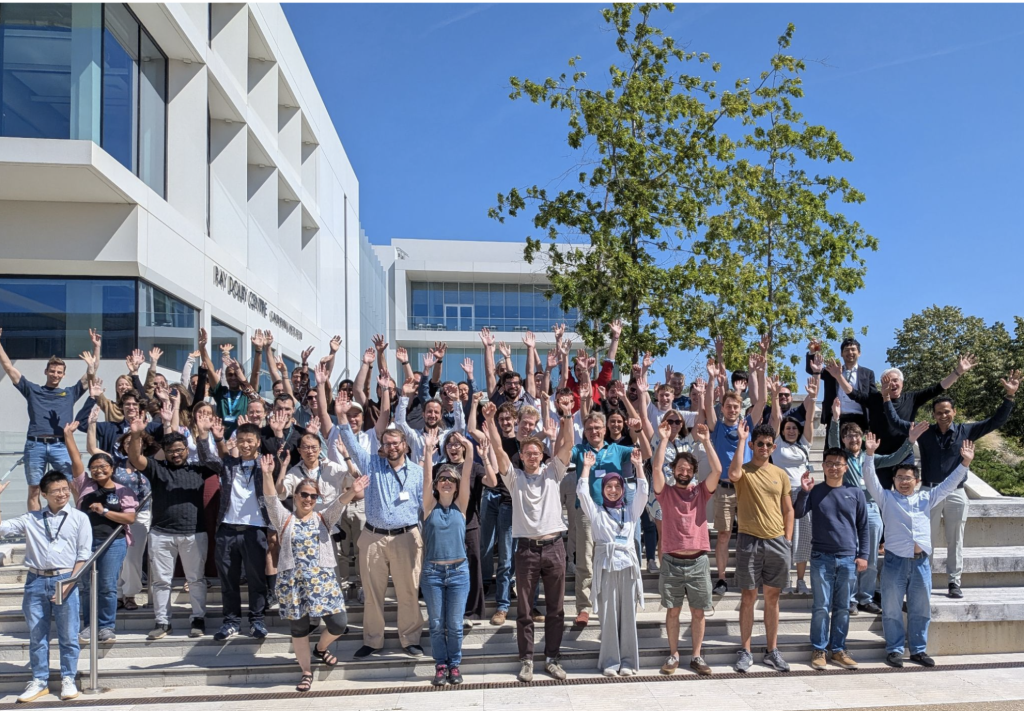
Figure 1. Participants at LLP2026 outside the Cavendish Laboratory. Credit: LLP2026 organisers.
On 29 June, as the Large Hadron Collider completed Run 3 and entered Long Shutdown 3 (LS3), another transition was being discussed in Cambridge, UK. The 16th workshop of the Long-Lived Particle Community, LLP2026, opened that day at the University of Cambridge’s Cavendish Laboratory, bringing together around 80 theorists and experimentalists (Figure 1) working on particles that could travel measurable distances before decaying, or otherwise leave striking signatures very different from those assumed in conventional searches [1].
The workshop itself reflected how broad the community has become. The scientific programme ranged from new theoretical ideas and phenomenology to detector performance and searches. Graham Kribs gave a keynote on long-lived particles from strongly interacting dark sectors, while other theory contributions ranged from precision predictions for LLP production and novel signatures at future facilities to an unexpected connection between anomaly cancellation in minicharged-particle models and the Prouhet–Tarry–Escott problem in number theory. Exciting results from junior researchers were highlighted in a poster reception that was preceded by three-minute “appetiser” talks, giving visibility to a large set of detector, analysis and phenomenology results; two hackathon-style hands-on sessions focused on the practical problem of reinterpreting LLP searches. The experimental reach also extended well beyond CERN: MicroBooNE presented recent LLP searches using its liquid-argon time projection chamber at Fermilab. Together, these contributions underscored that the lifetime frontier is not a single class of LHC analyses, but truly a meeting point between theory, collider experiments, neutrino and beam-dump facilities, and dedicated detectors.
Extending what the LHC experiments can see
A central theme was how much the main LHC experiments have changed their ability to record and reconstruct unconventional signatures. CMS presented the strategy and performance of its LLP trigger programme for Run 3, with dedicated selections targeting displaced tracks and jets, delayed calorimeter deposits, muon-system showers, displaced muons, and out-of-time particles. These substantially enlarge the lifetime and detector-volume regions accessible to LLP searches. [2]
CMS also presented the first physics search using Level-1 trigger scouting, which records reduced information directly from the hardware trigger. With 3.7 fb-1 of 2024 data, the search targeted heavy long-lived charged particles traversing the muon system over several bunch crossings, exploiting the resulting time-correlated signals to extend sensitivity to slowly moving particles. [3]
ATLAS showed a complementary Run 3 advance with its search for events containing both a displaced vertex and a displaced muon. Using 164 fb-1 recorded in 2022–2024, the analysis benefits from a dedicated displaced-muon trigger introduced for Run 3, improved large-radius tracking and improved displaced-vertex reconstruction (Figure 2). These developments extend sensitivity from millimetre-scale displacements to tens of centimetres and set world-leading limits for several benchmark scenarios. [4] The significance is broader than any one exclusion curve: signatures that were previously difficult to select in real time or reconstruct offline have become part of the experiments’ standard search toolkit.
LHCb contributions showed yet another, complementary, direction: new reconstruction approaches are pushing sensitivity towards vertices displaced on metre scales, exploiting the experiment’s forward geometry and flexible software trigger to reconstruct decays far outside the region normally used for precision vertexing.
ALICE also presented its developing BSM programme, including a strategy to search for LLPs with the Time Projection Chamber. With ATLAS, CMS, ALICE and LHCb all represented, the workshop showed how LLP signatures now cut across the LHC experimental programme.
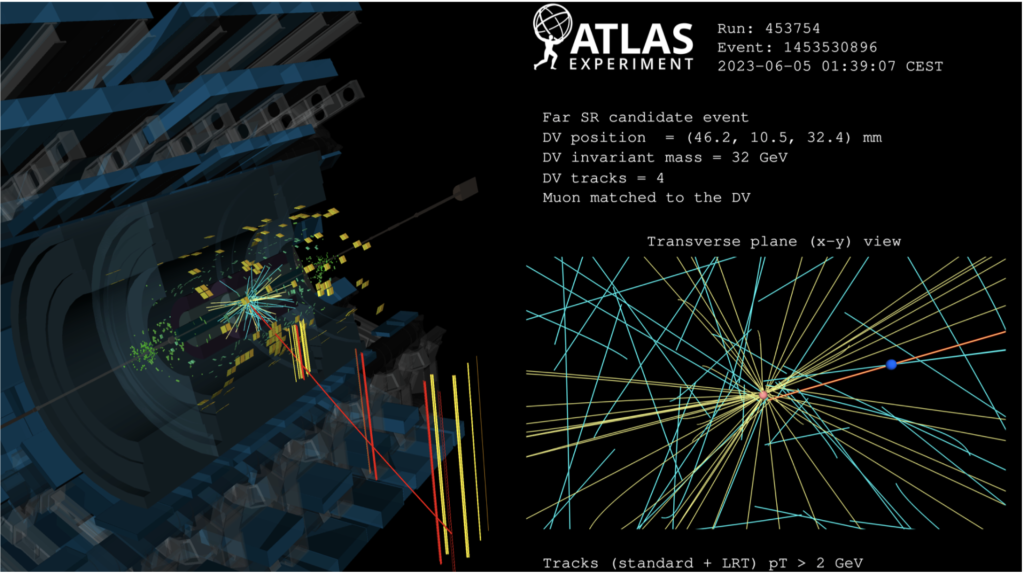
Figure 2. Candidate event from the ATLAS Run 3 displaced-vertex + displaced-muon search, showing a four-track displaced vertex about 47 mm from the primary vertex and a displaced muon. Credit: ATLAS Collaboration/CERN.
A different kind of blind spot
One of the most unusual results presented at LLP2026 came from FASER: the first LHC search for quirks. Quirks are hypothetical heavy particles connected by a new confining interaction, so a produced quirk-antiquirk pair can remain tied together and follow trajectories unlike those of ordinary charged particles. FASER used scintillator charge and timing information in 186 fb-1 of Run 3 data to search for slowly moving quirk pairs. No candidates were observed (Figure 3) in a nearly background-free signal region, excluding previously unexplored combinations of quirk mass and confinement scale. [5]
The result gives a concrete example of a long-recognised challenge: searches can lose sensitivity when a signal falls outside assumptions built into standard triggering and reconstruction. FASER shows how the right detector geometry and timing information can turn such a highly non-standard signature into a clean search. It is an exciting reminder of the value of retaining experimental flexibility for signatures that do not resemble familiar tracks or displaced decays.
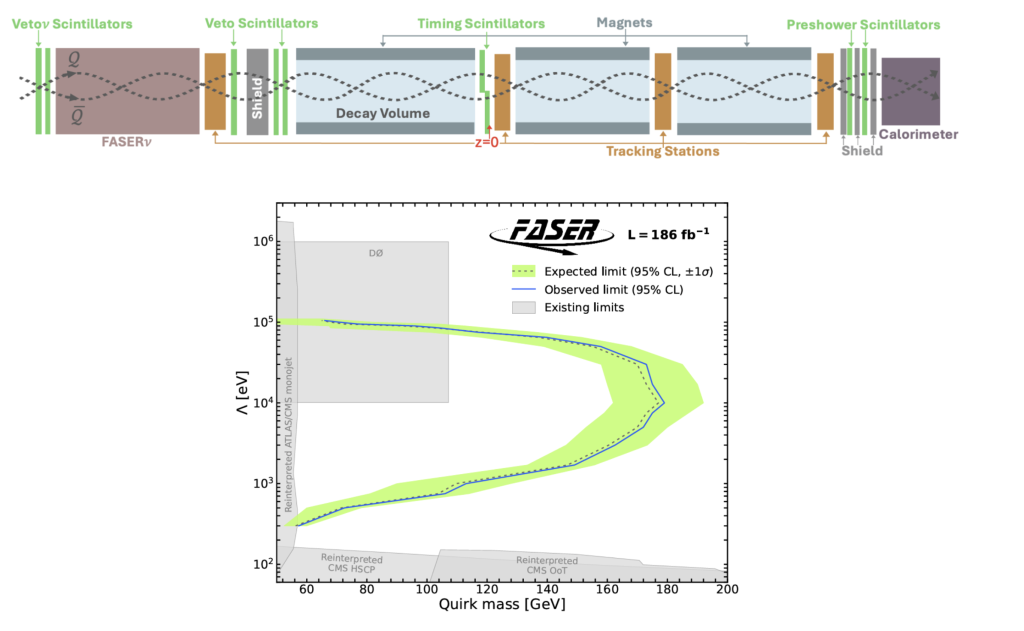
Figure 3. Schematic of quirk trajectories through FASER (top) and the resulting exclusion limits on quirk mass and confinement scale (bottom). [5]
From demonstrators to dedicated experiments
Progress was equally visible in detectors built specifically to extend LLP coverage. CODEX-β, the 2 × 2 × 2 m3 demonstrator for the proposed CODEX-b detector near LHCb, completed its first data-taking campaign after installation and commissioning (Figure 4, left). Its role is deliberately practical: to validate detector technology and reconstruction, measure backgrounds in situ, and test the connection to LHCb needed for a larger experiment. [6]
The proANUBIS demonstrator, installed in the ATLAS cavern, likewise completed its in situ data-taking programme in 2025. Work presented at LLP2026 and a new performance paper brought together results on calibration, track and vertex reconstruction, detector efficiency, and timing using LHC collision data; the measured efficiency and timing resolution meet the requirements set for the proposed ANUBIS detector (Figure 4, right) [7]. The ANUBIS posters at the workshop also showed how prototype data can support both detector-performance studies and the refinement of projected physics sensitivity.
MATHUSLA likewise reported progress on trigger development, background studies, and prototype-detector results for the proposed surface detector near CMS.
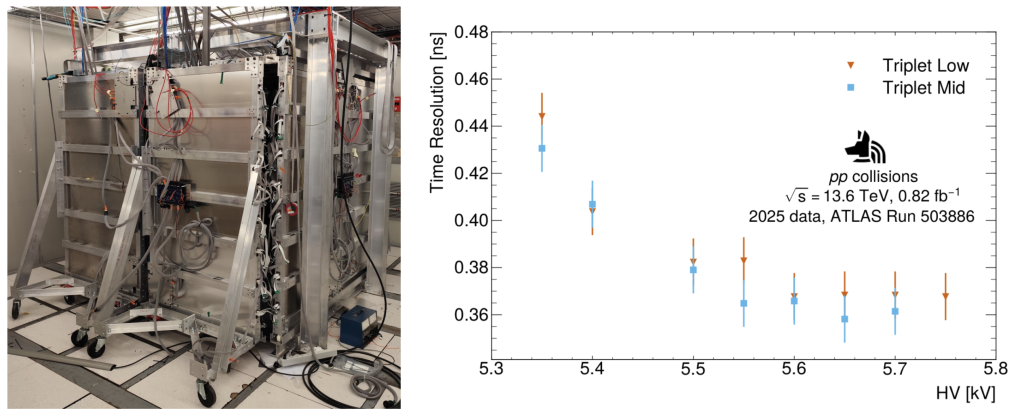
Figure 4. The installed CODEX-β detector (left; credit: CODEX-b Collaboration) and the proANUBIS timing resolution as a function of RPC high voltage (right). [7]
New ideas, and a wider lifetime frontier
Meanwhile, the inventive LLP community keeps producing new ideas. A particularly fresh proposal at LLP2026 was GRENDEL (GalleRy ExperimeNt for Decays of Exotic LLPs), which would instrument the existing PX56 drainage gallery at CMS Point 5 as a transverse LLP detector. [8] The concept is attractive because it starts from an already available underground space rather than requiring a new cavern, while its geometry could complement both CMS and other proposed transverse detectors. Its appearance at LLP2026 showed that even as existing concepts mature, there is still room for genuinely new ways to extend the LHC’s LLP acceptance.
Other projects represented still different scales and timescales. SHiP is preparing a dedicated intensity-frontier programme at the SPS Beam Dump Facility in ECN3, while the proposed Forward Physics Facility would greatly expand the far-forward programme during the High-Luminosity LHC era. [9,10] Together with continuing work on future colliders, these efforts show how the lifetime frontier is increasingly influencing not only searches within ATLAS, CMS and LHCb, but also where experiments are placed and what detector capabilities are designed in from the start.
Designing for the unusual
The LLP2026 workshop brought together the LLP community at an apt moment. Over the past decade, the community has identified places where conventional searches lose sensitivity; Run 3 increasingly showed what becomes possible when those gaps are addressed with dedicated triggers, reconstruction, data streams and detector hardware. At the same time, theory continues to produce signatures that test assumptions the experiments did not originally need to make, while reinterpretation work helps turn published results into constraints on a much wider range of models.
As CERN enters LS3 and prepares for the High-Luminosity LHC, Run 3 results show how dedicated triggers, reconstruction, data streams, and detector hardware can substantially extend the reach of existing experiments. They also reinforce a broader lesson: sensitivity to unconventional signatures is most powerful when considered from the outset of experimental design. The next generation of searches – and, increasingly, experiments – can build on that experience. If we want to find the unexpected, we have to design our experiments to recognise it.
References
[1] LLP2026: 16th workshop of the Long-Lived Particle Community – timetable and programme
[2] CMS Collaboration, Strategy and performance of the CMS long-lived particle trigger program in proton-proton collisions at √s = 13.6 TeV, Phys. Rept. 1205 (2027) 1-83, arXiv:2601.17544
[3] CMS Collaboration, Search for heavy long-lived charged particles with level-1 trigger scouting data from proton-proton collisions at √s= 13.6 TeV, Phys. Lett. B 878 (2026) 140498, arXiv:2601.20063
[4] ATLAS Collaboration, Search for massive, long-lived particles in events with displaced vertices and displaced muons in pp collisions at √s= 13.6 TeV with the ATLAS experiment, Phys. Lett. B 878 (2026) 140509, arXiv:2603.01991
[5] FASER Collaboration, First Search for Quirks at the LHC with FASER, arXiv:2607.26195
[8] M. Citron, F. Redi and R. Schmitz, GRENDEL: a new LLP detector proposal for the HL-LHC, LLP2026 contribution, arXiv:2609.00152