
From beam dumps to missing energy: the SPS search for hidden particles
by Panos Charitos (CERN)
This article is based on the lecture “Feebly Interacting Particles II: Searches at the SPS”, delivered by Paolo Crivelli (ETH Zurich) at CERN on 13 July 2026. The author gratefully acknowledges Paolo Crivelli for his scientific guidance, comments and support in preparing the article.
Feebly interacting particles could provide a window onto hidden sectors and other physics beyond the Standard Model, but their extremely weak interactions make them particularly difficult to detect. In this second article of a two-part series, we turn from the theoretical motivation to the experimental search programme at CERN’s Super Proton Synchrotron. From pioneering beam-dump experiments to today’s missing-energy, missing-momentum and visible-decay searches, the SPS offers a uniquely versatile environment for probing dark photons, light dark matter, axion-like particles, heavy neutral leptons and other possible new particles across a broad range of masses and couplings.
Dark matter is inferred to make up about five times more matter in the universe than the familiar baryonic matter of stars, planets and people. Yet all compelling evidence for it so far comes from gravity: from the rotation curves of galaxies and the cosmic microwave background to gravitational lensing and systems such as the Bullet Cluster. Its particle nature, if it has one, remains unknown.
One possibility is that dark matter belongs to a wider hidden or “dark” sector containing particles and interactions not described by the Standard Model. Some of these hypothetical states may be feebly interacting particles, or FIPs: particles so weakly coupled to ordinary matter that they are produced only rarely and can travel through substantial amounts of material without being absorbed.
Searching for them requires a different experimental logic from that commonly associated with CERN. Rather than relying only on the highest possible collision energies, experiments at the intensity frontier use enormous numbers of beam particles, exquisitely controlled backgrounds and several complementary signatures to reveal extremely rare processes. The two approaches are not alternatives. While the LHC explores the highest energies directly accessible in the laboratory, fixed-target experiments at the Super Proton Synchrotron (SPS) can probe light particles, very small couplings and long lifetimes that are difficult to reach at colliders.
This experimental landscape was the subject of a recent CERN academic training lecture by Paolo Crivelli of ETH Zurich, co-spokesperson of NA64. Focusing on the SPS and CERN’s North Area, Crivelli connected the earliest beam-dump searches with today’s missing-energy programme and with future experiments specifically designed to explore hidden sectors.
“My focus will be on the experimental side,” he said at the outset, pointing participants to Maxim Pospelov’s overview of the theoretical foundations in the first lecture of the Academic Training series. That experimental history reveals both continuity and reinvention: some basic ideas are more than 40 years old, but improvements in beams, detectors, experimental strategies, and theory have repeatedly made them sensitive to entirely new classes of particles.
Four elements of a beam-dump experiment
The modern experimental story begins with the early beam-dump searches of the 1970s and 1980s. In a typical beam-dump experiment, an intense particle beam strikes a thick, dense target known as the dump. The collisions may produce new, long-lived particles. While the dump and the shielding behind it absorb the incoming beam and most known secondary particles, a feebly interacting particle could pass through them and enter a decay volume—a shielded, often evacuated region designed to minimise background—where it may decay. Detectors positioned downstream then identify and reconstruct the visible products of that decay.
Discussing the pioneering E137 experiment at SLAC, which used a 20 GeV electron beam to search for neutral, long-lived particles, Crivelli identified an arrangement that remains recognisable today: “You have a dump, shielding, decay region and detector. These are the four elements which are still what we use today.”
Every part performs a distinct function. The dump provides a large number of particle interactions and therefore opportunities to produce the new state. Shielding removes the intense flux of known particles. The decay region provides space in which a long-lived particle can transform back into visible particles, while the detector identifies and reconstructs those products.
The sensitivity of such an experiment reflects a competition among several probabilities. The new particle must be produced in the dump, survive the remaining target and shielding, decay inside the available volume and send its decay products into the detector acceptance. This competition produces the characteristic “banana-shaped” regions often seen in exclusion plots. At large coupling, particles are readily produced but decay too soon, often inside the dump or shielding. At very small coupling, they live long enough to reach the detector but are produced too rarely – and may also decay beyond it. Between these extremes lies the region the experiment is sensitive to.
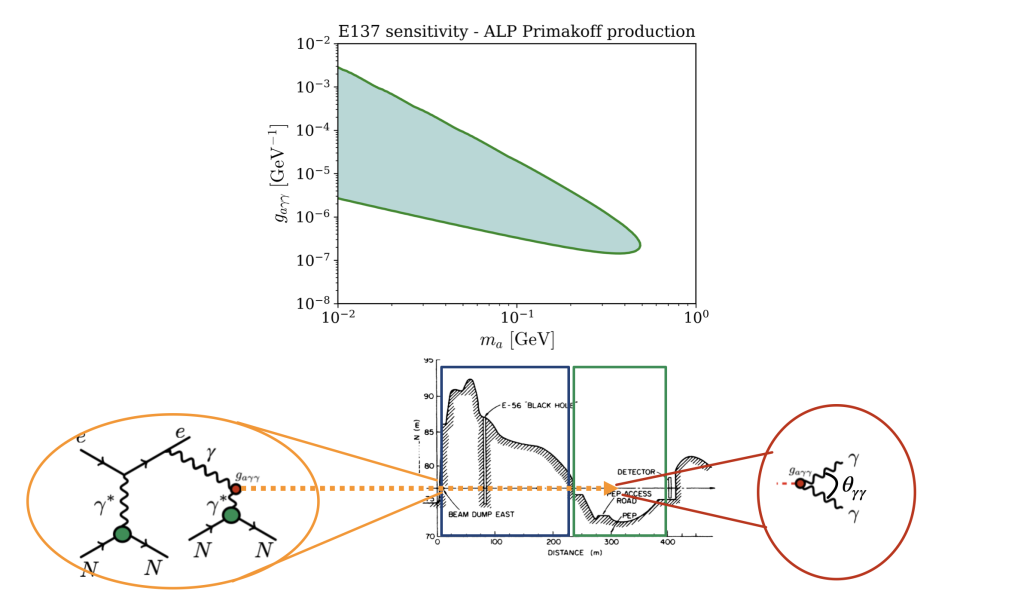
Figure 1: How beam-dump searches work. Left: the four essential elements—dump, shielding, decay volume and detector. Right: the characteristic sensitivity region arising from the balance between production probability, particle lifetime and detector acceptance.
Axions provided an early motivation for such searches. The Peccei-Quinn mechanism, proposed in 1977 to address the strong-CP problem, implied a new light particle: the axion. More general axion-like particles, or ALPs, need not have precisely the properties of the QCD axion but can be sought through similar experimental signatures, including decays into two photons.
The SPS enters the search
CERN was considering these opportunities at an early stage. A workshop held in December 1982, SPS Fixed-target Physics in the Years 1984–1989 [1], explored future searches for massive neutrinos—now commonly described as heavy neutral leptons (HNLs)—axions, supersymmetric particles and other phenomena beyond the Standard Model. Crivelli encountered its proceedings while preparing a tribute to Guido Barbiellini, whose contribution outlined how the SPS could be used to pursue such searches [2], and was struck by how closely the questions raised more than four decades ago resemble those being pursued today.
The workshop helped stimulate the use of CHARM, an existing SPS neutrino experiment, to search for axion-like particles produced in 400 GeV proton-copper interactions. The detector was located about 480 m downstream of the target. A scintillator veto suppressed charged particles entering the apparatus, followed by a decay region about 35 m long and with a transverse area of roughly 3 x 3 m2. An ALP decaying into two photons could produce an isolated electromagnetic shower in the calorimeter, aligned with the direction back towards the target.
The collaboration used electron and pion beams to characterise the detector response, together with simulations of the expected axion signal, and constructed an estimator to distinguish electromagnetic showers from hadronic backgrounds. The collaboration found no candidate events in the signal region. The resulting limits, published in 1985, covered parameter space comparable to that explored at SLAC and remain important reference constraints in modern ALP studies.
Another important step came from PS191 at CERN’s Proton Synchrotron. Using 19.2 GeV protons, PS191 was among the first dedicated beam-dump experiments to search for heavy neutral leptons. Pions and kaons produced at the target were allowed to decay, potentially creating an HNL through its small mixing with an ordinary neutrino. The HNL could traverse the shielding and then decay visibly inside the detector, for example into a charged lepton and a pion.
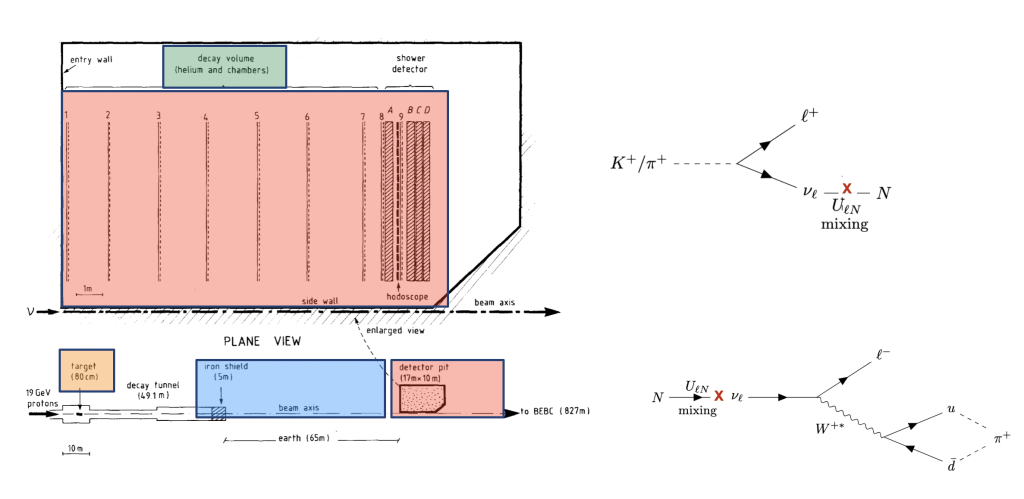
Figure 2: The PS191 beam-dump search for heavy neutral leptons. Left: 19 GeV protons strike a target, producing pions and kaons whose decays could generate heavy neutral leptons (HNLs) through neutrino mixing. Ordinary particles are absorbed by shielding and earth, while sufficiently long-lived HNLs can reach the helium-filled decay volume. Right: an HNL produced in a charged-pion or kaon decay can subsequently decay into visible Standard Model particles, producing the experiment’s characteristic signature: a displaced decay vertex inside the decay volume. Credit: PS191 Collaboration; adapted from a presentation by Paolo Crivelli.
No signal was found, but PS191 placed important bounds on HNL mixing. Its accessible mass range was limited by production kinematics: an HNL emerging from a pion or kaon decay must be lighter than the parent meson minus the accompanying charged lepton. This limitation is one reason why a future high-energy proton beam dump, capable of producing large samples of charm and beauty hadrons, can extend the search to substantially higher HNL masses.
“There are still many of these techniques or ideas that we are exploiting now in maybe different forms,” Crivelli observed. The central geometry has survived; the beams, detectors, background rejection and theoretical targets have advanced dramatically.
From the WIMP to light dark matter
For many years, the dominant particle candidate for dark matter was the weakly interacting massive particle, or WIMP. In the conventional thermal-freeze-out picture, WIMPs and Standard Model particles were in equilibrium in the hot early universe. As the universe expanded and cooled, the interactions became too infrequent to maintain equilibrium. The WIMPs “froze out”, leaving a relic density that survives today.
The observed abundance is inversely related to the thermally averaged annihilation rate. If that rate is governed by a weak-scale coupling and the particle mass lies around the electroweak scale, the calculation naturally produces approximately the observed dark-matter density. This coincidence became known as the “WIMP miracle” and provided an attractive connection with theories such as supersymmetry.
It also motivated a remarkable experimental effort. Direct-detection experiments have improved their sensitivity by many orders of magnitude, and the LHC has conducted extensive searches for dark-matter production and supersymmetric particles. No conclusive WIMP signal has yet emerged. This does not mean that WIMPs have been excluded – as Crivelli stressed in the discussion, many viable models remain – but the absence of a discovery has widened the field. “There might be some other ideas,” he said.
The thermal mechanism does not require the dark-matter particle to have the mass or coupling of a conventional WIMP. If the interaction strength is treated as a free parameter, much lighter dark matter can achieve the observed relic abundance through a new mediator connecting the visible and dark sectors. It becomes possible, in Crivelli’s phrase, to realise “the WIMP miracle without the WIMPs”.
Only a small number of “portals” can connect a hidden sector to the Standard Model. A new scalar can mix with the Higgs field; a hidden fermion can mix with neutrinos; an axion-like particle can couple through gauge fields; and a new vector boson can mix with the ordinary photon. These possibilities motivate searches for dark scalars, HNLs, ALPs and dark photons.
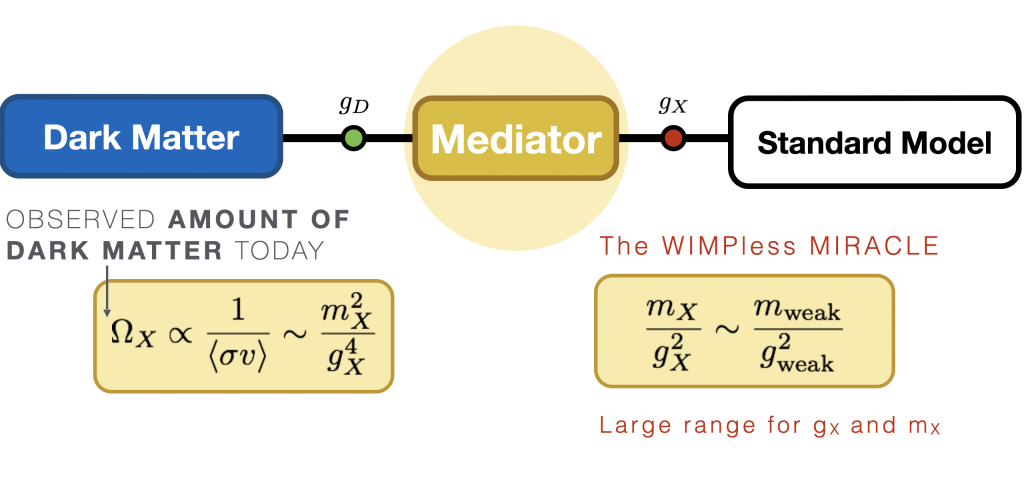
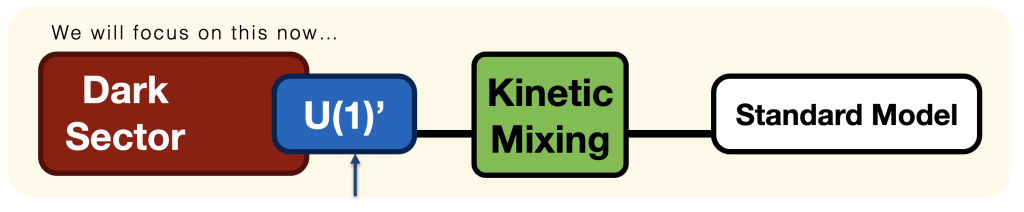
Figure 3: Portals to a hidden sector. A small number of possible interactions can connect Standard Model particles with hidden-sector states, motivating searches for dark photons, dark scalars, heavy neutral leptons and axion-like particles.
The dark-photon benchmark
Crivelli concentrated on the vector portal and the dark photon. Like the photon, the dark photon is associated with a U(1) gauge symmetry, but the dark symmetry is broken, and its force carrier can therefore have mass. The ordinary and dark photons can communicate through kinetic mixing, parametrised by a small coupling epsilon. The dark photon may also couple to dark-sector particles with a dark-sector analogue of the electromagnetic fine-structure constant, usually written alpha_D.
If dark-sector particles are light enough, a produced dark photon can decay invisibly into them. If this channel is not kinematically accessible, it can decay back into visible Standard Model particles, such as an electron-positron or muon-antimuon pair. Experiments therefore search both for visible decays and for energy or momentum carried away by invisible particles.
For thermal light dark matter, the relevant parameters can be combined into a dimensionless quantity usually denoted y, which includes epsilon, alpha_D, and the ratio of the dark-matter and mediator masses. Plotting y against the dark-matter mass allows experimental sensitivity to be compared with the lines on which different candidates – scalar, Majorana or pseudo-Dirac particles, for example – would reproduce the observed relic abundance.
These “thermal targets” give accelerator searches a concrete objective rather than merely an arbitrary exploration of coupling and mass. They also highlight complementarity with direct detection. Galactic dark matter moves non-relativistically, at roughly 10^-3 of the speed of light. In some Majorana or pseudo-Dirac scenarios, direct-detection scattering is suppressed by powers of this small velocity, whereas particles produced at accelerators are relativistic. Accelerator experiments can therefore test models for which direct-detection experiments would require improvements of many orders of magnitude.
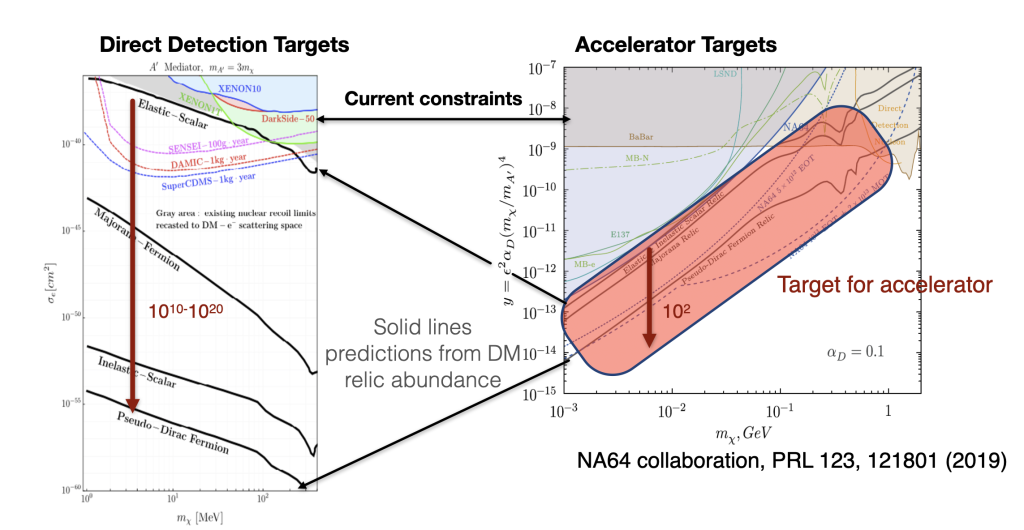
Figure 4: Complementarity between accelerator and direct-detection searches for light dark matter. The left panel shows direct-detection sensitivity in the dark-matter–electron scattering plane, while the right panel presents accelerator constraints in the –dark-matter-mass plane. The solid black lines indicate thermal-relic targets for different dark-matter candidates, including scalar, Majorana and pseudo-Dirac particles. Accelerator experiments can retain sensitivity in scenarios where the non-relativistic scattering relevant to direct detection is strongly suppressed. The comparison assumes and . Source: NA64 Collaboration, Phys. Rev. Lett. 123, 121801 (2019); adapted from a presentation by Paolo Crivelli.
Paying for the small coupling only once
A conventional beam-dump search for light dark matter can produce a flux of dark-sector particles in the dump and then look for one of them to scatter in a downstream detector. The small portal coupling is paid twice: once in production and again in detection. For a dark-photon mixing epsilon, the signal rate typically scales as ε4.
NA64 uses an active-dump, missing-energy method. NA64 measures the energy and identity of every incoming electron before it enters an electromagnetic calorimeter, which serves as both the target and the detector for the resulting shower. If the electron radiates a dark photon and that dark photon decays invisibly, the dark-sector particles escape, taking energy with them. NA64 does not require them to interact a second time: it infers their presence from the deficit. The signal rate therefore scales as ε2.
For a representative epsilon of 10-5, this difference corresponds to reaching comparable sensitivity with up to 10 orders of magnitude fewer incident particles than a production-and-rescattering search would require. It brought thermal light-dark-matter targets within reach of the existing SPS beam infrastructure.
One particle at a time
The proposal for NA64 appeared on the arXiv in 2013 and was submitted to CERN as CERN-SPSC-2013-034 / SPSC-P-348, and the experiment was proposed to the SPSC in January 2014. After receiving support for test measurements and completing a feasibility run in 2015, the CERN Research Board formally approved it on 9 March 2016, and it became NA64, the 64th experiment in CERN’s North Area. “NA64 turned 10 years old this year,” Crivelli noted.
The experiment initially used 100 GeV electrons from the H4 beamline. Delivering and identifying particles one by one is essential to its method. SPS protons are slowly extracted over a spill lasting several seconds and strike a target to create secondary particles. Neutral pions decay into photons, which can convert in a thin target into electron-positron pairs. A magnetic spectrometer then selects the desired charge and momentum. Reversing the polarity allows the beamline to select either electrons or positrons; changing the configuration makes hadron beams available.
Crivelli described H4 as “the fantastic beam line”: a high-purity, high-intensity source whose flexibility is central to the programme. Before an electron reaches the active target, scintillators and tracking detectors tag it, while a magnetic spectrometer measures its momentum. A synchrotron-radiation detector distinguishes electrons from heavier pions, kaons and muons, which emit far less radiation in the magnetic field.
The electron then enters the electromagnetic calorimeter (ECAL). A dark-photon event would deposit substantially less than the 100 GeV beam energy there. Veto detectors and hadronic calorimeters (HCALs) downstream test whether the apparent deficit was instead carried by an ordinary neutral hadron or another Standard Model particle. For the example selection discussed in the lecture, a candidate would have less than about 50 GeV in the ECAL and less than about 2 GeV in the HCAL. The approximately 30 m-long apparatus is designed to make the energy accounting as hermetic as possible.
Ten years of NA64 results
NA64’s first two-week run recorded almost 3 x 10⁹ electrons on target. Even this initial dataset tested whether an invisibly decaying dark photon could explain the then-prominent discrepancy in the anomalous magnetic moment of the muon, muon g-2. No signal appeared, allowing NA64 to exclude a substantial part of the favoured region; a subsequent BaBar result closed this particular minimal dark-photon explanation.
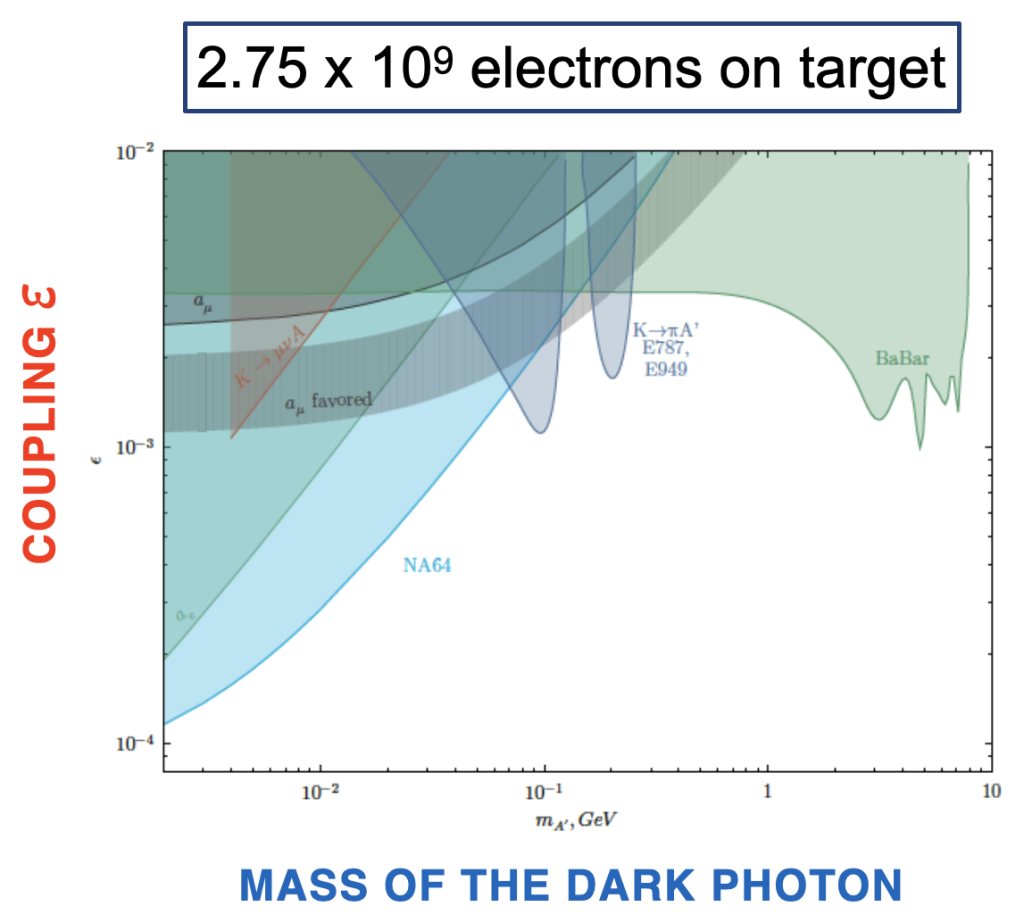
Figure 5: NA64’s first search for invisibly decaying dark photons. Using 2.75 × 10⁹ electrons on target during its initial two-week run, NA64 excluded most of the parameter region in which an invisibly decaying dark photon could explain the muon discrepancy. A subsequent BaBar result excluded the remaining region in this minimal scenario. Sources: NA64 Collaboration, Phys. Rev. Lett. 118, 011802 (2017); BaBar Collaboration, Phys. Rev. Lett. 119, 131804 (2017).
The experiment then increased its electron statistics by more than two orders of magnitude and refined its production model. Besides direct dark-photon bremsstrahlung, positrons created inside an electromagnetic shower can annihilate with atomic electrons and resonantly produce a dark photon. Incorporating this contribution strengthened the sensitivity in specific mass ranges.
Results based on approximately 3 x 10¹¹ electrons on target placed leading constraints on invisibly decaying dark photons and could be expressed directly against thermal-relic targets. For the benchmark values discussed in the lecture, NA64 had reached or nearly excluded substantial regions in which scalar or Majorana light dark matter would account for the observed abundance.
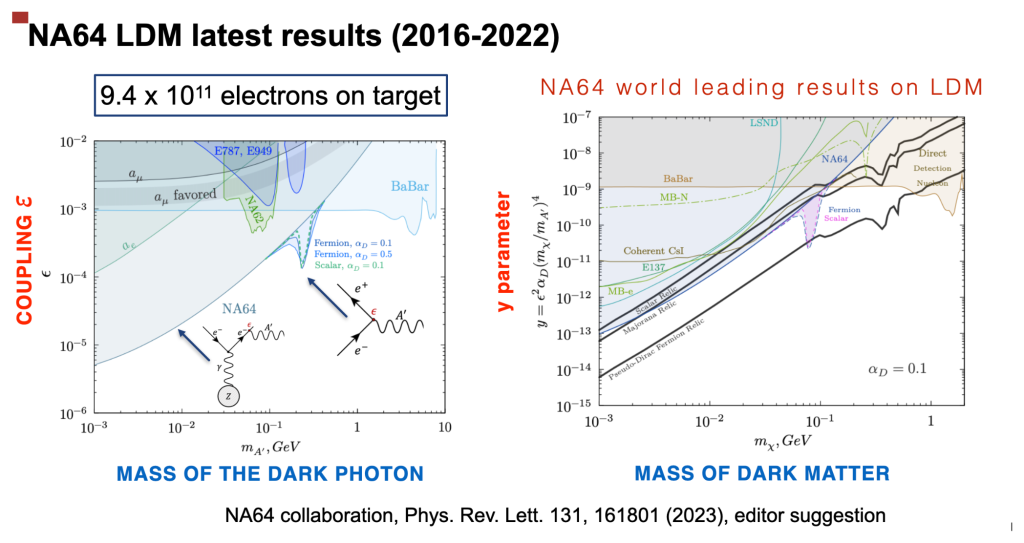
Figure 6: NA64 constraints on invisible dark photons and light dark matter. Left: limits on the kinetic-mixing parameter as a function of dark-photon mass, incorporating both direct dark-photon bremsstrahlung and resonant production through positron annihilation. Right: the same results expressed in the –dark-matter-mass plane and compared with thermal-relic targets for scalar, Majorana and pseudo-Dirac dark matter. The plot assumes . Source: NA64 Collaboration, Phys. Rev. Lett. 131, 161801 (2023).
By the end of the latest electron run in May 2026, the collaboration had accumulated roughly a factor of three more data than in that published sample. “We really reached this milestone,” Crivelli said. “We are analysing this data, and soon we will come out with some – let’s see – exciting results.”
The compact setup also permits searches beyond the invisible channel. With a short decay region and modifications including a compact tungsten calorimeter upstream, NA64 has searched for dark photons decaying visibly into electron-positron pairs. It has also probed ALPs with couplings large enough that their lifetimes are too short for conventional long-baseline beam-dump experiments. Other interpretations include B-L gauge bosons, for which NA64 has improved on constraints from some neutrino-scattering measurements, and tests related to the proposed X17 anomaly. Limited beam time necessarily requires choices, however, and the principal priority has remained light dark matter.
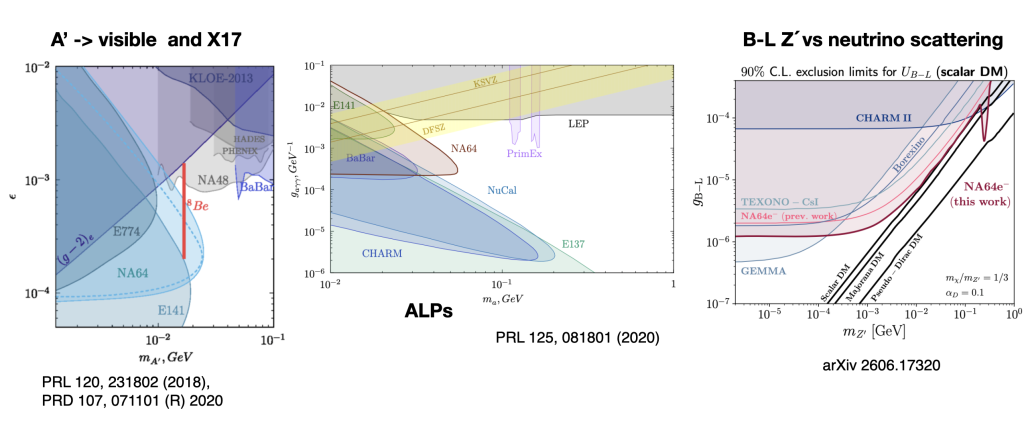
Figure 7: Extending the NA64e physics programme beyond invisible dark-photon searches. NA64e has also searched for visibly decaying dark photons and the proposed X17 boson, axion-like particles with comparatively short lifetimes, and gauge bosons. The plots compare NA64’s exclusions with limits from other accelerator, beam-dump and neutrino-scattering experiments. Credit: NA64 Collaboration; adapted from a presentation by Paolo Crivelli.
From electrons to positrons, muons and hadrons
NA64 has evolved from a single-beam experiment into a broader programme. A dedicated positron beam provides a particularly clean way to exploit resonant annihilation. In an electron-induced shower, useful positrons appear only after part of the initial energy has already been lost. An incident positron, by contrast, begins with the full beam energy and a much greater effective annihilation path. Crivelli noted that a positron sample two orders of magnitude smaller could deliver sensitivity comparable to that obtained from secondary positrons inside an electron shower. Varying the beam energy allows scanning different dark-photon masses.
At the M2 beamline, NA64 uses 160 GeV muons and a related but distinct signature. Because muons penetrate the target, their momenta can be measured both before and after the interaction. If a muon radiates an invisible mediator, it emerges with substantially reduced momentum. The experiment therefore combines missing momentum with missing energy and hermetic vetoing.
The muon programme reaches higher mediator masses than the electron mode. As Crivelli explained in response to a question, a heavier incoming particle can more readily radiate a heavier mediator, and a muon can use the full target length rather than showering near its front. Muon beams also provide unique sensitivity to models that couple preferentially to second-generation leptons, including L_mu-L_tau gauge bosons and other “muon-philic” mediators.
The first muon dataset revealed no events in the signal region but already probed the band associated with a possible new-physics explanation of muon g-2 and other previously unexplored parameter space. NA64 subsequently collected about 20 times more muon data, which were approaching unblinding at the time of the lecture. During LS3, the collaboration plans detector upgrades to make use of an M2 intensity potentially about 20 times larger than it can presently handle. The eventual gain in muon statistics could reach two orders of magnitude or more.
The SPS also enables pion and kaon beams. An initial one-day hadron test already improved limits on invisible eta and eta-prime decays. A larger programme would probe mediators coupled preferentially to quarks, complementing the electron, positron and muon modes.
“We started with the electron programme,” Crivelli said, but the SPS allows NA64 to operate “with electrons, muons … but also with positron and hadron beams”. This breadth is scientifically important. Different initial particles probe different couplings and mass ranges; if an excess appeared in one mode, another could provide an independent test using a related production mechanism.
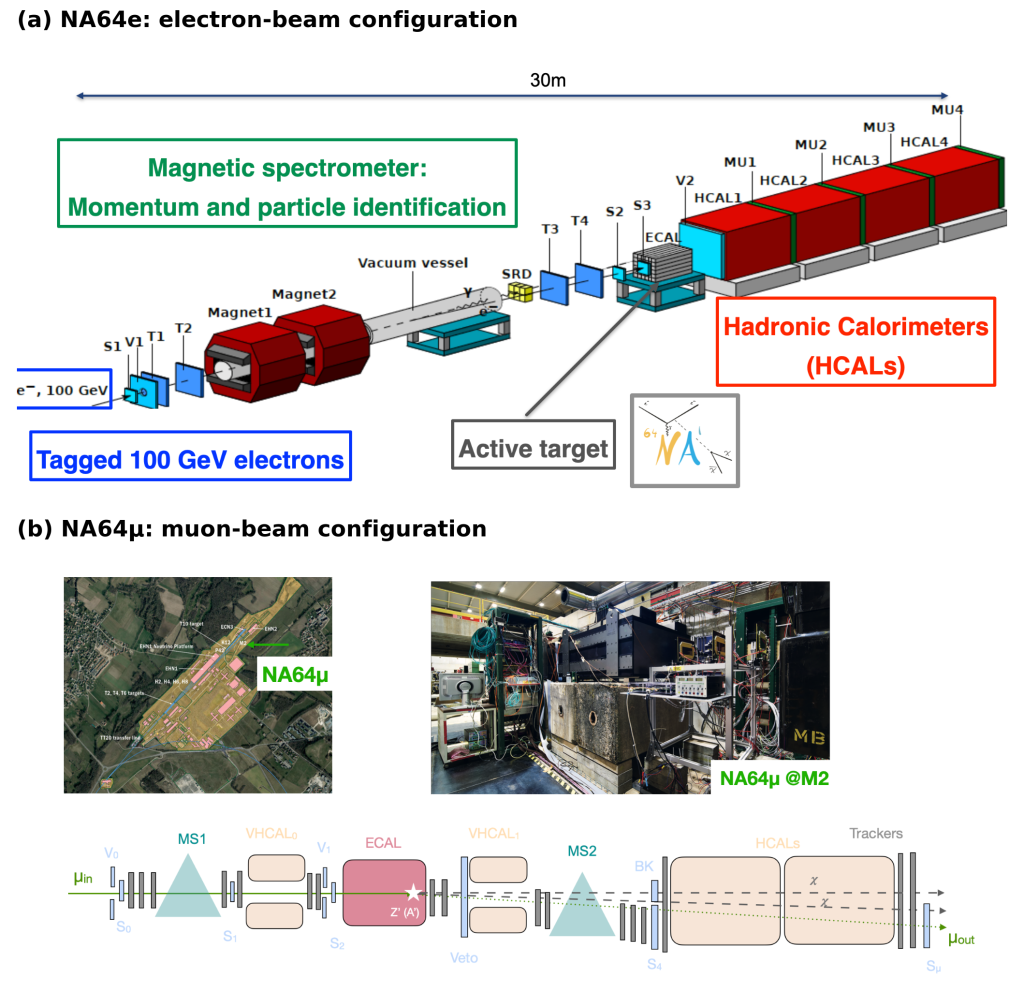
Figure 8: Electron- and muon-beam configurations of the NA64 experiment. (a) NA64e uses tagged 100 GeV electrons, an upstream magnetic spectrometer, an active electromagnetic-calorimeter target and downstream hadronic calorimeters to search for energy carried away by invisible particles. (b) NA64μ uses 160 GeV muons from the SPS M2 beam line. Magnetic spectrometers measure the incoming and outgoing muon momenta, while veto detectors and calorimeters reject visible backgrounds. In both configurations, a significant deficit in the measured energy or momentum can indicate the production of an invisibly decaying mediator and dark-sector particles. Credit: NA64 Collaboration; adapted from a presentation by Paolo Crivelli.
NA62: new searches with an existing detector
The versatility of the SPS programme is also demonstrated by NA62. Its primary purpose is a precision measurement of the ultra-rare charged-kaon decay K+ → π+νν̄, a flavour-changing neutral-current process with a Standard Model branching fraction of order 10-10. The experiment precisely reconstructs the incoming kaon and outgoing charged pion; it infers the two neutrinos through missing mass.
The same precision missing-mass technique can search for a generic invisible particle X produced in K+ → π+X. A new particle of definite mass could generate a narrow feature in the missing-mass-squared distribution. NA62 can also search for visible hidden-sector particles through resonances in final states such as muon pairs or photon pairs. Reinterpretations of its kaon datasets have consequently produced competitive limits on dark photons, scalars, ALPs and other scenarios.
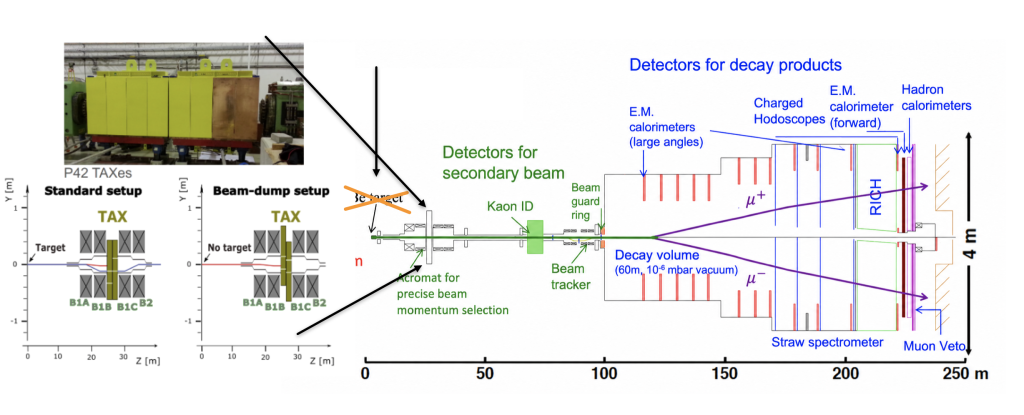
Figure 9: NA62 in beam-dump mode. With the normal production target removed and the TAX collimators closed, the SPS proton beam is absorbed in the dump. Long-lived hidden-sector particles produced there can traverse the shielding and decay inside NA62’s 60-metre evacuated decay volume. Their visible decay products are reconstructed using the spectrometer, RICH detector, calorimeters and muon-veto system. Credit: NA62 Collaboration.
NA62 can also operate as a beam-dump experiment. With its normal beryllium production target removed and its movable collimators closed to absorb the primary proton beam, the dump can produce long-lived particles that traverse the shielding and decay in the large downstream fiducial region. Short periods of data taking in this configuration have already achieved interesting sensitivity. Crivelli highlighted this transformation of an existing precision detector into a FIP experiment through limited hardware changes, a different beam configuration and new analysis strategies.
SHiP and the Beam Dump Facility
The future Beam Dump Facility (BDF) is evolving from an adaptation into a purpose-built intensity-frontier facility. Approved in 2024, it is designed explicitly for searches for feebly interacting particles and for precision neutrino physics. Its flagship experiment is SHiP, designated NA67.
The BDF will direct 400 GeV SPS protons onto a dense target, with an integrated exposure planned to reach approximately 6 x 10²⁰ protons over 15 years. The resulting flux creates both an opportunity and a formidable background challenge. An absorber and an active magnetic muon shield will reduce the immense muon flux emerging from the target. A compact scattering and neutrino detector will study neutrinos and can search for light-dark-matter scattering. Downstream, a long helium-filled decay vessel provides a low-density region in which long-lived particles can decay, followed by a spectrometer that reconstructs their visible products.
Helium offers a practical alternative to a vacuum vessel: it permits very thin walls and keeps the amount of material – and hence the probability of background interactions – extremely low. The complete experimental complex extends over roughly 100 m.
SHiP’s high-energy proton beam gives it a major advantage in HNL searches. Whereas PS191 relied mainly on pion and kaon decays and was limited by their masses, SHiP will produce enormous samples of charm and beauty hadrons. Decays of D and B mesons can create heavier HNLs, substantially extending the accessible mass range. At the nominal annual exposure, about 2 x 10¹⁷ charmed hadrons are expected within the detector acceptance, together with a significant beauty sample.
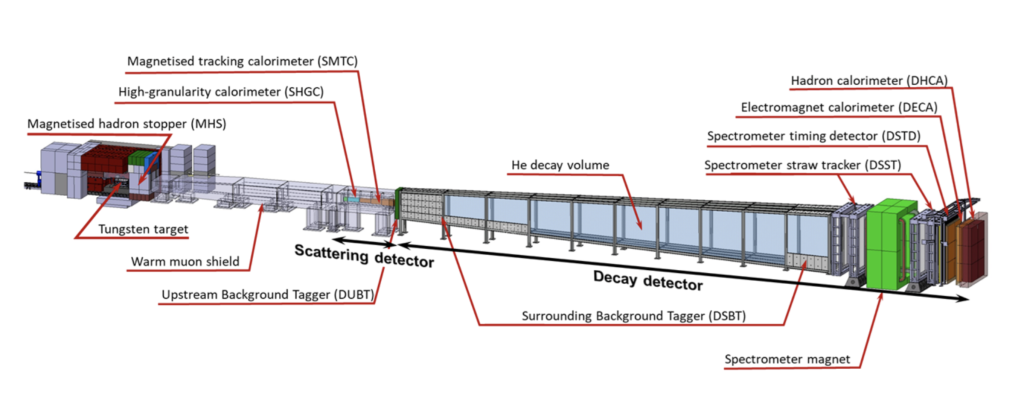
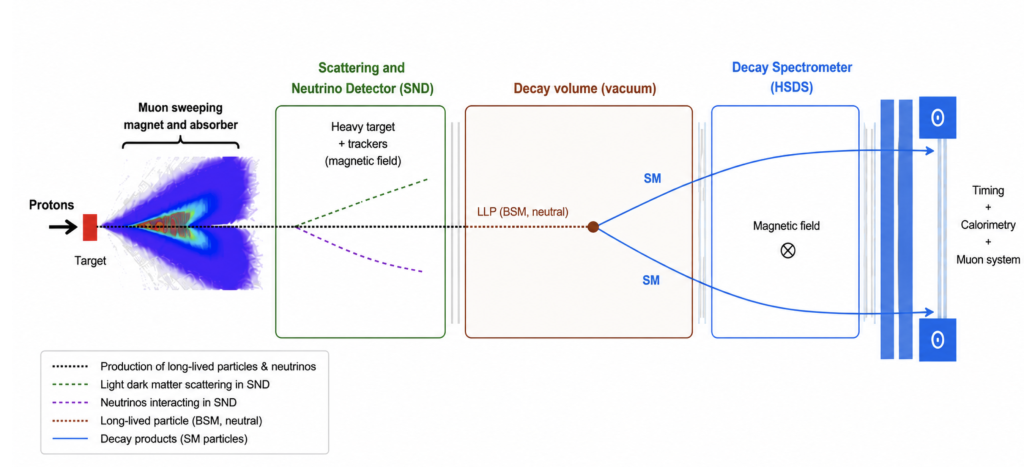
Figure 10: The SHiP experiment at CERN’s Beam Dump Facility. High-intensity SPS protons strike a thick target, while a magnetic muon shield and absorber suppress backgrounds. The Scattering and Neutrino Detector searches for interactions of light dark matter and neutrinos, while long-lived neutral particles can decay inside the evacuated decay volume. Their Standard Model decay products are reconstructed by the downstream decay spectrometer, timing detectors, calorimeters and muon system. Credit: SHiP Collaboration.
The BDF will also be a “charm factory and tau-neutrino factory”. Its scattering detector is expected to record an unprecedented sample of high-energy tau neutrinos in the approximate 10-200 GeV range, complementing measurements at higher energies by FASER and SND@LHC. This enables a substantial neutrino programme alongside searches for HNLs, dark photons, dark scalars, ALPs and light-dark-matter scattering.
Background control is decisive. Around 1012 neutrinos and 10^11 muons above 1 GeV could traverse relevant parts of the apparatus during each spill. SHiP must suppress combinatorial muon backgrounds and deep-inelastic scattering by muons and neutrinos, while minimising material in the decay vessel. Despite the enormous exposure, the design target discussed in the lecture is an order-of-one expected background event across the full hidden-sector decay-search dataset.
The timeline presented by Crivelli envisages construction during LS3, commissioning around 2032 – including direct measurements and reconstruction of beam-induced backgrounds – and physics operation from approximately 2033, with the possibility of further upgrades for later runs.
When there is no signal
Missing-energy experiments turn absence into an observable, but only after every ordinary explanation for it has been tested. During the discussion, an audience member asked Crivelli about backgrounds that NA64 had not anticipated at the outset.
“We started with 109, and we learn by doing,” he replied.
As the dataset grew, initially negligible processes became visible. Large-angle hadrons could be produced in upstream tracking material and pass around the main HCAL. The collaboration responded by improving the apparatus in stages: adding vetoes and hermetic coverage, studying control samples and refining its reconstruction. A veto hadronic calorimeter installed in 2023-2024, with an opening for the beam, catches particles produced in structures upstream of the active target. Future upgrades may also enlarge the lateral dimensions of the calorimeters to intercept more particles that would otherwise escape around their edges.
At exposures approaching 1013 electrons, simulations alone cannot establish that a remote distribution tail is understood. NA64 therefore uses a blind analysis: the signal region remains hidden while selections and background estimates are developed. Data control regions, extrapolations and deliberately varied conditions reveal how background tails behave before the signal region is opened.
“It’s a tricky business,” Crivelli said. “If I were to observe one event, I wouldn’t believe it, even if I had predicted background zero.”
A credible discovery would require consistency checks. An electron-beam excess might be examined with positrons, muons or a different beam energy, and compared with experiments using other methods. The SPS’s versatility is therefore part of the strategy for validating a signal, not only for expanding exclusion plots.
NA64 considers 1013 electrons on target a reasonable goal for Run 4, supported by work on the beamline, detector and data acquisition. At still greater exposures, extremely rare neutrino-producing interactions are eventually expected to constitute an irreducible background, analogous to a “neutrino floor”. The muon mode has more room to grow because the final-state muon is reconstructed and analogous neutrino backgrounds are more suppressed.
“The background is the key,” Crivelli concluded. “It’s really a tough business.”
Complementarity rather than a single winner
The experimental programme at the SPS is powerful because it combines several perspectives. A traditional beam-dump search excels when a particle is long-lived enough to pass through shielding and then decay visibly. NA64 is sensitive when invisible particles carry away energy or momentum. NA62 exploits precision missing mass and can also switch into beam-dump mode. SHiP will combine an unprecedented proton exposure, a long decay volume, scattering measurements and neutrino physics.
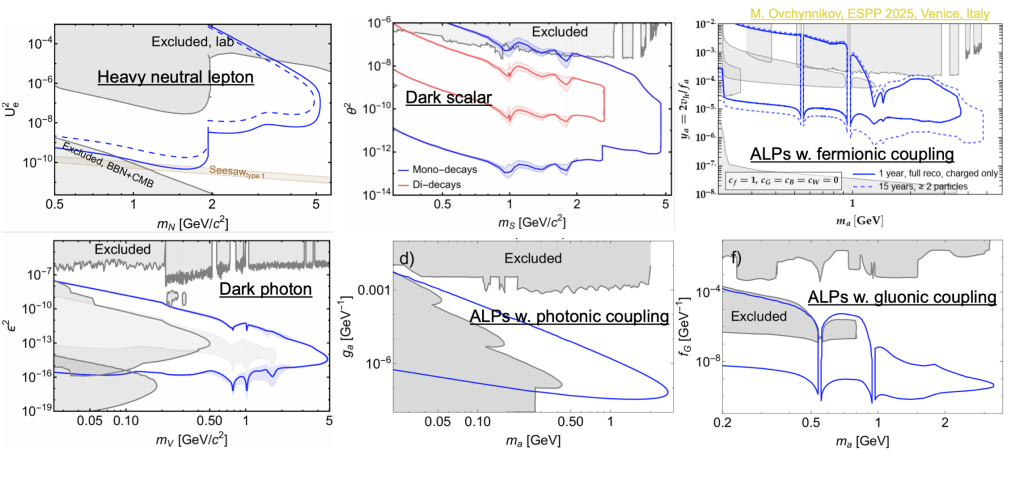
Figure 11: Projected SHiP sensitivity to different feebly interacting particle models. The panels show the regions that SHiP could explore for heavy neutral leptons, dark scalars, dark photons and axion-like particles with fermionic, photonic or gluonic couplings. Grey areas indicate parameter space already excluded by existing searches, while the coloured contours delimit SHiP’s projected reach under the assumptions indicated in each panel. The characteristic closed contours arise because particles with very small couplings are produced too rarely, whereas those with larger couplings may decay before reaching the experiment’s fiducial volume. Credit: SHiP Collaboration; adapted from M. Ovchynnikov, ESPP 2025.
The same complementarity exists beyond CERN. Lower-energy, very-high-statistics electron experiments such as the proposed LDMX concept can be particularly powerful at lower dark-matter masses; the higher SPS beam energy and NA64’s muon mode extend sensitivity towards heavier mediators. Collider, direct-detection and astrophysical searches add still different information. A robust discovery may require several of these approaches to converge.
Nor should the expansion of the programme be read as the replacement of one fashionable candidate by another. WIMPs remain viable even though many models have been constrained. Minimal ALP, dark-photon or HNL models are benchmarks that make experiments testable and comparable, not guarantees of what nature contains. Richer dark sectors may produce semi-visible, inelastic or otherwise unexpected signatures.
Crivelli therefore ended where the 1982 SPS workshop had begun: with the need to remain open to new experimental concepts. He paraphrased Barbiellini’s recommendation to physicists searching for small effects not predicted by the Standard Model: be “a little bit heretical (but not too much)” – willing to move beyond the current mainstream and imagine signatures that existing searches might miss.
“Theory is evolving,” he said, and richer dark sectors could bring “new kinds of unexpected signatures”. The SPS is unusually well placed to respond because it can deliver multiple particle species, energies and configurations to existing or purpose-built detectors.
More than four decades after the earliest beam-dump searches, the central challenge remains unchanged: how can an experiment reveal particles whose defining feature is their ability to pass unseen? The answers have multiplied – visible decays, missing mass, missing energy, missing momentum and scattering – and each covers a different part of the hidden landscape. With NA64 and NA62 analysing new datasets, major upgrades planned during LS3 and SHiP preparing to open a new high-intensity frontier, the SPS will continue to offer many ways to bring the hidden universe into view.
Further reading
- I. Mannelli (ed.), Workshop on SPS Fixed-target Physics in the Years 1984–1989, CERN, Geneva, 6–10 December 1982, CERN-83-02-V-2 (1983). CERN Document Server; DOI.
- G. Barbiellini, “Search for Massive Neutrinos, Axions and SUSY Particles at CERN SPS Energies,” in Workshop on SPS Fixed-target Physics in the Years 1984–1989, CERN-83-02-V-2 (1983), pp. 250–269. Contribution.
- P. Crivelli and M. Mongillo, “Axion Searches at the CERN SPS: From Their Dawn to Current Prospects,” arXiv:2507.18254 (2025). arXiv.
- F. Bergsma et al. (CHARM Collaboration), “Search for Axion-Like Particle Production in 400 GeV Proton–Copper Interactions,” Physics Letters B 157 (1985) 458–462. CERN record; DOI.
- A. M. Cooper-Sarkar et al. (WA66 Collaboration), “Search for Heavy Neutrino Decays in the BEBC Beam Dump Experiment,” Physics Letters B 160 (1985) 207–211. CERN record; DOI.
- F. Bergsma et al. (CHARM Collaboration), “A Search for Decays of Heavy Neutrinos in the Mass Range 0.5–2.8 GeV,” Physics Letters B 166 (1986) 473–478. DOI.
- J. D. Bjorken et al., “Search for Neutral Metastable Penetrating Particles Produced in the SLAC Beam Dump,” Physical Review D 38 (1988) 3375. DOI.
- G. Lanfranchi, M. Pospelov and P. Schuster, “The Search for Feebly Interacting Particles,” Annual Review of Nuclear and Particle Science 71 (2021) 279–313. arXiv; DOI