
Taking Our Ideas Seriously: In discussion with Alan Guth
by Panos Charitos (CERN)
Few ideas have transformed modern cosmology as profoundly as inflation. Developed at the beginning of the 1980s, with Alan Guth playing a foundational role, inflation proposes that the very early universe passed through a brief period of extraordinarily rapid expansion. This simple but powerful idea offered solutions to some of the most persistent puzzles of Big Bang cosmology, explaining why the universe appears remarkably flat and uniform and why hypothetical relics such as magnetic monopoles are not observed today. Inflation has since developed into a broad theoretical framework whose predictions continue to be tested through increasingly precise cosmological observations.
In this conversation, Guth retraces the unlikely path that led him from particle physics and grand unified theories to the birth of inflation. He recalls the excitement—and unease—of realising how many problems the idea could solve, the flaw that undermined its original formulation and the subsequent evolution of the theory. He also reflects on eternal inflation, dark energy and the unresolved challenge of assigning probabilities in an infinite universe, as well as the observations that may offer new clues. Above all, the interview reveals how scientific progress emerges from curiosity, uncertainty and a willingness to take the consequences of our best ideas seriously.
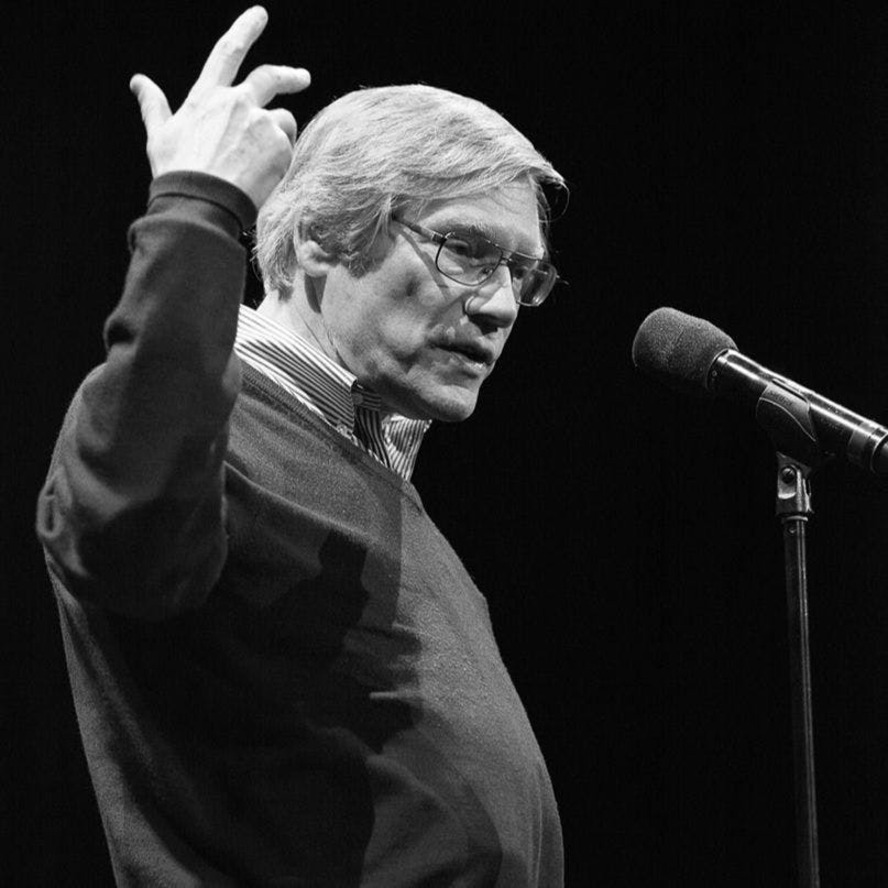
Q: Was there a particular teacher, family influence or early experience that first drew you towards science?
A.G: It was probably not one single thing, but rather a series of events. One of the strongest early influences I remember was a television programme I watched when I was in grade school, Watch Mr. Wizard, hosted by Don Herbert. It was not a cartoon; it was a live programme, with Mr. Wizard performing experiments, usually with a child guest. It was extremely well done, and I think it certainly played a role in hooking me on science.
By the time I was in high school, I think I had already decided that physics was what I really liked most. Somewhere in between, I had been reading popular-level books. One that I particularly remember was The Universe and Doctor Einstein, by Lincoln Barnet. I became fascinated by the idea that simple mathematical ideas could actually describe nature. That struck me as something quite extraordinary.
Q: Was an interest in science and physics common among your classmates, or did it feel like an unusual path?
A.G: There were a few other students who were very interested in science as well, so I was not completely alone. But perhaps I was the one who went furthest with it. In any case, it did not feel entirely eccentric.
My family was certainly supportive. I think, though, that they did not really distinguish very clearly between science and engineering. They probably imagined that engineering was the more obvious path and perhaps would have preferred that. But they were absolutely fine with my pursuing science, even if they did not entirely understand the difference.
Q: When did cosmology enter the picture? Was it already there when you were an undergraduate?
A.G: Cosmology entered rather indirectly. My PhD was actually in particle theory. What fascinated me most was the idea that there might be fundamental laws of nature – laws that, at least in principle, describe everything. I have always found that idea extraordinarily compelling. We certainly do not know the final laws yet, but physics has made remarkable progress, and for many phenomena around us, we can write down extremely accurate equations.
So my early research was not in cosmology at all. My PhD work at MIT was on quark models – very early quark models, before the modern theory of the strong interactions had really taken hold. In the framework I worked on, quarks were treated as very heavy particles, deeply bound by scalar exchange, or perhaps vector exchange. But that picture became obsolete almost immediately, around the time I finished my PhD, when QCD emerged as the correct theory. In the modern picture, quarks are not heavy in that sense; they are bound by forces that grow with distance, which is a very different concept.
I had, however, already been interested in cosmology at a popular level since high school. Some of the books I read then were about cosmology, so the subject had always been in the background. As a graduate student, I took a cosmology course co-taught by Steven Weinberg and Philip Morrison.
Q: You have described your path into cosmology as indirect. How did the transition actually happen?
A.G: It did not happen until my third postdoc. I had four postdocs altogether, which is somewhat unusual. My first was at Princeton, where I continued working on quarks and related models. Then, during my second postdoc at Columbia, I learned about gauge theory and worked on magnetic monopoles in gauge theories.
The real turning point came during my third postdoc, at Cornell. There, I reconnected with Henry Tye, who had also been an MIT graduate student, though we had not interacted much during graduate school. At Cornell, we became colleagues again, and he is really the person who drew me into cosmology.
Henry was very interested in grand unified theories, which were still relatively new at the time. This was 1978. Grand unified theories had been invented a few years earlier, but they had not yet fully captured the field’s attention. One day, Henry asked me whether grand unified theories would give rise to magnetic monopoles. Since I had been working on monopoles, it was a natural question for him to ask.
Henry had to explain to me how grand unified theories worked, but then I could figure out the answer. It was yes: grand unified theories do indeed generically predict magnetic monopoles. But the monopoles would be fantastically heavy – on the order of 10¹⁶ times the proton mass. So my first reaction was that this was interesting, but experimentally irrelevant. We would never produce such objects in an accelerator.
Q: And yet that question turned out to open the door to cosmology.
A.G: Exactly. Henry’s immediate response was: why not ask how many would have been produced in the Big Bang? At first, I have to admit, this sounded rather crazy to me. I didn’t feel that we understood particle physics particularly well at grand-unification scales, and I didn’t feel that we understood the very early universe particularly well either. So my instinct was that combining two poorly understood subjects was unlikely to produce anything fruitful.
For about six months, we didn’t really pursue it. We were both occupied with other work. Steve Weinberg’s visit to Cornell changed my mind. At that time, Weinberg had started working on similar questions – in particular on the baryon asymmetry of the universe, but more broadly on the idea of applying grand unified theories to the earliest moments of cosmology. He was thinking seriously about the universe at something like 10⁻³⁵ seconds.
That still seemed bizarre to me. But I had tremendous respect for Steve Weinberg. He had been at MIT while I was a graduate student, and I had learned general relativity from him. He was one of the most sensible and powerful physicists I had ever encountered. So I thought: if Steve Weinberg believes this subject is worth working on, perhaps I should reconsider. That was the moment when Henry and I began to study magnetic monopole production in the early universe.
Q: Was that the point at which the road to inflation really began?
A.G: Yes, although it still took a few steps. The first thing we found – although John Preskill published it before we did – was that standard grand unified theories combined with standard Big Bang cosmology appeared to predict far too many magnetic monopoles. The estimate was astonishing: roughly as many monopoles as protons, but each monopole was about 10¹⁶ times heavier. A universe like that would look nothing like the one we observe. So there was a deep inconsistency.
Of course, we were disappointed that Preskill published first, but it also immediately suggested an even more interesting question: Is there a way to modify the story so that monopoles are not overproduced?
We considered several possibilities. One idea led nowhere, and we dropped it. The more promising idea was that, at the grand unified phase transition, the universe might undergo extreme supercooling. Instead of occurring promptly at the critical temperature, the phase transition could be delayed. If that happened, monopole production could be dramatically suppressed. And if the supercooling were sufficiently strong, it could reduce the monopole abundance enough to match the fact that we do not see monopoles around us today.
At that stage, we were working with the standard SU(5) grand unified model. We could show that this model had a phase structure that would allow such supercooling, but we did not calculate how extreme the supercooling would be.
Q: At what point did you realise that supercooling implied something much more dramatic – inflation itself?
A.G: That came very suddenly. It was December 1979. Henry was about to leave for a six-week trip to China, and in those days communication with China was like communicating with the far side of the moon. So he was extremely eager for us to finish and submit our paper before he left. At the same time, I have always been painfully slow at writing papers, so he was very much pushing the schedule.
At the beginning of December, Henry suggested that we should check whether the supercooling might affect the expansion rate of the universe. One evening I went home and wrote down the relevant equations. It turned out to be very simple to see that the answer was yes – it had an enormous effect on the expansion rate. In fact, it drove the universe into a period of exponential expansion.
That was the moment inflation was born, although we did not yet use the word “inflation”. I realised immediately that the supercooling did not merely suppress monopoles; it caused the universe to expand exponentially.
Henry and I submitted our paper about supercooling a few days before Henry left. To finish it by then, we didn’t mention exponential expansion.
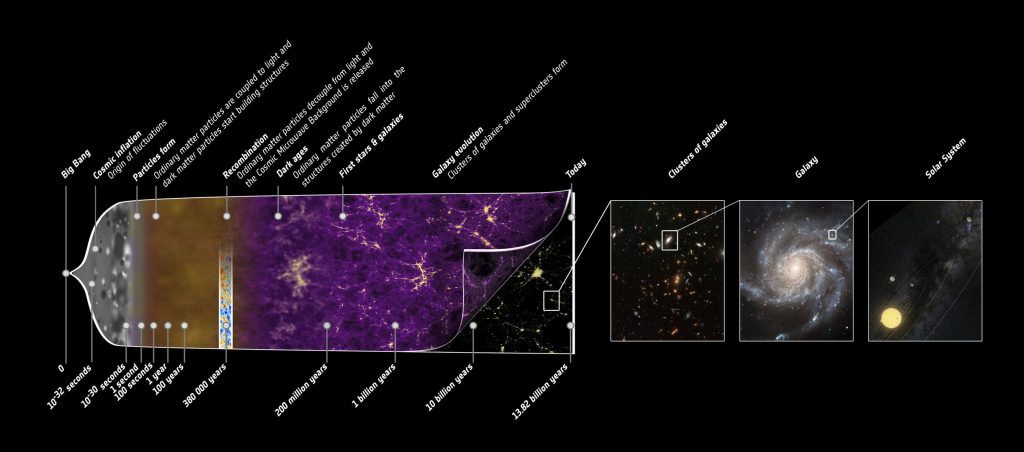
The evolution of the Universe from its earliest observable moments to the present day. At the far left, inflation produces a brief period of extremely rapid expansion. The Universe then expands and cools, allowing matter, stars, and galaxies to form, before entering its current phase of accelerated expansion. Credit: NASA/WMAP, ESA.
Q: And you also saw, almost at once, that this exponential expansion could solve another cosmological puzzle: the flatness problem.
A.G: Yes, exactly. The same night that I realised the exponential expansion would occur, I also realised that it would solve the flatness problem.
I had first learned about that problem roughly a year earlier in a lecture by Bob Dicke. The issue is one of extraordinary fine-tuning in the conventional Big Bang picture. As Dicke explained it, if you look at the expansion rate of the universe at one second after the beginning, it had to be tuned to the correct value to about 14 decimal places. If it had been even slightly faster, the universe would have expanded too rapidly for galaxies ever to form. If it had been even slightly slower, it would have recollapsed before galaxies could form. So the standard model of cosmology seemed to require a miraculous initial condition.
It is called the flatness problem because, through general relativity, the expansion rate is linked to the spatial geometry of the universe. The special value corresponds to a geometrically flat universe. What I realised that night was that exponential expansion naturally drives the universe toward precisely that critical state. In other words, inflation did not merely address the monopole problem; it also explained why the universe appears so close to flat.
That was enormously exciting.
Q: But there was still another major cosmological problem that inflation soon seemed to solve, correct?
A.G: Yes – very quickly another major piece fell into place: the horizon problem.
In conventional cosmology, the universe expands in such a way that, when you look at the cosmic microwave background, two points on the sky separated by more than about two degrees should never have been in causal contact with each other by the time that radiation was released. In other words, there is no conventional way for those regions to have “known” about one another. And yet they are at nearly exactly the same temperature. That is the horizon problem.
Inflation solves that too. I actually learned about it in a rather accidental way – through a conversation at the lunch table at SLAC. People were discussing a paper by Tony Zee about the horizon problem, and since I had not yet heard of it, I asked them to explain it to me. Once they did, it became clear fairly quickly that inflation provided a solution there as well.
So by that point, inflation was no longer just a mechanism that could dilute magnetic monopoles and explain flatness. It also explained why the universe appears so remarkably uniform on large scales.
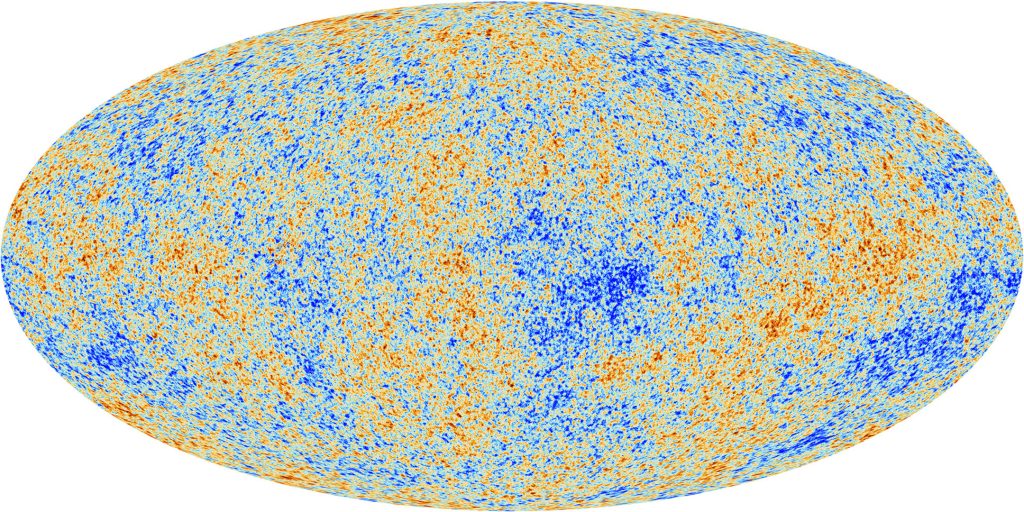
The cosmic microwave background as observed by ESA’s Planck satellite. Released when the Universe was approximately 380,000 years old, this radiation is remarkably uniform across the sky, despite originating from regions that—without inflation—would not have had time to exchange information. Its tiny temperature variations represent differences in density that eventually developed into today’s stars, galaxies and large-scale cosmic structures. (Credit: ESA/Planck Collaboration)
Q: All of this came together within a remarkably short period. How did that feel at the time?
A.G: I remember feeling two things very strongly at the same time. First, I was tremendously excited. But second, I was also very uneasy about it. It all seemed too good to be true.
I had only just entered cosmology, and I certainly did not think of myself as someone who knew the field deeply. So my natural reaction was to assume there must be something wrong. If this really solved so much so simply, why had others not already thought of it?
So even though I was excited, I was also very cautious and, to be honest, rather nervous about whether the whole thing would hold up.
Q: Did you seek feedback from senior figures in the field before publishing?
A.G: Yes, one very important source of encouragement came from Sidney Coleman. He was visiting SLAC that same year, and he attended the first lecture I gave about inflation at SLAC at the end of January (1980). We spoke from time to time, and he became very enthusiastic about inflation. That mattered a great deal to me, because Sidney was someone whose judgment I trusted enormously. He started telling his friends about it, and that helped inflation become known very quickly in the particle-theory community.
After the talk at SLAC, I went around the country giving talks about inflation. I had not yet submitted a paper about inflation, so I was relying on the hope that the talks could serve as a kind of “oral publication.” That was a little risky, of course, but luckily everything turned out okay. And as the idea began circulating, I was struck that people did not raise any significant objections. That gave me some confidence.
Q: And yet there was still a major unresolved question in the original model – how inflation actually ends.
A.G: Very much so. During inflation, everything seemed wonderful. The universe becomes flat, homogeneous, and free of unwanted relics like monopoles. But inflation cannot simply go on forever – at least not in the region that becomes our observable universe. It has to end somehow, leaving behind the hot, matter-filled universe we actually live in.
In the version I originally proposed, inflation ended via a first-order phase transition, much like water boiling. Bubbles of the new phase form at random, then expand, and eventually collide. The hope was that those collisions would redistribute the energy and leave behind a universe smooth enough to resemble ours.
But whether that actually worked was not obvious. In fact, it eventually turned out not to work. That became known as the graceful exit problem.
Q: What was wrong with that first ending mechanism?
A.G: The problem is subtle, but very important. In the original model, bubbles of the new phase do form. But because the universe is expanding exponentially while they form, the story does not unfold in the simple way one might imagine.
The easiest way to think about it is in co-moving coordinates – coordinates that expand along with the universe. In those coordinates, the speed of light effectively becomes smaller and smaller in the sense that the coordinate distance light can travel per unit time decreases exponentially. That means that each bubble can only grow to a finite size in co-moving terms. Later bubbles grow to even smaller co-moving sizes.
So instead of bubbles growing and eventually merging everywhere, you keep producing more and more bubbles in the gaps between earlier bubbles. The new phase never cleanly takes over the whole universe in the way one would need.
Q: This is where the mathematician Harry Kesten entered the story.
A.G: Exactly. I was travelling around giving talks about inflation and trying to understand this problem more clearly. During a visit to Cornell, where I had previously been a postdoc, I asked colleagues whether they knew of anyone who might help with the mathematical side of it. They pointed me to Harry Kesten.
I explained the basic physical problem to him, and he immediately recognised that it was analogous to a mathematical problem he already understood – a two-dimensional percolation problem on a checkerboard. In that problem, you repeatedly subdivide squares and randomly blacken some fraction of them, and then ask whether the black regions eventually form an infinite connected cluster.
The analogy turned out to be exactly the right one. The bubbles in inflation behave like those blackened regions. And the result was that, unless the nucleation rate is very large, the bubbles never percolate – in other words, they never form a connected structure large enough to complete the transition throughout space.
That is fatal for the original mechanism. If the rate is too low, inflation never ends properly. If you try to make it high enough, other things break. So the original picture simply did not provide a viable way to end inflation.
Q: Did you already understand that flaw before publishing your first inflation paper?
A.G: Yes. I was very cautious and did not want to publish until I understood that issue as well as I could.
In the end, I worked on the problem with Eric Weinberg – not Steve Weinberg, but the other Weinberg, as I sometimes put it, slightly less famous but certainly a very good physicist. Harry Kesten showed us the mathematical structure of the problem, and Eric Weinberg and I wrote the paper analysing its implications for inflation.
So by the time my first inflation paper appeared, I already knew that the original version had this serious flaw. That flaw is discussed in the paper itself.
Q: Was the Higgs field already part of the inflationary picture at that stage?
A.G: Yes, very much so. That was an important underlying ingredient.
In the SU(5) grand unified theory we were using, the phase transition responsible for inflation involved Higgs fields. These were not the Standard Model Higgs field in the precise sense we use today, but they were certainly analogous scalar fields, and that is exactly why they were called Higgs fields. They were responsible for symmetry breaking and for the transition structure that made the whole story possible.
So scalar fields – Higgs-like fields – were central to inflation from the very beginning. And they remain central to it.
Nowadays, however, we think much more broadly about scalar fields. There may be many such fields at high energies, arising from supersymmetry, string theory or other extensions of known physics. Some models even consider the Higgs boson discovered here at CERN as the inflaton itself. So the connection between inflation and Higgs physics remains very much alive, although in many different forms.
Q: Looking back, which aspects of inflation have proved the most robust? And where do you still see the main conceptual challenges?
A.G: The most robust part, to my mind, is the overall idea that a period of accelerated expansion in the early universe can explain otherwise puzzling large-scale features of the cosmos. In particular, the solutions to the flatness problem and the horizon problem are, I think, conceptually very powerful. The dilution of unwanted relics such as monopoles is also a very compelling feature.
So the broad logic of inflation remains, in my view, extraordinarily strong. What has changed over time is not so much the attractiveness of the idea, but the details of how one implements it. The first version I proposed did not end gracefully, so the model had to evolve. So the broad idea survived, even though its earliest realisation did not.
As for unresolved issues, there is certainly a very major one connected with eternal inflation – namely, how one defines probabilities in an eternally inflating universe. That remains a profound conceptual problem.
Q: For readers who may not be familiar with it, how would you introduce eternal inflation?
A.G: Eternal inflation is the idea that, once inflation starts, it may never end everywhere. It can end in some regions – producing universes like ours – while continuing indefinitely in others. So instead of one inflationary event producing one universe, you get a kind of ongoing cosmic process in which pocket universes, or bubble universes, are continually formed.
I should say that I did not invent eternal inflation. The history is a bit complicated. As far as I know, the first eternally inflating model was published by Paul Steinhardt, though he regarded it more as a curious possibility than as a feature of inflation. I believe it was Alex Vilenkin who first realised that eternal inflation is actually a very generic outcome of successful inflationary models. And Andrei Linde certainly played a major role in popularising it and showing how powerful its implications might be.

The three 2014 Kavli Prize laureates in Astrophysics—Alan H. Guth, Andrei D. Linde and Alexei A. Starobinsky—on stage with His Majesty King Harald V during the award ceremony in Oslo. The three physicists were recognised “for pioneering the theory of cosmic inflation”. (Photo: Thomas Eckhoff/The Kavli Prize)
Q: Why did eternal inflation become such an important concept?
A.G: One reason is that it provides a framework in which many different kinds of universes can exist. That became especially interesting after the 1998 discovery that the expansion of the universe is accelerating – what we now attribute to dark energy or, in the simplest description, a cosmological constant.
For a long time, many of us assumed the cosmological constant was exactly zero, simply because it appeared very close to zero and we had no good reason to think it was anything else. But quantum field theory changed our whole understanding of the vacuum. In modern physics, the vacuum is not empty at all. It is filled with fluctuating fields, and at least one of them – the Higgs field – has a non-zero average value throughout space. So the vacuum is a rich and complicated physical state, and there is no obvious reason why its energy density should vanish.
What is astonishing is that the observed vacuum energy is not only non-zero, but fantastically small compared with what one might naively expect from quantum gravity – smaller by something like 120 orders of magnitude. That is one of the deepest puzzles in theoretical physics.
Q: And eternal inflation offers a possible way of thinking about that puzzle?
A.G: Yes. If eternal inflation is combined with something like string theory – or any theory with many long-lived metastable vacuum states – then one expects many different regions of the multiverse to realise different vacuum energies. Eternal inflation populates those possibilities, producing different pocket universes with different low-energy properties.
Then one can invoke what I prefer to call anthropic selection, rather than the anthropic principle. The point is simply that life can only arise in regions where the vacuum energy is small enough to allow structure to form. If it were much larger and positive, the universe would expand too quickly for galaxies to condense. If it were negative and too large in magnitude, the universe would recollapse too quickly. Either way, life would have no chance.
So the argument is not that life explains the vacuum energy, but that, among a vast ensemble of possibilities, observers will find themselves only in the rare regions where the vacuum energy is compatible with galaxies, stars, and chemistry.
Steve Weinberg famously showed that this line of reasoning could predict a cosmological constant not too far from the one later observed – within roughly an order of magnitude. That made a very strong impression on many people.
The idea of explaining properties of the laws of physics through anthropic selection seems completely logical to me, but some physicists refuse to accept it. I think that it is certainly worthwhile to search for more dynamical explanations of the value of the cosmological constant, but in the absence of such explanations, I think that anthropic selection suffices.
Q: In that picture, then, new universes continue to emerge with different properties?
A.G: Yes. In the eternal inflation picture, new universes are continually being produced – not in our location, but far away in the inflating spacetime. Different regions may realise different vacuum states and therefore different effective constants of nature.
There may be some correlations between parent and child universes, so to speak – some degree of inheritance – but it is not absolute. The overall picture is one of enormous diversity.
And that is precisely what makes the probability question so hard. If everything happens infinitely many times, what does it even mean to say that one thing is more probable than another? That is the central conceptual challenge of eternal inflation, and I think it remains unresolved. I should add that a number of proposed answers to this question have been considered, and a number of those appear to give reasonable predictions. But we lack any understanding of what underlying principle determines the right answer to this question.
Q: When you think about eternal inflation today, do you approach it as a philosophical idea, or still very much as physics?
A.G: I regard it as physics. It is an attempt to pursue the consequences of theories that were formulated to explain things we actually observe. From my point of view, if a theory has demonstrated value – if it accounts for observed phenomena and has real explanatory power – then its consequences are worth taking seriously and worth investigating.
That does not mean I know for certain that eternal inflation is what is happening. I do not. But I think there is a good chance that some version of it is relevant, and it is certainly an idea worth pursuing. In particular, I think it may be crucial for addressing one of the deepest questions we face: why the vacuum energy is as small as it is. At present, I think eternal inflation, together with a landscape of possible vacua, provides the best answer we have.
Q: So eternal inflation does not replace dark energy as a concept?
A.G: No. Eternal inflation is not a substitute for dark energy. What it offers is a possible explanation for why the vacuum energy in our universe is so small. But it would still be the vacuum energy in our universe that drives the accelerating expansion, and that is what we call dark energy.
Q: Do you hope that future progress in quantum gravity – perhaps through holography or some other framework – could give us a more concrete understanding of eternal inflation?
A.G: Very much so. Right now, we really cannot say anything definitive about what quantum gravity predicts for the creation of a universe. And I am also hoping that quantum gravity will eventually tell us how to define probabilities in an eternally inflating universe, because that is the major unresolved conceptual issue.
We have spent a great deal of time working on that problem. In fact, it lies at the core of much of the work on eternal inflation. The difficulty is what we call the measure problem: how does one define probabilities in a universe where everything that can happen happens infinitely many times?
My view, looking back on all the work many people have done, is that we have learned a lot by exploring different possible measures and their consequences. We can certainly exclude some possibilities because they give absurd predictions. And we can construct measures that appear to give sensible results. But the troubling point is that the sensible ones are not unique. I do not really see a path by which they become unique simply by continuing in that way. There just are not enough observational handles.
So I think the only real hope is that quantum gravity will one day single out the correct measure. I don’t know how that will happen, unfortunately, but I suspect that is the only route to a genuine answer.
Q: How would you explain the measure problem in a simple way?
A.G: The clearest way to begin is probably to say a few more words about how eternal inflation works.
Imagine a region of space filled with what is called a false vacuum – a metastable state that drives exponential expansion. Inflation ends locally because the false vacuum is unstable: from time to time, in random places, it decays into a lower-energy state, producing what one might call a pocket universe.
But because the background space is expanding exponentially, these transitions never manage to fill everything. New bubbles form here and there, but inflation continues elsewhere. In any realistic model, the expansion rate is so fast that the inflating volume keeps growing overall, even while parts of it decay. So the process never ends globally. That is the simplest picture of eternal inflation.
The measure problem arises because this picture produces infinities. If there are infinitely many pocket universes, and infinitely many events of different kinds, what does it mean to say that one type of event is more probable than another?
A standard analogy is to ask what fraction of the integers are even. If you list them in the familiar order – 1, 2, 3, 4, 5, 6 – then clearly half are even. But you could order them differently, for example, by putting two odd numbers for every even number: 1, 3, 2, 5, 7, 4 – then it looks as though two-thirds are odd. With an infinite set, the answer depends on the ordering, unless some other rule is specified.
That is very similar to what happens in eternal inflation. There is no unique way to order all events throughout spacetime. So if you try to define probabilities by counting occurrences, you run into an ambiguity that has no obvious unique resolution.
Q: How have physicists tried to get around that?
A.G: The usual idea is to define some finite region of spacetime, count how often different kinds of events occur within that region, take ratios, and then enlarge the region and see whether the ratios settle down to a limit. If they do, one can interpret those limiting ratios as probability ratios.
The difficulty is that in general relativity, there is no unique way to define time globally. Even in special relativity it is not unique, but in general relativity it is worse. So different ways of cutting off spacetime – different choices of the final surface, so to speak – lead to different counting procedures. And different procedures can give very different answers.
Some of those answers can be ruled out because they clash badly with what we observe. But as far as I know, there is no fundamental principle known today that tells us which prescription is the right one. That is why the measure problem remains open.
Q: Let us return, then, from eternal inflation to inflation more broadly. Which observables do you think are most important today?
A.G: There are several. Studies of the cosmic microwave background and baryon acoustic oscillations have been absolutely crucial for inflation. At the moment, I would say there are at least four things we would still very much like to know better.
The first is the famous B-modes in the polarisation of the cosmic microwave background. The polarisation of the cosmic microwave background clearly has more information than the temperature measurements, because at each point in the sky the polarisation is described by a 2-dimensional vector, while the temperature is just a single number. This allows us to describe the polarisation in terms of two kinds of patterns, or modes: E-modes and B-modes. The E-modes arise from the same density perturbations as the temperature perturbations, but the B-modes are thought to be the signature of primordial gravitational waves. Discovering primordial B-modes would be tremendously important, because it would give us a direct observational handle on the energy scale at which inflation happened — the higher the energy scale, the stronger the B-modes.
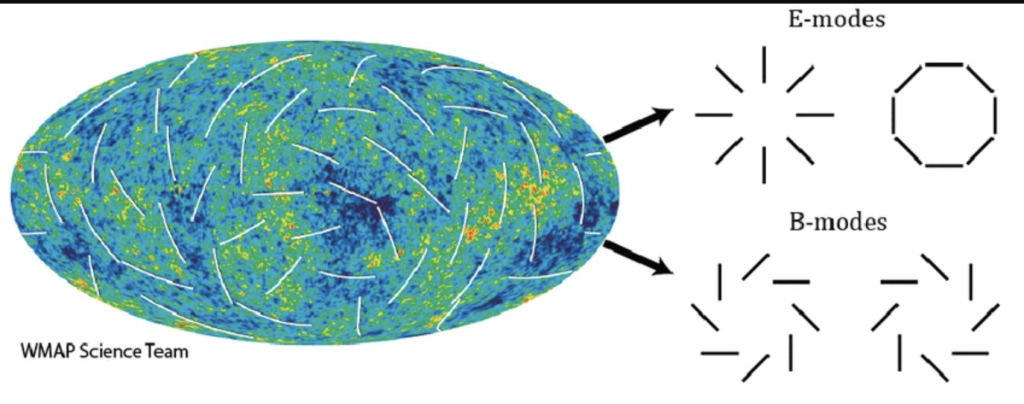
The polarisation of the cosmic microwave background can be decomposed into two characteristic patterns. E modes have radial or tangential orientations, while B modes exhibit a distinctive twisting pattern. The full-sky map on the left is based on WMAP observations; the diagrams on the right schematically illustrate the two types of polarisation. Primordial gravitational waves generated during inflation could leave a B-mode imprint in the CMB. Credit: WMAP Science Team.
Now, how soon that might happen is very uncertain. It depends crucially on the energy scale of inflation, which we do not know. If inflation happened near the grand-unification scale, then B-modes might be just around the corner observationally. If the scale was lower, they might be so faint that no conceivable experiment could ever detect them. So it is a very important observable, but also one whose prospects remain uncertain.
The second is non-Gaussianities. The simplest inflationary models predict that the fluctuations should be almost perfectly Gaussian, basically because they arise from quantum fluctuations of fields that are nearly free. So if one finds primordial non-Gaussianities, that would be evidence of interactions – perhaps involving the inflaton field and other fields. In practice, people often look for this through higher-order correlation functions, especially the three-point function.
The third is the precise value of omega, the parameter that tells us about the spatial curvature of the universe. Inflation predicts that omega should be extremely close to one, and observations have confirmed that with extraordinary precision. Even so, it would still matter enormously to know exactly whether the universe is slightly open, exactly flat, or slightly closed. Even a tiny deviation could have major implications for inflationary models, including eternal inflation.
And the fourth is spectral distortions of the cosmic microwave background – deviations from a perfect black-body spectrum. Those can tell us about small-scale density perturbations that we cannot otherwise see directly. That is especially interesting now, because there is growing discussion of whether enhanced perturbations at short wavelengths might produce primordial black holes.
Q: Is the concept of primordial black holes part of the inflationary discussion as well?
A.G: Very much so. People often discuss two major possibilities.
The one that interests me the most is the possibility that primordial black holes could help explain the supermassive black holes found at the centres of galaxies. Those seem to have formed surprisingly early, and although astrophysical mechanisms may explain them, the situation is not entirely settled. One possibility is that they have a primordial origin, connected to inflation.
A second possibility, which many of my colleagues are actively studying, is that primordial black holes could make up some or all of the dark matter. People have searched for dark matter particles very intensively for decades without success. So it is natural to ask whether dark matter might instead consist of black holes formed in the early universe. That is only viable in rather restricted mass ranges, but it remains a serious and interesting possibility.
Q: We have spoken about old inflation and eternal inflation. What were the key intermediate steps in the development of the theory?
A.G: The crucial next step after old inflation was what became known as new inflation. That was proposed by Andrei Linde, and independently, slightly later, by Andreas Albrecht and Paul Steinhardt.
Old inflation assumed that the inflaton field was trapped in a local minimum of the potential energy function, and then escaped by tunnelling through a barrier, ending inflation through bubble nucleation. That was what led to the graceful exit problem.
New inflation replaced that picture with a different potential. Instead of tunnelling through a barrier, the field starts near the top of a very gentle hill and rolls down slowly. Inflation continues during that slow roll and ends only when the field reaches the bottom. That removes the need to rely on bubble collisions to make the universe homogeneous. Instead, this can be described as the production of an entire universe from one bubble.
So new inflation solved the graceful exit problem and gave us the first genuinely workable model of inflation.
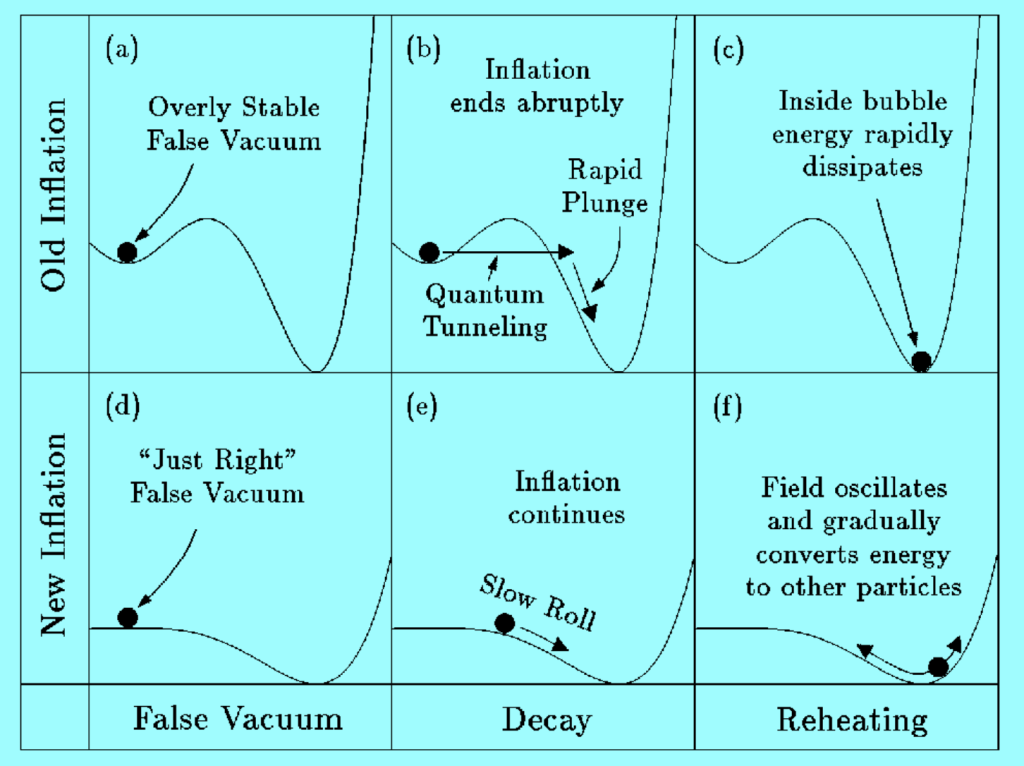
Comparison of old and new inflation. In old inflation, the field escapes from a false vacuum through quantum tunnelling, bringing inflation to an abrupt end. In new inflation, the field rolls slowly down its potential before oscillating and transferring its energy to particles during reheating.
That was the early 1980s. The next major step was to calculate the density perturbations predicted by new inflation. That happened at a very exciting workshop in 1982 – the Nuffield Workshop in Cambridge – where several groups, including Stephen Hawking, Alexei Starobinsky, Jim Bardeen, Paul Steinhardt, Michael Turner, and myself, with So-Young Pi, were working intensely on the problem.
The meeting was particularly memorable because, at the start, different groups had different answers. It was only at the end that we all converged. The conclusion was that the original version of new inflation produced density perturbations that were too large. But by then it was already clear that one could construct related models that would work, and since then, many viable models have indeed been developed.
So inflation evolved rapidly. The core idea remained, but the detailed realisations changed and improved.
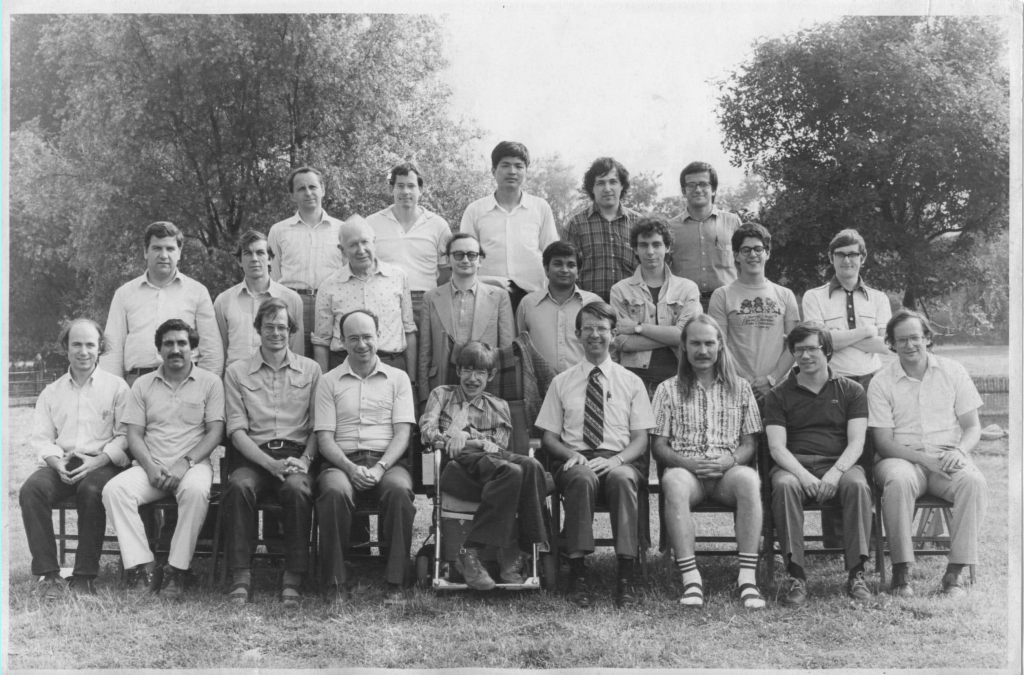
Participants at the 1982 Nuffield Workshop on the Very Early Universe at the University of Cambridge. Organised by Stephen Hawking and Gary Gibbons, the workshop brought together researchers working to calculate the primordial density fluctuations predicted by inflation. After considerable debate, the different groups converged on a common result. Stephen Hawking is seated at the centre of the front row.
Q: Does the multiplicity of inflationary models trouble you?
A.G: Not really. Observations have played, and continue to play, a crucial role in narrowing the field. Inflation is not a proven theory – I do not think scientific theories are ever “proven” in the mathematical sense – but I do think the evidence for some form of inflation is extremely strong.
One striking example is the value of omega. When inflation was first proposed, many people thought omega might be 0.2 or 0.3. Observations have instead shown that it is astonishingly close to one, now to within roughly a quarter of a percent when different data sets are combined. That is a spectacular success for inflation.
Perhaps even more compelling is the detailed spectrum of fluctuations in the cosmic microwave background – the famous multipole curve with its sequence of peaks. COBE began that story; WMAP sharpened it enormously; Planck refined it further. Those observations do not by themselves pick out a unique inflationary model, but they do provide very strong support for the general framework.
So yes, there are many models. But that is not a sign of failure. It reflects that the broad paradigm appears correct, while the detailed microphysics is still being worked out.
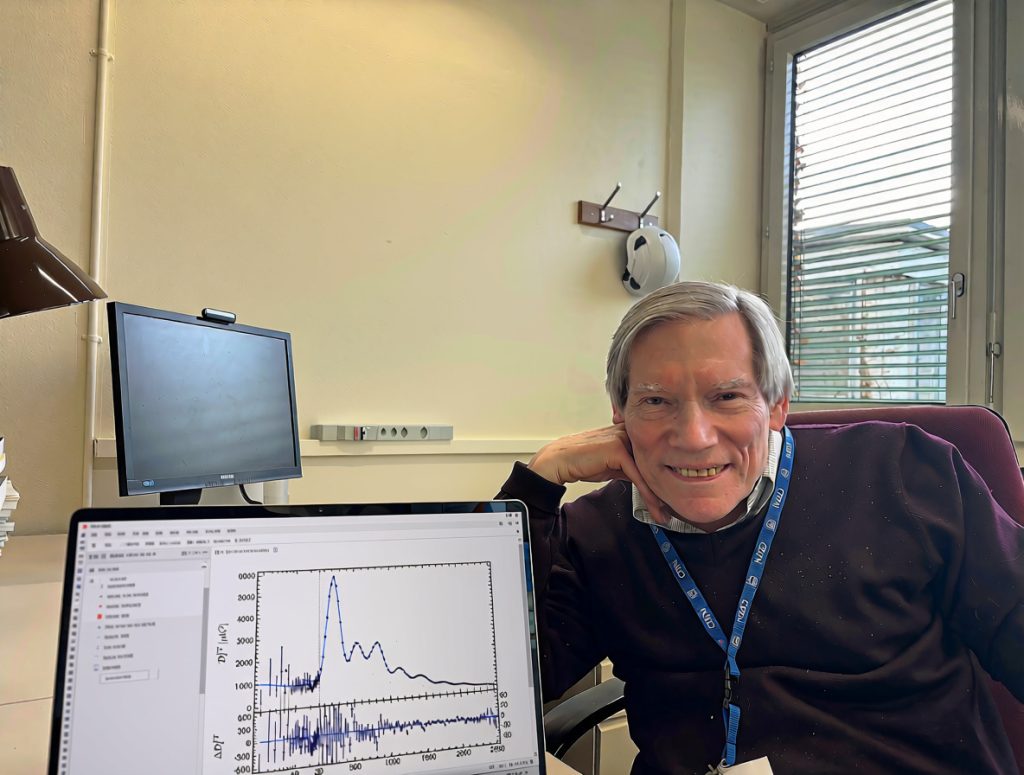
Alan Guth at CERN with the cosmic microwave background temperature power spectrum measured by the Planck satellite. The data show the strength of tiny temperature variations at different angular scales. Their detailed pattern provides strong observational support for the cosmological framework in which primordial quantum fluctuations, stretched to astronomical scales during inflation, provided the seeds of cosmic structure.
Q: From the perspective of particle physics, what discoveries do you think are especially important for cosmology going forward?
A.G: I think it is enormously important to know whether there is physics beyond the Standard Model below the Planck scale. That is the high-energy frontier, and we probe it partly through direct searches and partly through precision measurements that can indirectly reveal the effects of heavier particles.
It is also very important simply to test the Standard Model ever more precisely, to see whether any inconsistencies or cracks emerge. If there are deviations, they may point us towards the deeper structure that underlies both particle physics and cosmology.
So from my point of view, the continued study of the Higgs sector, precision tests of the Standard Model, and the search for new phenomena all matter a great deal. Cosmology and particle physics remain deeply intertwined.
Q: Looking back over the whole arc of this work, did it ever feel like a lonely path?
A.G: No, not really. I do not think it ever felt lonely. There were always people around me who were excited by the same questions, or at least curious about them. So no, I would not describe it that way.
Q: Finally, what advice would you give to a young graduate student considering a life in physics?
A.G: I have to admit that I have never found a really good answer to that question. When I am asked for such advice, I usually ask the questioner to put the answer in perspective by listening to Allan Sherman’s wonderful song, Good Advice. (“Good advice, good advice, good advice costs nothing, and it’s worth the price.”) More seriously, I think my basic advice is to follow your heart – to work on what genuinely interests you.
It also helps to look for new areas, because that is often where the ground is most fertile. In my case, when I entered cosmology, it was just beginning to connect in a deep way with particle physics; inflation turned out to be very low-hanging fruit. In hindsight, it is a rather simple idea, and it is still somewhat astonishing to me that no one had thought of it earlier.
So those would be my two pieces of advice: look for fields that are fresh and full of possibilities, and make sure you are working on something you truly love. I think the only way to work hard enough to stay at the frontier is to care deeply about what you are doing.