
Investigating the origin of elements with AMS on the International Space Station
by Mercedes Paniccia (University of Geneva)

Most of the elements in the periodic table are produced in stars. Nuclei from hydrogen through iron are produced in nuclear fusion processes within stellar cores [1]. At the end of their lives, massive stars die in supernova explosions, releasing these elements into interstellar space. The shock wave generated in a supernova explosion is believed to accelerate particles to energies up to about 10¹⁵ eV, giving rise to galactic cosmic rays. Some nuclei have different origins, as revealed by comparing the relative abundance of elements in galactic cosmic rays with that observed in stars; see Figure 1 left. Hydrogen and helium nuclei are overabundant in stars: a good fraction of these elements was produced at the Big Bang. Lithium, beryllium, boron, fluorine, phosphorus, potassium, and the elements from scandium to manganese are more abundant in cosmic rays than in stars. They originate from the fragmentation of heavier cosmic-ray nuclei colliding with the dust of the interstellar medium; see Figure 1 right.
Lithium, beryllium, and boron nuclei are created by fragmentation of heavier cosmic-ray nuclei, mainly carbon and oxygen. Similarly, fluorine originates from the fragmentation of neon and heavier nuclei, phosphorus from the fragmentation of sulfur and heavier elements, potassium from the fragmentation of calcium and heavier nuclei and elements from scandium to manganese derive mainly from the fragmentation of iron nuclei. Nuclei and particles originating from cosmic-ray collisions are called secondary cosmic rays, while those synthesised in stars, such as protons, helium, oxygen, silicon, iron, etc., are called primary cosmic rays.
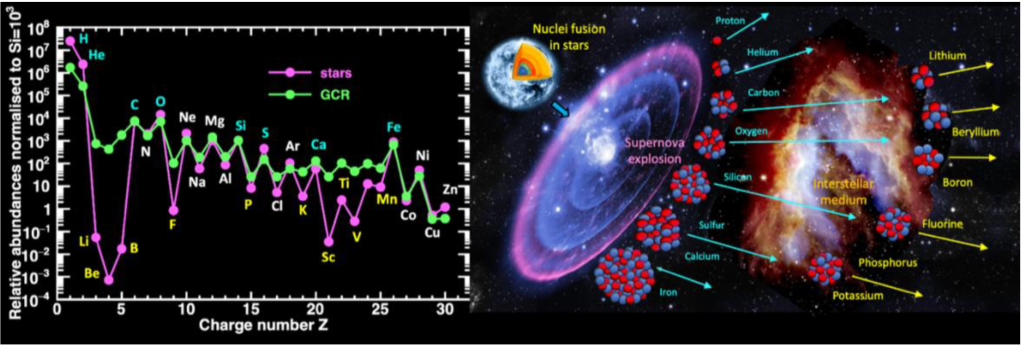
Figure 1: Left: Comparison of the relative abundances of elements observed in stars (magenta) and in galactic cosmic rays GCR (green) as functions of the nuclear charge number (CREDIT: Lodders, ACE). Elements with similar abundances in stars and in cosmic rays (cyan) are dominantly primary cosmic rays produced by stars. Elements more abundant in cosmic rays than in stars (yellow) are dominantly secondary cosmic rays produced by collisions of heavier cosmic-ray nuclei with the interstellar medium. Right: Primary cosmic rays, such as proton, helium, carbon, oxygen, silicon, sulfur, calcium, and iron nuclei are produced by nuclear fusion in the cores of stars. Massive stars at the end of their life die in a supernova explosion. Primary cosmic-ray nuclei are accelerated in the shock wave originating from the supernova explosion and are emitted into the interstellar medium, where they can collide with gas and dust and fragment into secondary cosmic-ray nuclei, such as lithium, beryllium, boron, fluorine, phosphorus, and potassium.
Nuclei make up about 99% of the cosmic rays; electrons account for 1%, while positrons and antiprotons, which are mainly secondary cosmic rays, are found in small amounts. Cosmic-ray nuclei are mixtures of two or more isotopes, often of different origin. For instance, helium nuclei are composed of 4He, which is primary, and 3He, which is secondary. Hydrogen is composed of protons, which are primary, and deuterons, which are thought to be secondary.
Cosmic-ray origin, acceleration and propagation mechanisms are studied by measuring their spectra in energy, or rigidity (=momentum/charge), i.e. the number of particles per unit time, solid angle, surface, and energy (or rigidity), as functions of energy (or rigidity). The shape of their spectra encodes the average spectra emitted by their sources, the effects of all processes occurring during propagation from their sources through the galaxy to the near-Earth environment where we detect them. Cosmic rays propagate diffusively by scattering on the irregularities of the galactic magnetic field. Light cosmic-ray nuclei diffuse over a larger galactic volume than heavier nuclei, as the probability of fragmenting in collisions with the interstellar medium increases with the mass. Thus, comparing the spectra of primary species gives information on cosmic-ray sources, while the comparison of secondary to primary nuclei spectra allows to single-out their propagation properties. Cosmic rays entering the Earth’s atmosphere fragment in collisions with the atmosphere’s nuclei. Thus, measuring the spectra of each individual element in cosmic rays requires a detector in space.
The Alpha Magnetic Spectrometer (AMS) is a high-energy particle detector operating on the International Space Station (ISS), orbiting Earth at an altitude of 400 km. AMS has now reached 15 years of continuous operation, and it has collected more than 260 billion cosmic-ray events. The AMS experiment is providing the most precise and comprehensive dataset of species-resolved spectra of cosmic rays in the GV to multi-TV rigidity range, including the spectra of electrons, positrons, protons, antiprotons, and nuclei from helium to calcium and iron, and isotope-resolved spectra of hydrogen, helium, and lithium. The AMS measurements have revealed a spectral hardening above 200 GV, that is, the observation of more high-energy particles than expected, in all the nuclei spectra. The accuracy of AMS measurements of the spectra of secondary Li, Be, and B and their primary progenitor, oxygen, has allowed us to firmly establish the origin of this spectral hardening as a propagation effect. Moreover, AMS has observed four classes of nuclear spectra, each characterised by a distinct rigidity dependence: two classes of primaries, He-C-O-Fe, and Ne-Mg-Si-S, and two classes of secondaries, Li-Be-B, and F.
Some of these results have been discussed in previous issues of the CERN EP Newsletter:
- Latest results from AMS on the International Space Station
- Ten years of operating the Alpha Magnetic Spectrometer on the International Space Station
- Highlights from the Alpha Magnetic Spectrometer on the International Space Station
Twenty elements, distinct cosmic-ray families
Recently, AMS has published measurements of the spectra of five cosmic-ray elements: phosphorus, chlorine, argon, potassium, and calcium [2]. Figure 2 shows their spectra alongside the fifteen spectra previously published by AMS. As seen, there are two classes of dominantly primary cosmic rays, He-C-O-Fe (Primary I) and Ne-Mg-Si-S (Primary II), and two classes of secondary cosmic rays, Li-Be-B (Secondary I) and F-P-K (Secondary II). The elements N, Na, Al, Cl, Ar, and Ca are combinations of primary and secondary cosmic rays, and their spectra lie between the primary and secondary spectra.
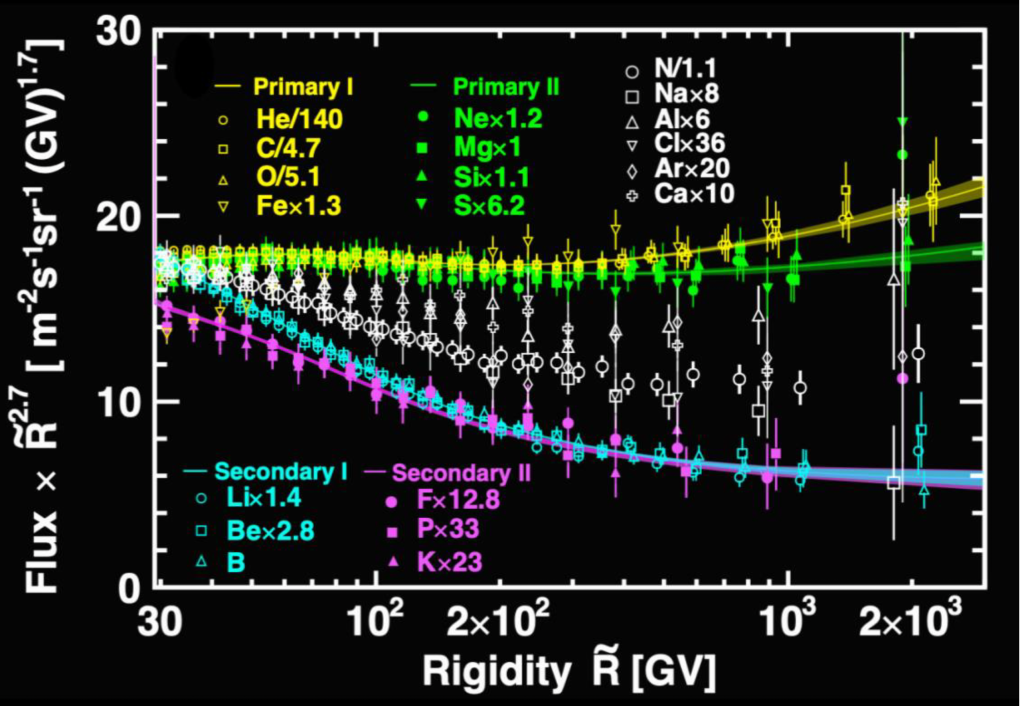
Figure 2: The twenty fluxes of cosmic-ray nuclei from He to Ca and Fe measured by AMS as a function of rigidity above 30 GV. As seen, there are two classes of dominantly primary cosmic rays, He-C-O-Fe (Primary I, yellow symbols) and Ne-Mg-Si-S (Primary II, green symbols), and two classes of secondary cosmic rays, Li-Be-B (Secondary I, cyan symbols) and F-P-K (Secondary II, magenta symbols). Elements N, Na, Al, Cl, Ar, and Ca (white symbols) are combinations of primary and secondary cosmic rays.
All the twenty cosmic-ray nuclei spectra measured by AMS so far can be described with these four classes of spectral shape, as shown in Figure 3. Oxygen, silicon, and iron are pure primaries. Oxygen and iron fluxes have identical rigidity dependence, while the silicon flux has a distinct rigidity dependence. The oxygen and silicon spectra define the spectral shapes of the two primary classes, respectively. Beryllium, lithium, boron, and fluorine are pure secondaries. Lithium, beryllium, and boron fluxes have identical rigidity dependence, while the fluorine flux is distinctly different. The boron and the fluorine spectra define the spectral shapes of the two classes of secondaries, respectively. Other nuclei are a mixture of a primary and a secondary component. Their spectra can be described by the sum of a primary component and a secondary component proportional, respectively, to the oxygen and boron spectra for nuclei lighter than oxygen, and to the silicon and fluorine spectra for nuclei from neon to calcium. Helium and carbon are dominantly primaries belonging to the same class as oxygen and iron; neon, magnesium, and sulfur are also dominantly primary, but they belong to the silicon class. Phosphorus and potassium are dominantly secondary and belong to the Secondary II class. Chlorine is mostly secondary and belongs to the Secondary II class, and calcium is mostly primary and belongs to the Primary II class. The fraction of their primary component provides the relative amount produced at sources of C/O, N/O, Ne/Si, Na/Si, Mg/Si, Al/Si, S/Si, Cl/Si, Ar/Si, K/Si, and Ca/Si.
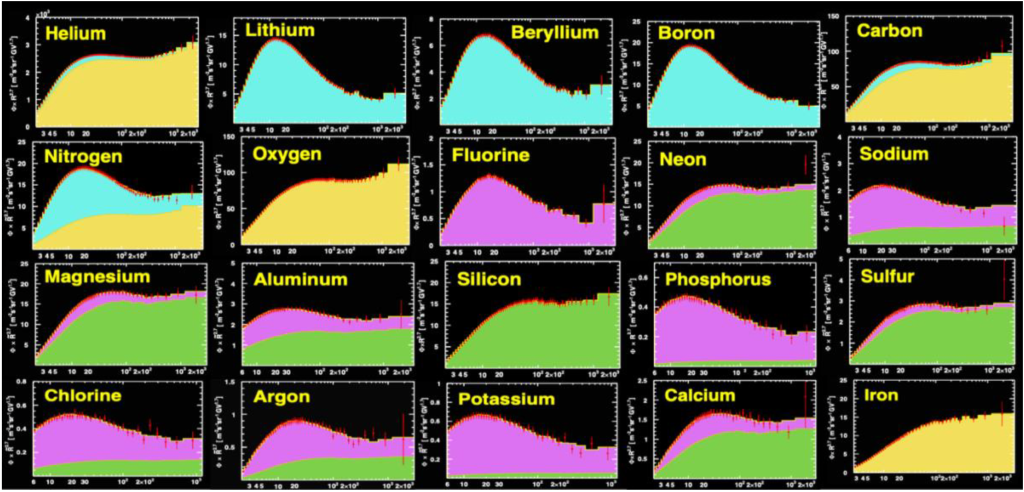
Figure 3: The twenty fluxes of cosmic-ray nuclei from helium (top left) to calcium and iron (bottom right) measured by AMS as functions of rigidity in the GV to TV range (red points). Oxygen and silicon are pure primaries, their spectra define the characteristic spectral shapes of the two classes of primaries: Primary I (yellow shades) and Primary II (green shades) respectively. Boron and fluorine are pure secondaries and define the characteristic spectral shapes of the two classes of secondaries: Secondary I (cyan shades) and Secondary II (magenta shades) respectively. Iron is a pure primary with spectrum identical to oxygen. Li, Be and B are pure secondary with identical spectra. The spectra of other nuclei can be described by the sum of a primary component and a secondary component proportional respectively to the oxygen and boron spectra for nuclei lighter than oxygen (yellow and cyan shades respectively), and to the silicon and fluorine spectra (green and magenta shades respectively) for nuclei from neon to calcium.
In the coming years, AMS will complete its inventory of nuclear spectra by measuring the spectra of heavier secondary nuclei from scandium to manganese. These measurements are of fundamental importance to building a comprehensive cosmic-ray model.
To measure these spectra accurately and improve the accuracy of electron and positron measurements at TeV energies, the AMS collaboration is planning a detector upgrade (see https://ams02.space/tracker-layer-0-upgrade). The upgrade will increase the current AMS detector acceptance by 300% by adding an additional double-layer of silicon microstrip tracking sensors, L0, at the top of the current apparatus, as described in a previous newsletter issue.
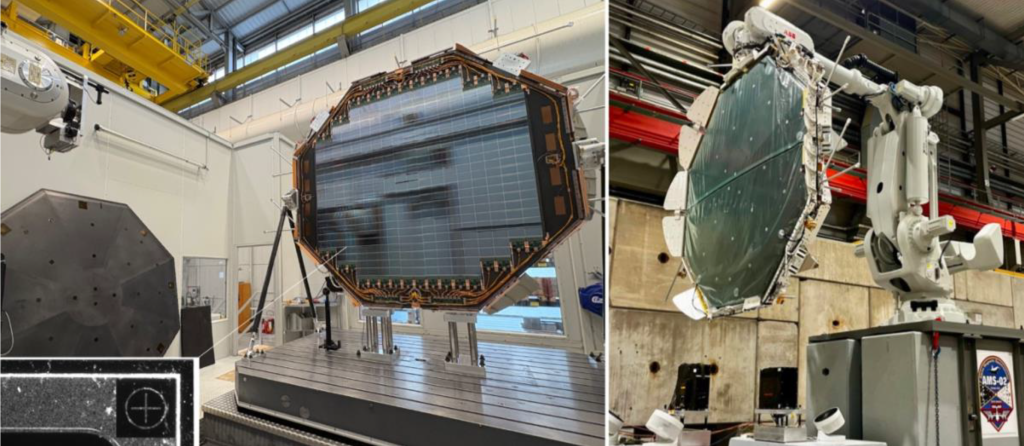
Figure 4: Advances in the tests of the new silicon tracker layer, L0, for the AMS Upgrade: (left) L0 at the CERN metrology measurement facility in October 2025; (right): L0 at the CERN SPS North Area being tested with proton beams in July 2026.
The L0 integration has been completed at CERN in Summer 2025. Since then, L0 has been undergoing an intensive campaign of tests and measurements, including space qualification tests in Italy, metrology measurements at CERN (Figure 4 left), and tests at the CERN SPS proton beam (Figure 4 right) (see also HERE). L0 will be delivered to the NASA Kennedy Space center in January 2027 in preparation for the installation in April 2027. AMS will continue to take data for the entire ISS lifetime, through at least 2030.
References
[2] AMS Collaboration, Properties of Heavy Cosmic Nuclei Phosphorus, Chlorine, Argon, Potassium, and Calcium: Results from the Alpha Magnetic Spectrometer Phys. Rev. Lett. 136, 241002 (2026) https://doi.org/10.1103/d2vf-fw3v