
Looking for soft unclustered energy patterns from dark matter in CMS and ATLAS
by Simone Pagan Griso (LBNL) and Weijie Jin (Imperial College)
Motivation for SUEP searches
The dark-sector search program at the LHC is motivated by the strong evidence for dark matter from multiple astronomical observations and the expectation of beyond the Standard Model (SM) physics due to the well-known incompatibility between the theories of the SM and gravity. As searches have ruled out many models with distinctive collider signatures, attention has shifted to well-motivated dark-sector models with more subtle signatures that can blend into SM backgrounds and evade conventional searches.
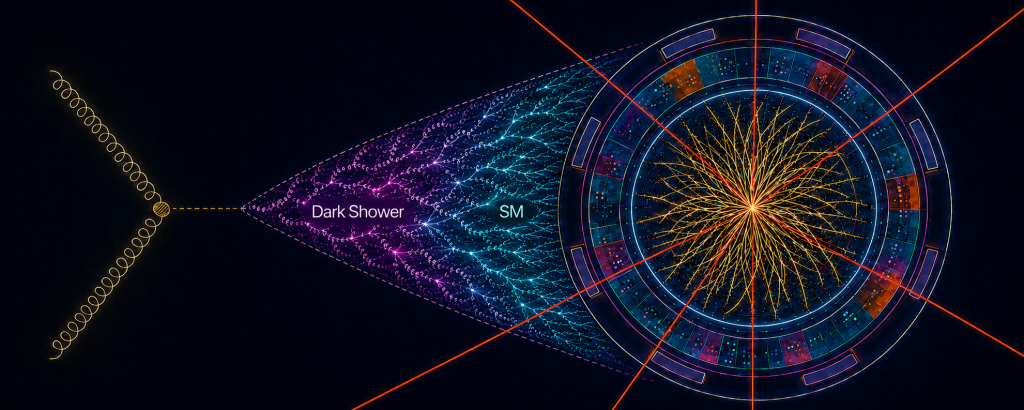
The searches presented here target soft unclustered energy patterns (SUEPs) originating from hidden-valley models with a strongly coupled dark sector. The dark-matter particles in this model are light but not directly coupled to the SM particles, thus living in a “hidden-valley” of experimental accessibility. In our simplified models, the dark sector is accessed by a heavy mediator particle (S) from gluon-gluon fusion, which then decays into a shower of dark matter particles, which subsequently form dark hadrons φ. Unlike ordinary quantum chromodynamics (QCD), the dark sector produces a nearly isotropic cloud of low-energy particles instead of narrow jets. The momenta of φ behave like those in thermodynamic equilibrium and are controlled by a “temperature” parameter TD. Each φ decays into a pair of dark photons A′, and each A′ promptly decays into a pair of SM particles, such as electrons, muons, or charged pions. The resulting spray of soft, visible particles forms the characteristic SUEP signature.
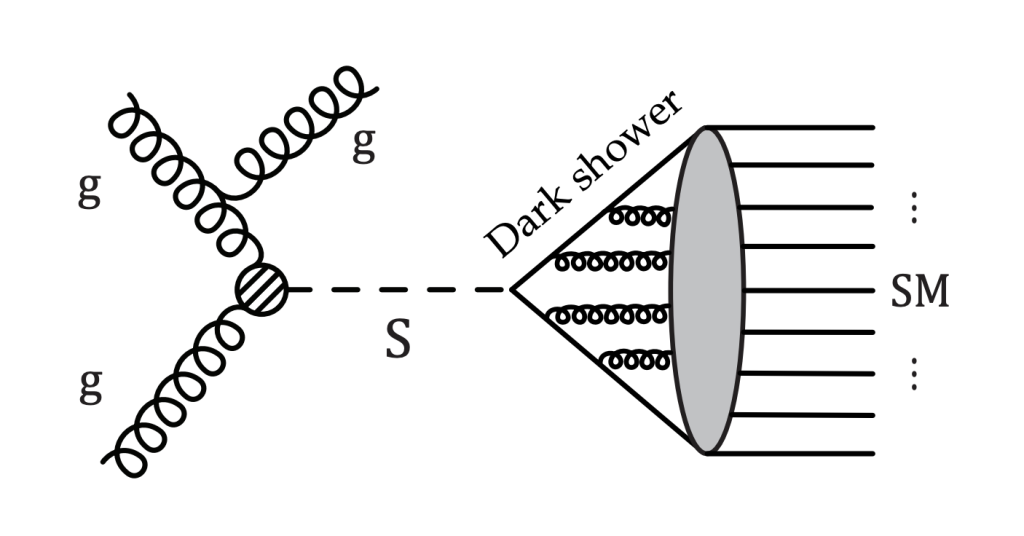
Figure 1: A schematic diagram of the SUEP signal. Two gluons (g) from a proton-proton collision fuse to form a heavy mediator particle (S), with possible initial-state radiation of extra gluons. Under a new strong force in the dark sector, S decays isotropically into many soft dark matter particles, which further decay into ordinary SM particles, forming the SUEP signatures targeted by the searches. (Image: CMS Collaboration/CERN)
Experimental Challenges
In the CMS and ATLAS experiments, SUEPs are characterised by a high multiplicity of charged particles with an isotropic distribution. Using multiplicity and the event-shape variable sphericity, SUEPs can be distinguished from the SM background.
The two experiments target slightly different signal models. The CMS search considers three scenarios of A′ mass and decay modes: mA′ = 1 GeV with fully hadronic decays A′ → π⁺π− ; mA’ = 0.7 GeV with hadron-dominated decays A′ → π⁺ π− (70%), e⁺e⁻ (15%), μ⁺μ− (15%); and mA’ = 0.5 GeV with lepton-dominated decays A′ → π⁺π− (20%), e⁺e− (40%), μ⁺μ− (40%). The ATLAS search focuses on decay modes containing muons, using the lepton-dominated case as the nominal benchmark, complemented by the hadron-dominated and additional muon-enhanced scenarios with mA’ = 0.3 GeV and A′ → e⁺e− (50%), μ⁺μ− (50%). This necessitates different trigger and analysis strategies tailored to the benchmark signals.
CMS strategy
The LHC operates at a 40 MHz bunch-crossing rate, producing far more data than can be stored. The CMS and ATLAS trigger systems therefore perform rapid online event reconstruction, selecting potentially interesting collisions for storage and subsequent offline analysis. In current experiments, trigger acceptance is a major limitation for SUEP searches, particularly for fully hadronic signatures, as no dedicated triggers are designed to identify their unique characteristics. The CMS analysis uses a high-HT trigger, requiring a large scalar sum of jet transverse momenta (HT), to select SUEPs recoiling against initial-state radiation gluons (Fig. 1), which boosts the otherwise diffuse SUEPs into reconstructed jets. However, a significant fraction of SUEP signal events have low HT and therefore fail the trigger selection, making trigger acceptance the dominant limitation on the search sensitivity. To overcome this limitation, a scouting strategy is employed during data taking, in which high-level physics objects reconstructed online by the trigger system are stored directly instead of the full detector readout. The substantially reduced data volume enables a lower HT threshold than in standard offline processing, allowing the search [CMS-EXO-23-001] to recover additional signal events beyond those accessible in previous offline analysis [CMS-EXO-23-002].
Another major challenge arises from the large background contribution from QCD multi-jet processes, whose complex dynamics make them difficult to model accurately with theoretical predictions. To address this challenge, the background is estimated directly from data rather than relying on simulations. Since multiplicity and sphericity are found to be largely uncorrelated in the background, the two-dimensional multiplicity–sphericity plane is divided into nine regions. Data from the eight background-dominated control regions with low multiplicity and/or sphericity are then used to estimate the background contribution in the signal region with high multiplicity and sphericity. Figure 2 shows the boundaries of these regions, as well as the unrolled distributions of multiplicity for observed data, estimated background and simulations of two benchmark SUEP signals. The signals exceed the background estimate in the SR, especially in the high-multiplicity tail, while the observed data is compatible with the estimated background, excluding a large set of signal hypotheses with high sensitivity.
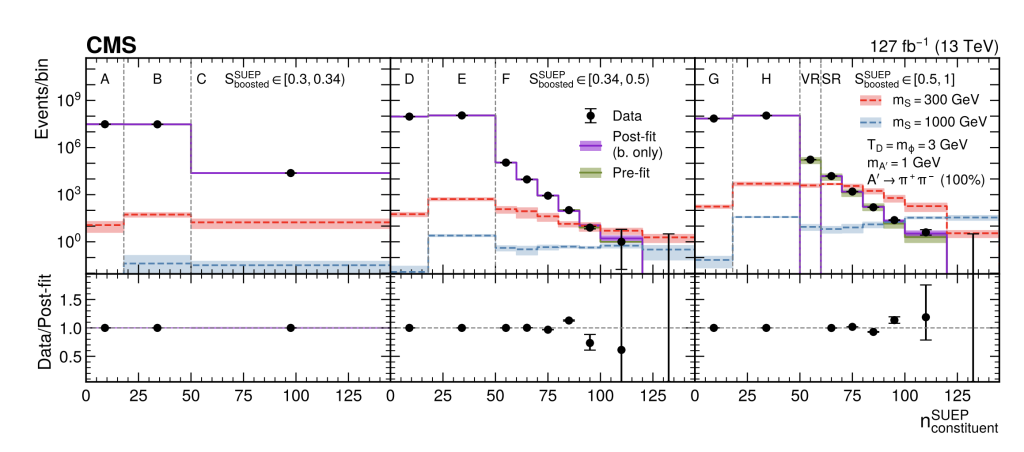
Figure 2: Event distributions of data, estimated background, and representative benchmark signals as a function of multiplicity in the eight control regions, labelled as A-H, a validation region (VR) to check the background estimation, and the signal region (SR). The plot indicates the selection criteria defining each region.
Figure 3 summarises the exclusion limits on the signal parameters given by the CMS experiment, assuming fully hadronic decays. The limits for signal models with more leptonic decays are comparable, as the analysis strategy does not explicitly exploit the particle-identity information. The results extended the parameter space excluded by the previous CMS offline analysis and improved the exclusion limits with greater sensitivity.
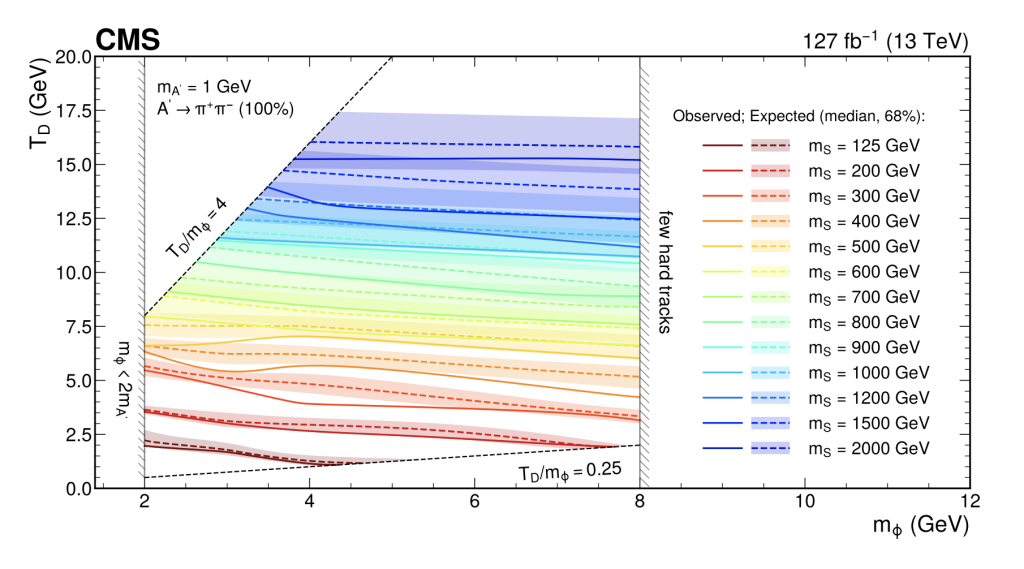
Figure 3: Exclusion limits of SUEP signals in the (TD, mφ) plane assuming mA′ = 1 GeV and fully hadronic decays. The region below each curve is excluded for the corresponding signal model of mS. The dashed lines show expected limits with background only, while the solid lines show observed limits based on the SR data.
ATLAS strategy
The ATLAS search takes a complementary approach by targeting SUEP events containing many low-momentum muons in addition to a large multiplicity of charged-particles, which include but are not limited to muons. It uses the full Run-2 dataset, corresponding to 140 fb−1 of proton–proton collision data collected at √s = 13 TeV. The unusually large number of muons expected in these models provides a distinctive signature that can be separated more effectively from Standard Model processes than a fully hadronic SUEP and offers a highly efficient trigger strategy as well as strong background suppression. It also allows ATLAS to probe scenarios with more moderate overall particle multiplicities and lighter mediators, including the important case of the Higgs boson being the mediator.
Rather than relying on energetic initial-state radiation, ATLAS selects events directly using specialised multi-muon triggers. Depending on the data-taking period, these required at least three muons with transverse momentum pT > 6 GeV or four muons with pT > 4 GeV. The subsequent analysis requires at least five reconstructed muons, each with pT> 3 GeV, and an average muon transverse momentum below 10 GeV. Requirements on the muons’ impact parameters select particles produced promptly near the proton–proton collision point and suppress muons originating from displaced decays of heavy-flavour hadrons.
Two main observables are then used to identify the unusual SUEP topology. The first is the number of reconstructed charged-particle (tracks) associated with the primary collision vertex, corrected for contributions from additional simultaneous proton–proton interactions. The second is the muon sphericity, Sμ, which measures how uniformly the muons are distributed. It is calculated after boosting the reconstructed muons into the rest frame of the muon system, reducing the effect of the mediator’s motion in the laboratory and increasing the discriminating power of this observable substantially.
As in the CMS analysis, the dominant background originates from QCD multijet production, in which muons are produced mainly through heavy-flavour decays. Since this background is difficult to model accurately using simulations, ATLAS estimates it directly from data. A likelihood-based ABCD method exploits the weak correlation between the charged-particle multiplicity and muon sphericity. Regions with low multiplicity and/or low sphericity constrain the background expected in the signal region, characterised by large track multiplicity and Sμ > 0.6. The expected and observed data are summarised in Figure 4.
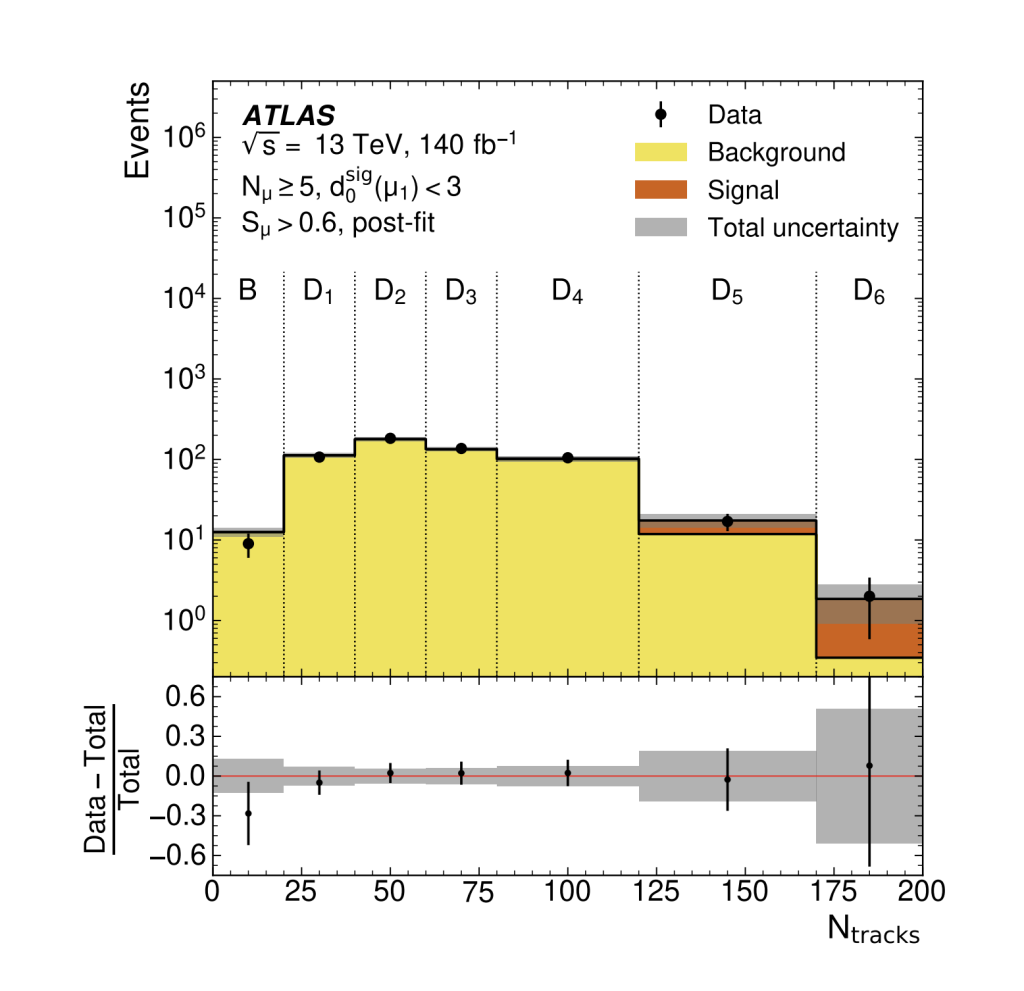
Figure 4: Distribution of the number of inner-detector tracks in the ATLAS signal region, defined by at least five reconstructed muons and a muon sphericity Sμ > 0.6. We compare the data with the estimated Standard Model background and a representative SUEP signal. We observe two events in the highest-multiplicity bin, consistent with the background expectation within uncertainties.
Two events were observed in the highest track-multiplicity bin. Although they resemble the expected SUEP topology, their number remains compatible with the Standard Model background. The largest local significance among the signal models tested is 1.7 standard deviations and therefore does not constitute evidence for new physics.
ATLAS consequently set upper limits on the product of the mediator production cross section and its branching fraction into SUEPs. These limits reach 0.05 fb for a mediator mass of 750 GeV, 0.4 fb at 400 GeV and 70 fb at 125 GeV. Results for representative model parameters are shown in Figure 5. If the 125 GeV mediator is identified with the Standard Model Higgs boson, the results constrain its branching fraction into SUEPs to approximately 0.2%, depending on the dark-sector parameters. The search therefore substantially extends previous sensitivity, particularly for models producing moderate particle multiplicities and sizeable numbers of muons.
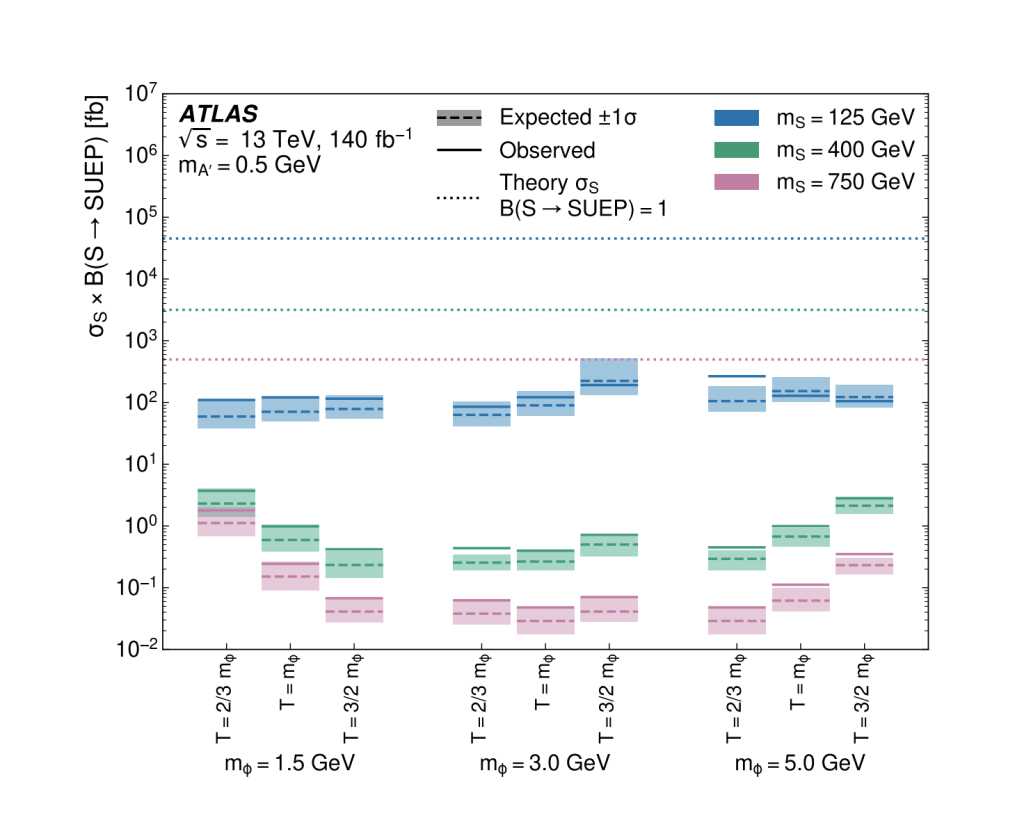
Figure 5: Expected and observed 95% CL upper limits on σ × B(S → SUEP) for representative models with a dark photon mass mA′ = 0.5 GeV. The theoretical predictions correspond to SM-like gluon-fusion production.
Outlook
Dark-sector models have been brought to the attention of the physics community, and over the last decade theoretical work has shown that even simple assumptions can produce complex predictions for phenomena accessible at LHC energies. At the same time, the challenge of isolating those signatures in the detector – signatures that were not initially foreseen when those were designed – means they are still largely unexplored. The articles presented here have begun to scratch the surface of this complex class of models and finally give us a glimpse of how powerful LHC data is for testing them.
The creativity and ingenuity of the experimental collaborations are enabling us to push the boundaries of what we can reconstruct and isolate from particles produced in proton-proton collisions, thanks to clever reconstruction algorithms, new data-processing and data-collection capabilities, and more. Those techniques can play a central role in further exploring these models in ways that promise to further extend these results. In other words, the best is yet to come!
Further reading
- First consideration of collider signatures from dark-sector/hidden-valley models. arXiv:hep-ph/0604261
- High-level theoretical summary of various possible dark-sector phenomenologies. arXiv:2103.01238
- Collider-oriented discussion of soft unclustered energy patterns, called “soft bombs” in the paper. arXiv:1612.00850