
A radioactive crossroads: n_TOF measurement validates a key reaction in the molybdenum-94 puzzle
by Panos Charitos (CERN)
Microscopic grains recovered from primitive meteorites offer an extraordinary link to stars that existed before the Sun. Formed in stellar outflows, these “presolar grains” survived the formation of the Solar System and retained distinctive isotopic signatures of the nuclear reactions that took place inside their parent stars.
Presolar silicon-carbide grains are particularly valuable because many originated around low-mass asymptotic giant branch (AGB) stars. These ageing stars are among the principal sites of the slow neutron-capture process, or s-process, which produces about half of the elements heavier than iron.
For more than two decades, however, the molybdenum isotopes measured in these grains have puzzled researchers. In particular, several nucleosynthesis calculations could not reproduce the observed enhancement of molybdenum-94 relative to other molybdenum isotopes.
A new measurement by CERN’s n_TOF collaboration, published in Physical Review Letters, has now tested one of the crucial nuclear-physics inputs behind these calculations. The collaboration has experimentally determined the neutron-capture cross section of radioactive niobium-94, a key branching-point isotope in the s-process path leading towards molybdenum-94.
The result did not reveal a dramatically different reaction rate that could resolve the discrepancy on its own. Instead, it provides something equally important: an experimental validation of the general scale of previous theoretical estimates. It rules out uncertainty in the niobium-94 neutron-capture rate as the principal explanation for the disagreement and shows that the solution lies primarily in a more complete treatment of stellar evolution and not in the nuclear physics input to the nucleosynthesis processes.
A nuclear crossroads inside ageing stars
During the s-process, atomic nuclei capture neutrons one at a time. If the resulting nucleus is unstable, it may undergo beta decay, converting a neutron into a proton and moving the nucleosynthesis sequence towards the next element in the periodic table.
Niobium-94, containing 41 protons and 53 neutrons, lies at an important crossroads in this sequence. It can undergo beta decay to become molybdenum-94, or it can capture another neutron and become niobium-95. The competition between these two pathways influences how much molybdenum-94 is produced.
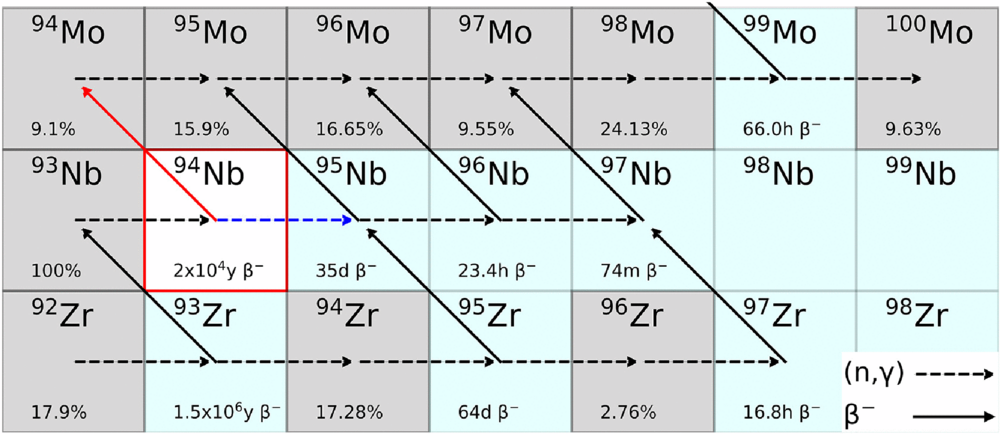
The s-process pathway through zirconium, niobium and molybdenum. Radioactive niobium-94, highlighted in red, forms a branching point: it can either undergo beta decay to molybdenum-94 or capture another neutron to form niobium-95.
Source: J. Balibrea-Correa et al., “First Measurement: Constraining the Nucleosynthetic Origin of in Presolar Grains”, Physical Review Letters 137, 082701 (2026), CC BY 4.0.
Under terrestrial conditions, niobium-94 has a half-life of approximately 20,000 years. Inside the hot plasma of an AGB star, however, its beta-decay rate is predicted to increase dramatically. At temperatures of around 300 million kelvin, its half-life may fall to less than a year. Beta decay and neutron capture can therefore compete during the short periods of high neutron density associated with stellar thermal pulses.
Until now, the probability of neutron capture by niobium-94 had not been experimentally determined over the neutron-energy range needed for astrophysical calculations. Researchers had to rely on theoretical nuclear reaction models, with different calculations producing somewhat different estimates.
“The problem was that nobody had ever measured how likely niobium-94 is to capture a neutron,” says Alberto Mengoni, spokesperson of the n_TOF collaboration.
A sample produced across Europe
The measurement required a radioactive niobium-94 sample with sufficient mass and exceptionally low contamination. Producing and characterising it demanded a coordinated effort involving several European research institutes.
Researchers at IFW Dresden first produced 304 milligrams of ultrapure niobium-93. The material was then irradiated for 51 days at the Institut Laue-Langevin’s high-flux reactor in Grenoble, converting approximately 1% of its atoms into niobium-94. Gamma-ray spectroscopy at the Paul Scherrer Institut in Villigen established an activity of around 10 Megabecquerels and confirmed that the sample contained no detectable radioactive contaminants.
The sample was subsequently transported to Experimental Area 2, or EAR2, at CERN’s n_TOF facility. Neutrons at n_TOF are produced when high-energy proton pulses from CERN’s Proton Synchrotron strike a lead target. By recording the time it takes to reach the experimental station, researchers can reconstruct their energies and determine the neutron-capture probability.
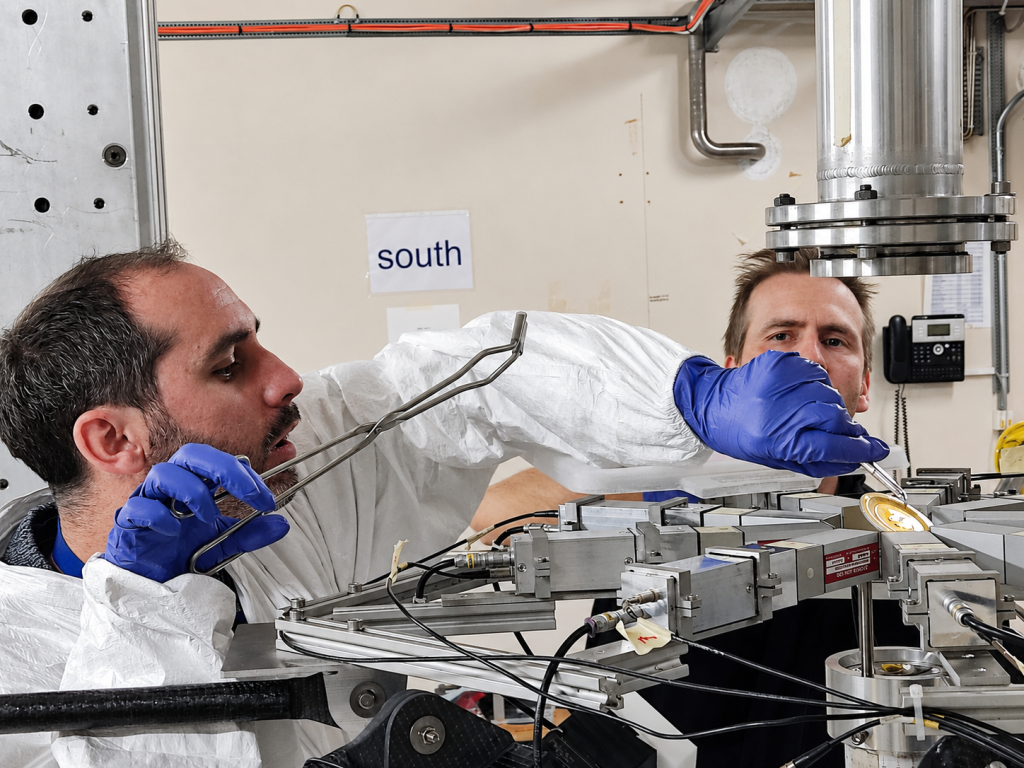
The EAR2 station at the n_TOF experiment at CERN produces large numbers of neutrons, opening up new possibilities for nuclear research. (Image: CERN)
The measurement was exceptionally challenging. Only a small fraction of the sample was niobium-94, and its radioactive decay produced an intense background of beta particles and gamma rays. The capture signal was therefore extremely faint.
“The unparalleled instantaneous neutron flux of the EAR2 station was pivotal for detecting the faint signal of neutron capture from the niobium-94 sample,” explains Javier Balibrea-Correa, corresponding author of the study and principal investigator of the experiment.
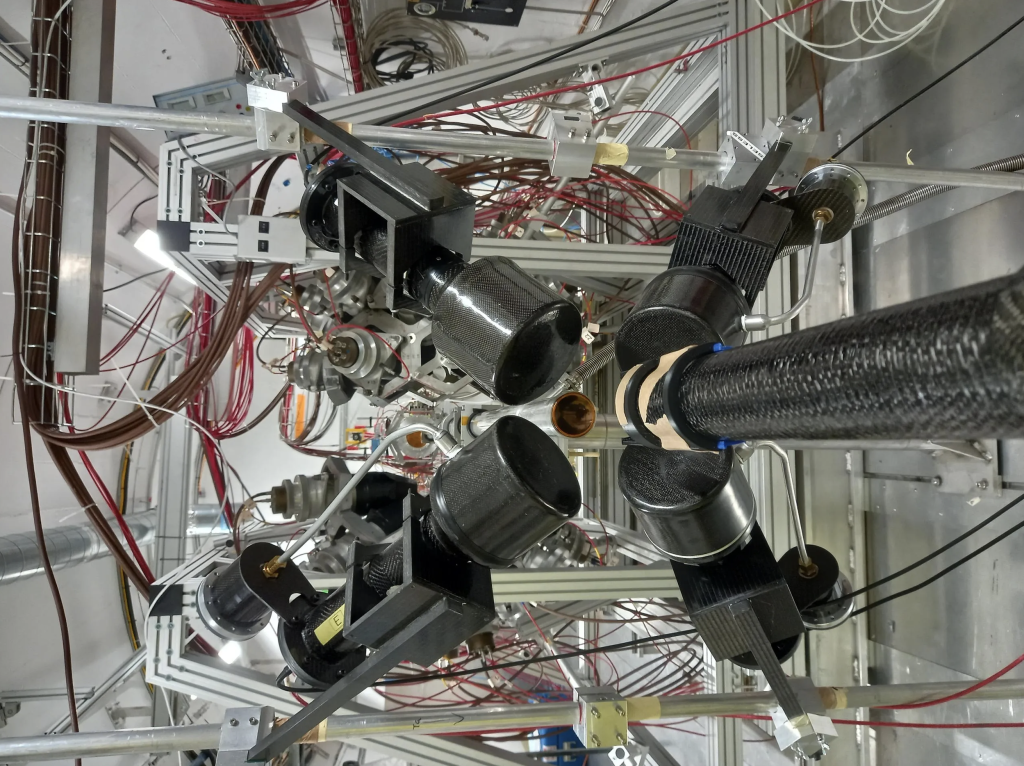
The experiment also relied on the segmented Total Energy Detector, or sTED, developed for neutron-capture measurements involving radioactive samples and high counting rates. Nine compact detector cells were arranged in a ring around the sample, helping to maximise the signal relative to the radioactive background and cope with the intense gamma-ray flash accompanying each neutron pulse.
The team identified and analysed ten niobium-94 neutron-capture resonances at neutron energies up to approximately 800 electronvolts. From these data, the researchers constrain the Maxwellian-averaged cross sections: reaction probabilities averaged over the neutron-energy distributions expected at different stellar temperatures.
Testing the theoretical predictions
The measured cross sections are broadly comparable to previously used theoretical values. At a thermal energy of 30 kiloelectronvolts, the experimental value is (460 \pm 37) millibarns, within approximately 5% of the recommendation from the KADoNiS nuclear-astrophysics database. At 5 kiloelectronvolts, the measured value of (1167 \pm 93) millibarns is around 26% higher, while at higher energies the new values are up to 13% lower.
This comparison provides the first experimental test of calculations that had previously been entirely theoretical. It confirms that their overall scale was realistic and excludes a substantially slower niobium-94 neutron-capture rate as a possible mechanism for producing more molybdenum-94.
When the experimentally determined rate replaced the previous theoretical estimate in the stellar calculations, the predicted molybdenum-94 abundance changed only modestly. Varying the measured cross section within twice its experimental uncertainty altered the predicted molybdenum-94 to molybdenum-96 ratio by less than 3%.
Rather than diminishing the significance of the measurement, this is its central diagnostic value. A previously untested nuclear input has been experimentally anchored, the associated uncertainty has been sharply reduced, and one possible explanation for the 20-year discrepancy has been decisively ruled out. The result shifts attention from the neutron-capture rate itself to how models of the evolving star treat nuclear reactions and radioactive decays.
The role of magnetic-FRUITY models
To study the astrophysical consequences, the researchers used magnetic-FRUITY models of low-mass AGB stars.
FRUITY is a database and stellar-modelling framework developed by researchers at the Italian National Institute for Astrophysics. Its models follow both the physical evolution of AGB stars and an extensive nuclear-reaction network, tracing the production of isotopes from hydrogen to bismuth.
This fully coupled approach differs from post-processing calculations in which nucleosynthesis is evaluated after the stellar structure has been calculated, sometimes using simplified treatments of how reaction and decay rates vary within the star. The magnetic-FRUITY models also incorporate mixing induced by buoyant magnetic flux tubes. This mixing contributes to the formation of the carbon-13-rich region that supplies most of the neutrons for the s-process in low-mass AGB stars.
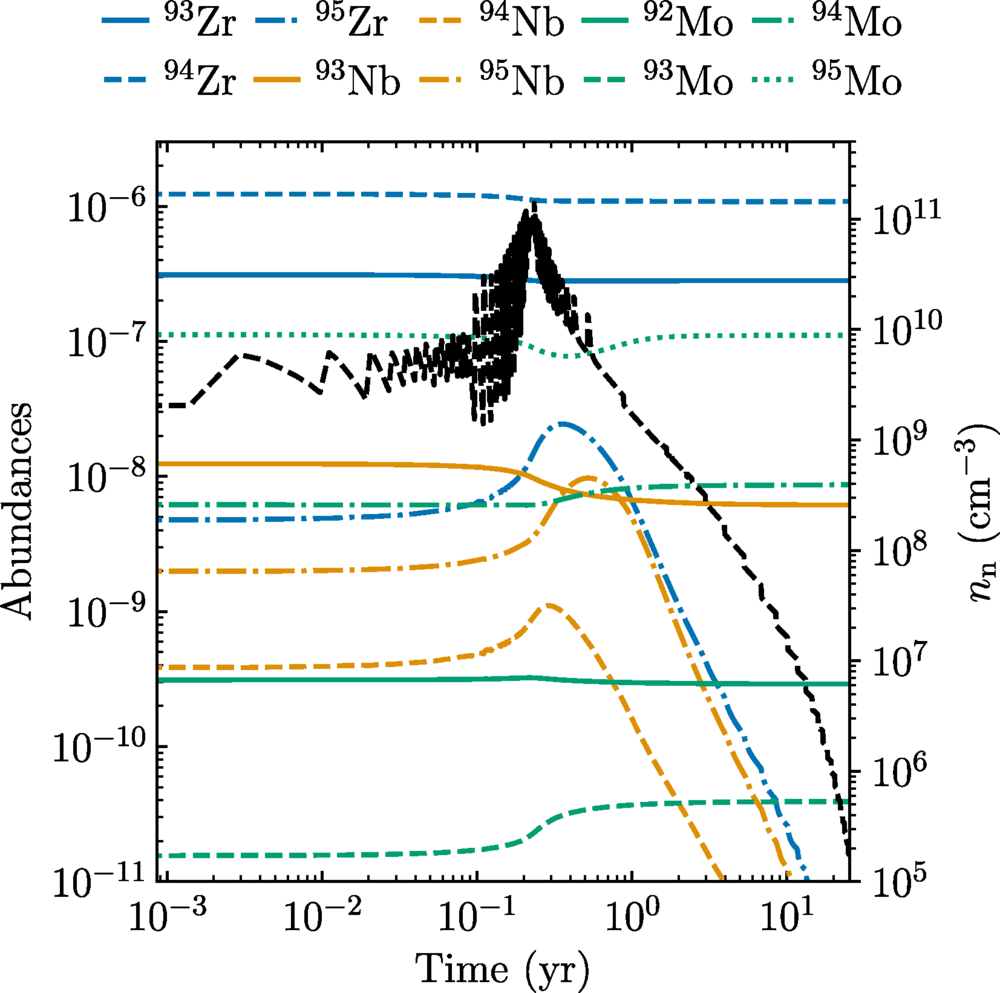
Crucially, the models follow the changing temperature and density of the star together with the nuclear network. They can therefore treat the competition between neutron capture and the strongly temperature-dependent beta decay of niobium-94 more self-consistently during successive thermal pulses.
With this treatment, the magnetic-FRUITY calculations reproduce the molybdenum isotope ratios measured in presolar silicon-carbide grains. Because introducing the new experimental cross section produces only a modest change, the agreement cannot be attributed to an unexpectedly large correction to the neutron-capture rate. Instead, the study indicates that the longstanding discrepancy probably arose from limitations in some earlier post-processing calculations—particularly their approximate treatment of the temperature- and density-dependent beta-decay rate of niobium-94.
The n_TOF measurement therefore critically validates this interpretation. It confirms that the success of the fully coupled models does not depend on an unconstrained or artificially adjusted neutron-capture rate.
Measured molybdenum isotope ratios in presolar silicon-carbide grains compared with magnetic-FRUITY calculations for two-solar-mass AGB stars at different metallicities. The agreement shows that the fully coupled stellar models can reproduce the molybdenum-94 signatures preserved in the grains. Source: J. Balibrea-Correa et al., “First Measurement: Constraining the Nucleosynthetic Origin of in Presolar Grains”, Physical Review Letters 137, 082701 (2026), CC BY 4.0.
One experimentally anchored branch—and one still to measure
The study also clarifies the s-process contribution to molybdenum-94. The magnetic-FRUITY calculations attribute approximately 4.6% of the Solar System’s total molybdenum-94 inventory to the s-process, in agreement with an independent estimate inferred from presolar grains. Most Solar-System molybdenum-94 is thought to originate from other nucleosynthesis mechanisms collectively described as the p-process.
These contributions are complementary parts of the same astrophysical history. The s-process component may represent a modest fraction of the total Solar-System abundance of molybdenum-94, but its distinctive signature in presolar grains provides a particularly sensitive test of reactions inside AGB stars. Experimentally determining this component helps researchers separate contributions from different stellar environments and strengthens models of the Galaxy’s chemical evolution.
One key quantity nevertheless remains theoretical: the beta-decay rate of niobium-94 under stellar conditions. Radioactive lifetimes can change when atoms are highly ionised in a hot plasma, but the predicted reduction in the niobium-94 half-life has not yet been experimentally confirmed.
The PANDORA project—Plasma for Astrophysics, Nuclear Decays Observation and Radiation for Archaeometry—is developing a magnetic plasma trap at the INFN Laboratori Nazionali del Sud in Catania. It aims to measure radioactive decay rates in plasmas reproducing selected features of stellar environments, including the charge-state distributions of highly ionised atoms. Niobium-94 is one of its principal nuclear-astrophysics targets.
A future PANDORA measurement would complement the n_TOF result by experimentally constraining the other side of the niobium-94 branching point. Neutron capture towards niobium-95 is now anchored by the n_TOF measurement; beta decay towards molybdenum-94 remains the next critical quantity to test.
By bringing together nuclear theory, a challenging neutron-capture measurement, fully coupled stellar models and isotopic data preserved in ancient grains, the study disentangles the different ingredients of a longstanding astrophysical puzzle. Its importance lies not in discovering an unexpectedly different reaction rate, but in validating a crucial nuclear input, identifying where the earlier discrepancy originated and establishing a clear path towards a fully experimentally constrained description of molybdenum-94 production in AGB stars.
Acknowledgement: The author would like to gratefully acknowledge Javier Balibrea-Correa, principal investigator of the experiment; César Domingo-Pardo, group leader at IFIC-Valencia and coordinator of the broader ^94Nb project; Nikolas Patronis, current spokesperson of the n_TOF Collaboration; and Alberto Mengoni, former n_TOF spokesperson when the experiment was prepared and conducted, for their valuable comments on the final draft.