
From particle flow to learned reconstruction at CMS

An interactive version of the above event display can be found on this page.
For more than a decade, particle-flow reconstruction has been at the core of CMS event interpretation. It was instrumental in the discovery of the Higgs boson and remains foundational for virtually every analysis carried out by the collaboration. By combining information from the silicon tracker, the electromagnetic and hadronic calorimeters, and the muon system, particle-flow produces a coherent, particle-level description of each proton–proton collision. Jets, missing transverse momentum, lepton identification, and flavour tagging all begin from this unified list of reconstructed particles. In many respects, particle-flow is the interface between the detector and physics.
CMS has now taken a decisive step forward with the implementation of a machine-learning-based particle-flow algorithm, known as MLPF. This development does not simply refine an existing component; it replaces the traditional rule-based linking stage with a learnable, transformer-based model capable of reconstructing the entire event in a single inference step. Crucially, this approach has been integrated into the CMS offline software and validated on Run-3 collision data. It represents the first full-event machine-learning reconstruction pipeline deployed and tested within a hadron collider experiment. As such, it signals a structural evolution in the interpretation of detector signals.
From handcrafted logic to learned global correlations
The traditional particle-flow (PF) algorithm reconstructs individual particles in a collision event by combining signals from the tracker, calorimeters and muon system. It is based on physics-motivated heuristics: carefully designed rules, associations and priorities derived from detector knowledge and particle behaviour, rather than learned directly from data. Tracks are extrapolated and linked to calorimeter clusters using geometric proximity and compatibility criteria. Ambiguities are resolved iteratively, and particle identities are assigned based on detector signatures. The approach is robust and well understood, but it is fundamentally combinatorial. As pileup increases and detector granularity becomes finer, the complexity of linking grows, and maintaining performance requires increasingly intricate tuning.
MLPF reformulates the reconstruction problem entirely as an optimisation problem that can be solved numerically using machine learning. Instead of explicitly defining linking rules, it treats event reconstruction as a set-to-set learning task. The inputs are the reconstructed tracks and calorimeter clusters already produced by upstream algorithms. The outputs are particle candidates—photons, electrons, muons, charged hadrons and neutral hadrons—with full kinematic information. All particle predictions are made simultaneously, rather than sequentially.
The model uses a transformer architecture with self-attention, enabling it to learn correlations between all detector elements in an event. This is essential because event reconstruction is inherently global. Signals from different particles overlap, showers develop across multiple layers, and pileup introduces diffuse contributions that must be disentangled from the hard interaction. Attention mechanisms allow the model to learn these patterns without relying on fixed proximity criteria.
A key technical element is the use of FlashAttention, which enables efficient scaling to thousands of input elements per event while maintaining practical memory and runtime characteristics on GPUs. In effect, MLPF is designed from the outset to operate in a modern, accelerator-aware computing environment.
Equally important is how the training target is defined. Generator-level “truth” is not directly observable and does not correspond one-to-one with reconstructable detector signals. Some particles fall outside acceptance or leave no measurable trace, while secondary interactions in the detector can produce additional signals. The MLPF target is therefore constructed as the set of reconstructable particles—those that interact with the detector and leave measurable signatures—while remaining aligned with generator-level information after pileup subtraction. This careful definition ensures that the model learns a physically meaningful mapping from detector inputs to particle outputs. It is not trained to reproduce idealised truth, but rather to reconstruct what the detector can and should measure.
Physics performance and validation on data
The ultimate measure of any reconstruction algorithm is its impact on physics observables. At the particle-level, MLPF shows improved efficiency for neutral hadrons while maintaining comparable misidentification rates. Neutral hadrons have historically been among the most challenging components of PF reconstruction because they rely heavily on calorimeter information, without complementary track information, and are sensitive to fluctuations and pileup. Gains in this area propagate directly to higher-level observables.
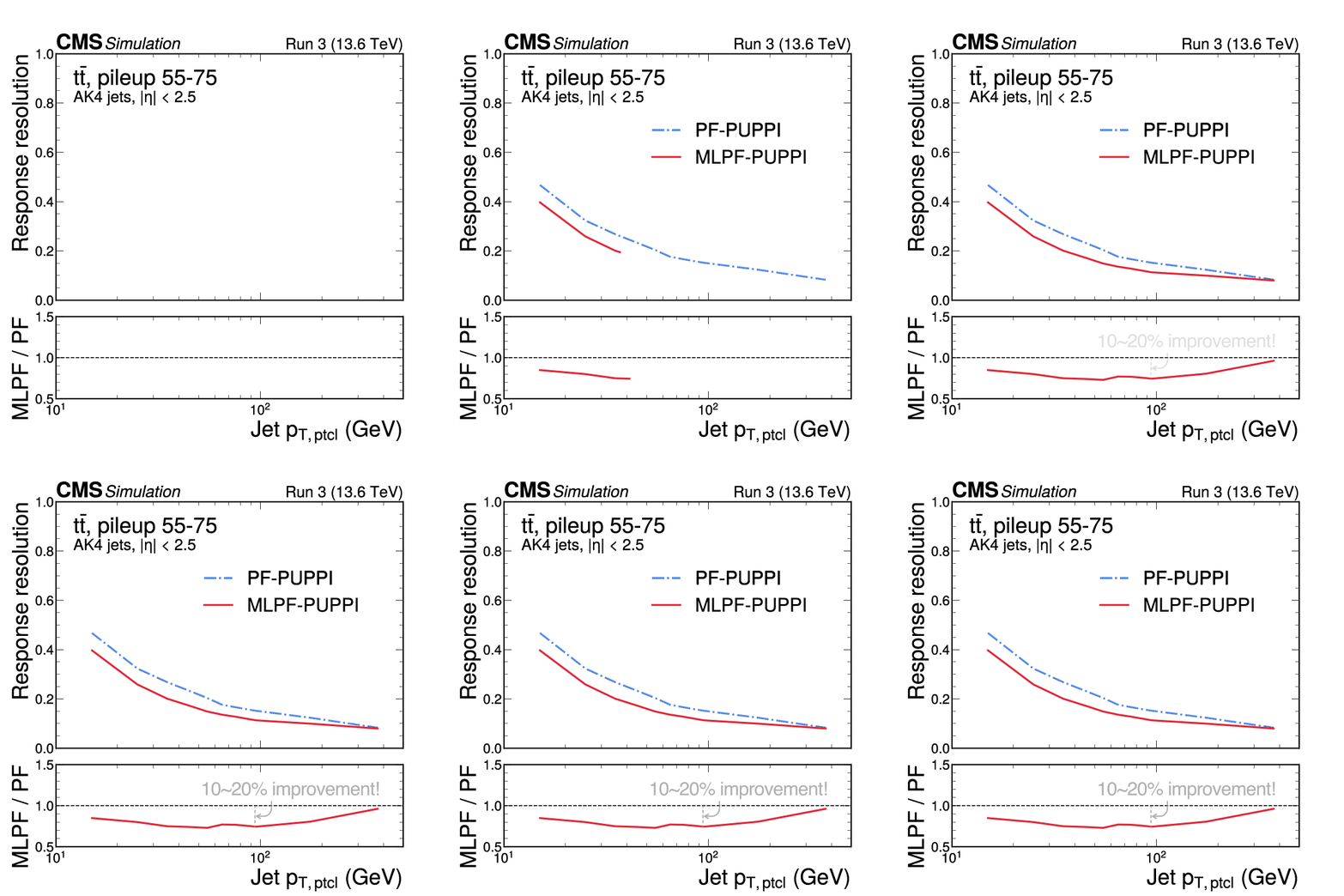
At the jet-level, the impact is even more striking. Without being explicitly trained on jets, MLPF achieves a 10–20% improvement in jet energy resolution in the transverse momentum range of approximately 30 to 100 GeV. This improvement arises purely from more accurate particle-level reconstruction. Since jets are clustered from reconstructed particles, improved particle resolution naturally enhances jet performance. Such gains are highly relevant for precision measurements, Higgs studies, top-quark analyses and searches for new resonances.
Missing transverse momentum remains broadly consistent between standard PF and MLPF, with similar overall distributions and somewhat harder tails for MLPF. Given that the model is trained at the particle-level rather than explicitly optimising pTmiss, this agreement indicates that global event balance is preserved. Existing downstream techniques for MET regression can be applied to MLPF outputs just as they are for PF.
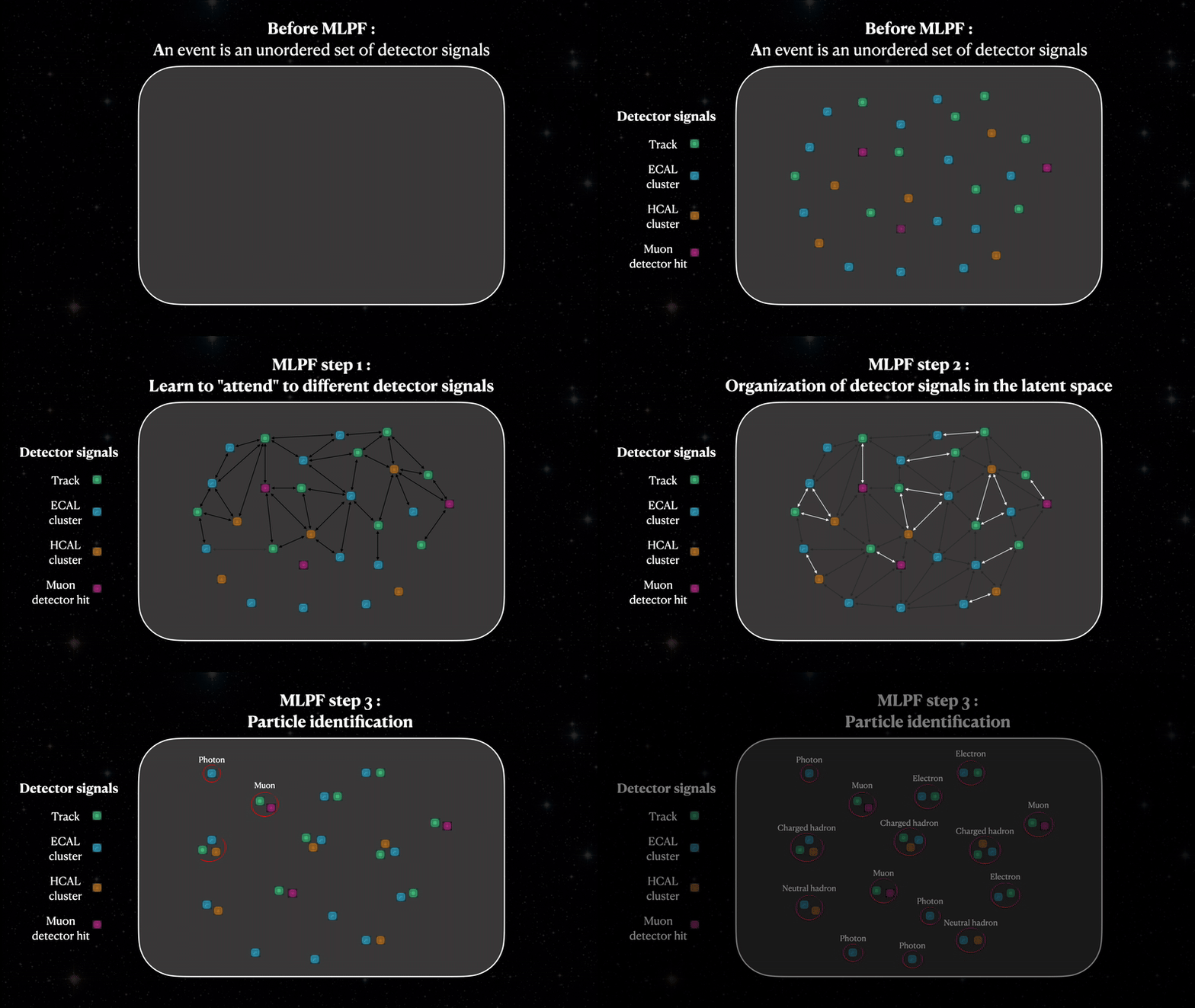
A critical milestone is that these results are not confined to simulation. The model has been integrated into the CMS offline reconstruction framework and validated on a Run-3 data sample. Comparisons of leading jet transverse momentum, dijet asymmetry and missing transverse momentum distributions show good agreement between PF and MLPF. This marks the first time a full-event machine-learning reconstruction has been applied and validated on real LHC collision data within an experiment’s production software. While further systematic studies and broader validation are required before full deployment, the proof of compatibility with real detector data has been established.
Computing performance and HL-LHC readiness
Beyond its performance in physics, MLPF introduces an important shift in computing strategy. In tests within the CMS software framework, inference on an NVIDIA L4 GPU achieves an average runtime of roughly 20 milliseconds per event, compared with approximately 110 milliseconds for the standard PF linking step on CPU. Moreover, inference time remains stable across events, including those that are slow for the traditional algorithm, demonstrating favourable scaling with event complexity.
Under Run-3 conditions, PF linking represents only part of the total reconstruction time. However, as the HL-LHC approaches with average pileup levels around 200, reconstruction complexity will increase substantially. Offloading the linking stage to GPUs opens the door to heterogeneous computing strategies and improved utilisation of accelerator hardware. MLPF demonstrates that full-event reconstruction can be designed with accelerator-native architectures in mind.
The broader implications are significant. Machine-learning-based reconstruction enables flexibility that is difficult to achieve with handcrafted algorithms. Models can be retrained to accommodate new detector geometries, fine-tuned for specific physics regimes, or integrated into workflows that more closely link detector design and reconstruction performance. As CMS prepares for Phase-2 upgrades, including the high-granularity endcap calorimeter and extended tracking coverage, such adaptability may become increasingly valuable.
Challenges and the path forward
Despite these promising results, important challenges remain. Robustness across varying detector conditions and long-term stability must be demonstrated. Any new algorithm must be carefully validated and calibrated. Ensuring adequate training coverage across the full kinematic phase space—particularly in boosted regimes—will require expanded datasets and continued refinement.
Interpretability and transparency are also essential. Replacing long-standing, well-understood heuristics with a neural network demands clear diagnostic tools and validation strategies to build collaboration-wide confidence. Operational considerations, such as GPU resource allocation, model versioning, and reproducibility within the reconstruction framework, must be addressed before large-scale deployment.
Nevertheless, this development marks a turning point. Particle flow once transformed CMS by unifying subdetector information into a coherent particle-level description. Machine-learning-based particle flow extends that transformation by replacing explicit linking logic with learned global correlations. It improves jet resolution, preserves global event properties, scales efficiently on modern hardware and has demonstrated compatibility with real collision data. At the same time, ML-based reconstruction enables learning flexible latent representations that can be reused or fine-tuned for specific analysis goals or event topologies, thereby opening the door to closer coupling — and eventually joint optimisation — between reconstruction and physics analysis.
As CMS moves toward the HL-LHC era, sustaining and extending the experiment’s physics reach will require innovations of this kind. MLPF shows that full-event machine learning has progressed from conceptual exploration to operational reality. The task ahead is to consolidate these gains, address the remaining challenges and ensure that this new approach strengthens the foundation on which the next decade of physics discoveries will be built.
The author gratefully acknowledges Farouk Mokhtar for valuable comments and constructive feedback on the manuscript.
Read more about these results:
-
CMS Publication (PFT-25-001): "Full event interpretation with machine-learning-based particle-flow reconstruction in the CMS detector"


