
Riccardo Barbieri: On naturalness, supersymmetry and the unfinished story of the Standard Model

Riccardo Barbieri has spent more than five decades at the forefront of theoretical particle physics, contributing to key developments in quantum field theory, electroweak precision physics and the exploration of physics beyond the Standard Model. A longtime professor at the Scuola Normale Superiore in Pisa and a frequent collaborator at CERN, Barbieri has helped shape generations of theorists while engaging deeply with some of the most persistent questions in fundamental physics — from the hierarchy problem to the role of symmetry in nature. In this conversation with EP News, he reflects on the formative years of the Standard Model, the intellectual atmosphere at CERN during the “November Revolution,” the enduring appeal of supersymmetry, and the motivations for future colliders in an era where precision and energy frontiers must once again advance together.
Panos Charitos: Professor Barbieri, let me start from the beginning. What first brought you into physics? Was there a particular moment, teacher, or book that pushed you in that direction?
Riccardo Barbieri: My origins are relatively humble. I was born in Parma. I still remember my father showing me, with a kind of proudness the report card for his third year in the primary school, with the maximum marks in all disciplines, after which he had to leave school. My parents moved with their families from the countryside to the town. The main concern in the family was simply to improve our situation and move forward in life.
At school, I had a teacher who had studied at the Scuola Normale Superiore in Pisa. He encouraged me to try to enter that world. I was already interested in science and initially hesitated between mathematics and physics.
So I entered the Scuola Normale in Pisa. By my second year, it was clear that physics was what I wanted to pursue. I graduated in 1969 and stayed in Pisa for several years afterwards.
Panos Charitos: Was there really no particular book or teacher that inspired you early on?
Riccardo Barbieri: I cannot point to a specific book or a single teacher who determined the choice. What I did inherit from my family environment was a strong sense of determination. There was a sense that one had to compete to move forward. That helped me in my studies — although sometimes I wonder whether it may also have limited me in certain ways.
But in terms of inspiration, it was not a romantic story. It was simply a gradual realisation that physics was the discipline through which I could, in the freest way, construct my point of view for reading and understanding the world.
Panos Charitos: Your PhD years coincided with a remarkable period in particle physics, when quantum field theory was being consolidated, and the foundations of the Standard Model were coming together. Was that atmosphere strongly felt where you were working?
Riccardo Barbieri: Not as much as one might imagine. Communication was very different back then from what it is now. It was not as easy as today to follow developments everywhere. In principle, I could have taken a train to join other Italian groups that were already addressing frontier questions in the foundations of the Standard Model, but that was not what I did. The development of the Standard Model did not pass through Pisa strongly at that time, nor until 1974, when I first came to CERN.
My own entry into quantum field theory came through quantum electrodynamics. My early work involved analytic calculations of higher-order QED corrections — for example, to the electron’s anomalous magnetic moment and charge radius, relevant to the Lamb shift. That was my training: precise quantum field theory calculations directly connected to measured physical observables. This is from where my interest in precision physics comes from, I think.
Panos Charitos: And then you arrived at CERN in 1974 — just as particle physics was entering one of its most dramatic moments.
Riccardo Barbieri: Yes! I arrived in September 1974, and only two months later came the November Revolution: the discovery of the J/ψ particle and the emergence of the charm quark as a concrete reality. That experience was, for me, almost an explosion: suddenly, I could see how the wider world of physics was moving.
At first, the interpretation of the new resonance as a charm–anticharm bound state — charmonium, as we would later call it — was not universally accepted, particularly in Europe. In the United States, people moved more quickly in that direction, making the connection with QCD asymptotic freedom. But for some of us, the remarkably narrow width of the resonance already made that picture very convincing. Open charm had not yet been seen — that came roughly a year later — but the evidence for a bound state of a new heavy quark was already compelling.
I continued to work on charmonium and related questions through much of the 1970s. Looking back, that moment was important because it marked a turning point in the consolidation of the Standard Model. Over the half-century since the November Revolution, the number of observables successfully described by the Standard Model has grown enormously, in many cases with striking numerical precision. And mostly via CERN contributions, one should say. As such, the Standard Model stands now as one of the most successful theories of a quadrant of nature ever formulated.
Panos Charitos: What were the main theoretical debates at CERN during that period?
Riccardo Barbieri: The interpretation of the November discoveries was one of the central debates, of course. But soon attention increasingly turned towards Beyond the Standard Model issues and, especially, to supersymmetry, or SUSY, as many like to call it.
Initially, what attracted interest in SUSY was its unique character as a symmetry capable to establish relations in relativistic theories among particles of different spins. In particular at CERN, already in the 70’s, this gave rapid rise to the explicit construction of different supersymmetric field theories with unique properties.
But what made SUSY by far the most intensive effort in Beyond the Standard Model since the very beginning of the 80’s was the focus on the hierarchy problem, which had already emerged clearly in the 70’s in different contexts.
That gave the subject a completely different status. For many theorists, supersymmetry became not just elegant but compelling — perhaps the most serious path beyond the Standard Model. I remember some senior figures at CERN looking at this enthusiasm with a certain amusement. They understood the attraction, but they sometimes joked that we were becoming a little too “religious” about supersymmetry.
Panos Charitos: In retrospect, do you think that enthusiasm might have led theorists to overlook other directions?
Riccardo Barbieri: No, I would not put it that way. The naturalness problem of the Higgs mass has not gone away. We still do not know what stabilises the electroweak scale, and that remains, in my view, a real physical problem.
Of course, over the years, other possibilities have been explored, rightly so. But I would still say that supersymmetry — and Higgs compositeness — remain among the most serious ideas we have to solve the problem of why the Higgs mass is not driven by quantum corrections to any higher mass scale to which the Higgs couples to.
In retrospects it is clear that, at least personally speaking, our expectations were too optimistic. If you had asked me around 1990, when LEP was beginning, I would have said that supersymmetry had to be discovered there. That did not happen. But a failed expectation about the timing of a discovery is not the same thing as a failed idea at all.
While no s-particle has been discovered yet, one should not forget what can be considered as indirect evidence for SUSY. Gauge coupling unification is highly successful in SUSY Grand Unified Theories. A discrete Parity, desired to avoid the breaking of Baryon and Lepton numbers at too low energies, makes the lightest s-particle stable and, as such, a natural Dark Matter candidate. The mass squared of the Higgs boson, generated at high energy by SUSY breaking, can be driven negative by the top coupling, thus explaining the origin of ElectroWeak symmetry breaking.
Unfortunately, none of these arguments sets a strong upper bound on masses and couplings of some s-particle that would make it necessarily visible at LHC.
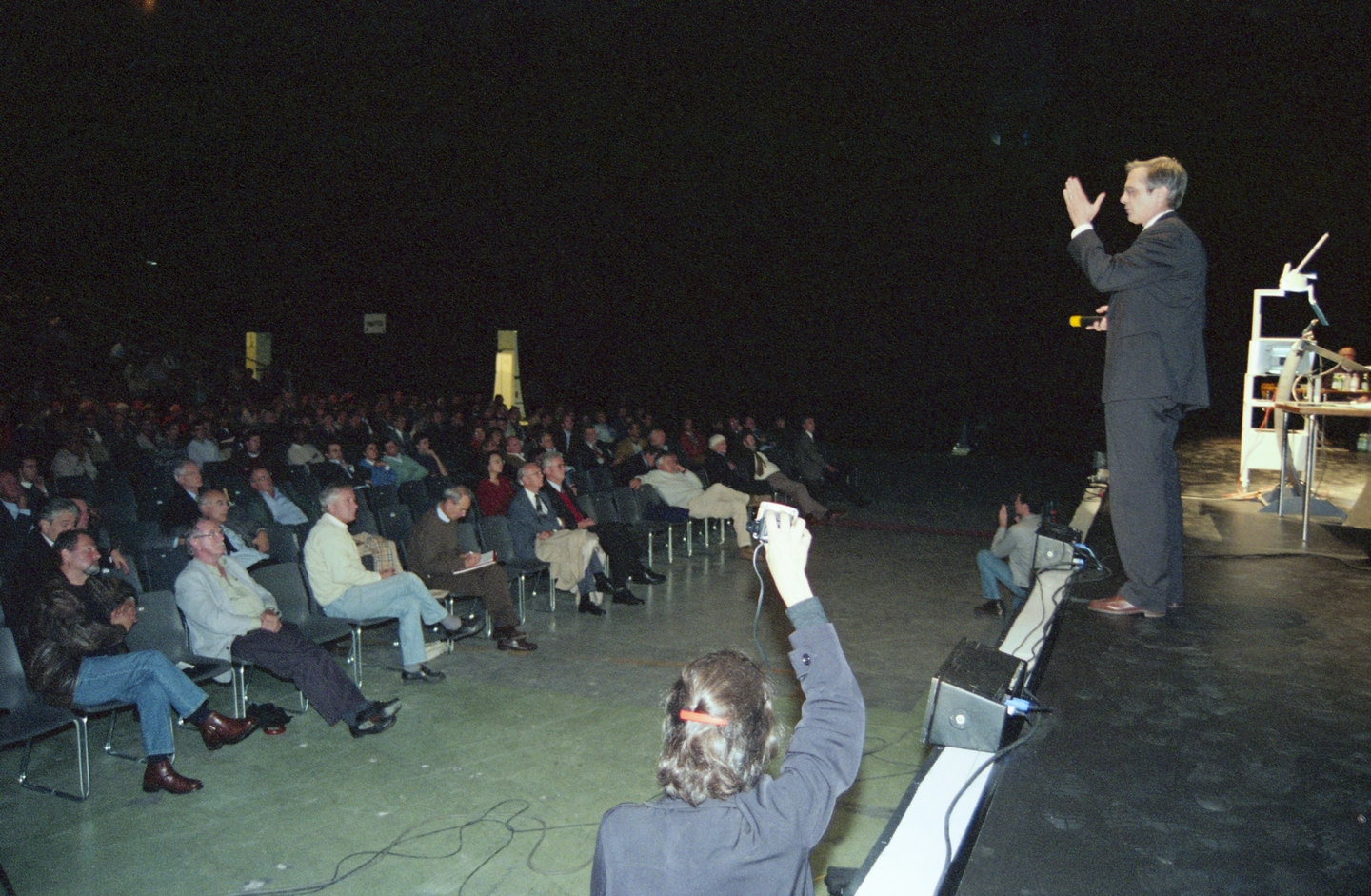
R. Barbieri during his presentation “LEP Physics II”, dedicated to Higgs searches.
Panos Charitos: Let me return to the late 1990s. When LEP finished running without discovering supersymmetry, what changed in your thinking?
Riccardo Barbieri: I remember that period very clearly. Around that time, together with Alessandro Strumia, I wrote a short paper that we called The LEP paradox, and the title stayed. The point was not simply that LEP had failed to find supersymmetry. It was that LEP had made the problem sharper.
On one side, the LEP precision measurements boosted the evidence for a perturbative Higgs physics, as expected in SUSY, against the case of a strongly interacting Higgs.
On the opposite side, two obvious questions became pressing: Where are the SUSY particles? Where is the lightest SUSY Higgs? A so-called little hierarchy problem was emerging. At the same time, the second question gave rise to a heated discussion about the maximal extension of the LEP2 energy for the Higgs search, with relevance to the competition with FERMILAB on the same search and to the timing of the LHC commissioning.
In that context, supersymmetry did not look less interesting to me. What did change was perhaps one’s sense of how indirect evidence should be read. LEP did not tell us that supersymmetry had to be there just above the electroweak scale. It told us that the Standard Model was working extraordinarily well, while still leaving unresolved the question of why the Higgs sector is so light and so special, a unique fundamental scalar - as far as we can tell - in all of particle physics. In that sense, the end of LEP did not close the question of new physics; it reformulated it in a more demanding way.
And in a certain sense, that remains our situation today. The Higgs boson has now been found, exactly in the mass range that precision data had pointed to, but the deeper structural questions — naturalness, flavour, and the organisation of the Higgs sector itself — are still with us. That is why I continue to think that both higher energies and higher precision remain essential.
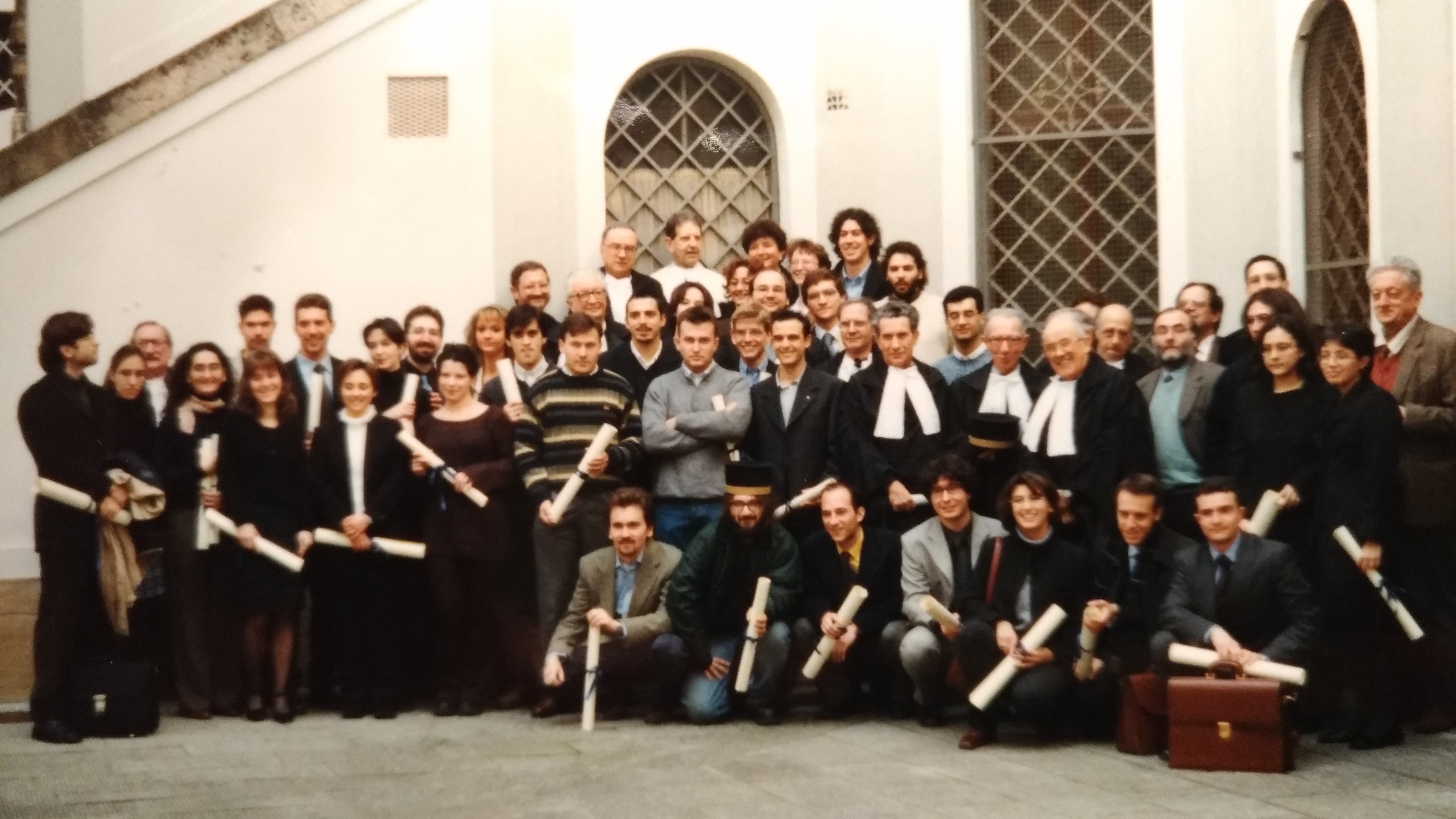
Graduation ceremony at the Scuola Normale Superiore, 2002. Seated in the front row are Emilio Picasso, who led the LEP project from 1981 to 1989 and served as Director of the Scuola Normale from 1991 to 1995, and Italo Mannelli, CERN Director of Research from 1979 to 1981.
Panos Charitos: How did that affect the community?
Riccardo Barbieri: Reactions were quite varied. Some people became discouraged and gradually moved away from supersymmetry, or at least stopped seeing it as the most urgent direction to pursue. That is understandable: expectations had been high, and neither LEP nor, later, the early LHC data delivered the clear signals many had hoped for.
My own reaction was different. I never lost confidence in the underlying question, because the naturalness problem of the Higgs sector did not disappear. What became less clear, after a certain point, was not the conceptual motivation but which concrete line of work was the most fruitful to follow directly. So although I did not continue to work on supersymmetry in a narrow sense, I never stopped regarding it as one of the most serious possibilities, together perhaps with the idea of a composite Higgs.
I remember very clearly the ICHEP conference in Melbourne in 2012, just days after the announcement of the Higgs boson. In my closing talk, I said that the LHC would have remained a crucial instrument in the search for supersymmetry. That was twelve years after the end of LEP, and I felt — as I still feel — that the question had not been closed. The discovery of a Higgs-like particle at 125 GeV did not remove the issue of naturalness; if anything, it made it more concrete.
Panos Charitos: From the experimental side, are there lessons to draw from this situation?
Riccardo Barbieri: I think the experimental community understands well how to pursue these searches, and of course, the LHC collaborations have already explored a large part of the most obvious parameter space. But the absence of simple signals should not be confused with the absence of viable possibilities.
There are still important regions that are harder to access experimentally. Electroweakly interacting s-particles, for example, are typically far more elusive than strongly interacting ones such as squarks or gluinos, simply because their production rates are lower and their signatures can be less striking. In the same way, supersymmetric theories usually imply an extended Higgs sector, including additional neutral and charged Higgs bosons, which remains a well-motivated target for direct searches.
More generally, the lesson is that the search has to remain broad and technically sophisticated. One has to be attentive not only to the classic signatures, but also to more compressed spectra, more indirect effects, and more subtle manifestations of new physics.
In the longer term, however, the essential point is energy. If the characteristic scale of supersymmetry is higher than we once hoped, then extending the reach in the centre-of-mass energy of the collision becomes crucial. In the end, if one wants to test seriously whether supersymmetry plays a role in stabilising the electroweak scale, one needs access to the proper mass range, which, based on the Higgs mass in the MSSM, might go up to the 10-20 TeV for the s-top.
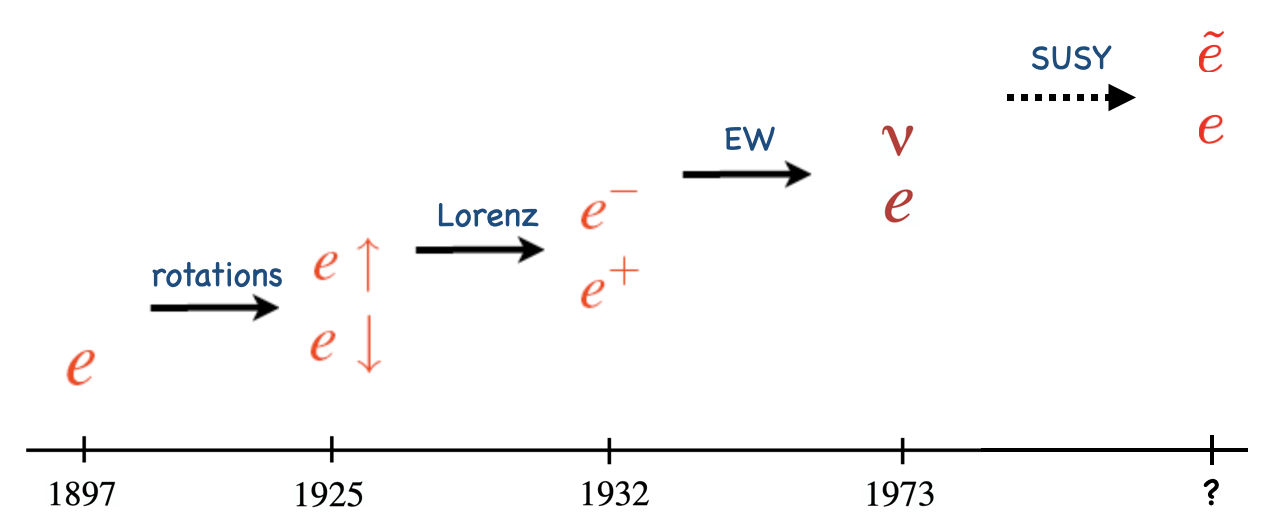
Panos Charitos: During our discussion, you showed a diagram (see above) illustrating the role of symmetries in particle physics. How does that motivate supersymmetry?
Riccardo Barbieri: If you look at the history of the electron, as summarised in this diagram, its properties become intelligible through a sequence of symmetry principles. Rotation symmetry accounts for its two spin states. Lorentz invariance leads to the existence of the positron. In its unbroken phase, electroweak symmetry makes the left-handed electron and the neutrino indistinguishable particles.
From that point of view, supersymmetry can be seen as a further step in the same direction: it extends this sequence of symmetries by associating a new partner to each known particle.
Some critics object that supersymmetry introduces too many new particles. But if one considers the historical role that symmetry principles have played in particle physics, that kind of extension is not unnatural at all. On the contrary, it fits into a broader pattern in which deeper symmetries reveal new layers of structure.
Needless to say, that does not mean supersymmetry must be realised in nature. But it does help explain why the idea has remained so compelling for so long.
Panos Charitos: What role could a future electron–positron collider play?
Riccardo Barbieri: As I said, the Standard Model is a theory of nature of extraordinary success. As such, it leaves us with major unanswered questions — not only observational ones but structural ones as well. How should we think about the origin of the Fermi scale, its naturalness, or the flavour puzzle?
Aside from this concentration of problems in the Higgs sector of the Standard Model, the issue of precision also draws attention to it. Against the better than per-mille level at which the gauge sector of the Standard Model has been tested, our current tests of the Higgs properties are at the level of about ten per cent. The high-luminosity LHC may reduce this to a few per cent. But to fully bridge the precision gap between the two pillars of the Standard Model, a dedicated collider is required, with the electron–positron collider as a leading candidate.
Such a machine could provide extremely sensitive tests of the Standard Model and reveal small deviations pointing toward new physics. These hints would then guide the searches at future higher-energy machines.
That, in my view, is one of the main motivations for future colliders. On a shorter timescale, increased precision in flavour physics is equally important. If we can push flavour tests to the per cent level across a broad set of observables, we may begin to see patterns that point to new structures beyond the Standard Model.
Altogether, the questions opened up at the end of the 1970s are not closed; in many ways, they have simply become sharper.
EP News: One last question: what accompanies you outside theoretical physics?
Riccardo Barbieri: Music, above all, concerts and especially opera. I remind you that I am from Parma, the town of Verdi. Music has always been a source of pleasure for me, and from time to time I still play the recorder. Music offers a different kind of order, a different kind of emotion, from the one we seek in physics, but perhaps not a wholly unrelated one.

This photograph, taken in 2017, shows his entire family, with the exception of his youngest grandchild, now aged five.
As for family life, physics has never served as the dominant language at home, even though my oldest son conducts experiments and tests special detectors in laser optics. My two children have chosen entirely different paths, and I think that is a good thing — perhaps even the most natural thing. One should not expect life to repeat itself too closely.


