
Chris Quigg: Grace in All Simplicity and the Unfinished Business of the Standard Model
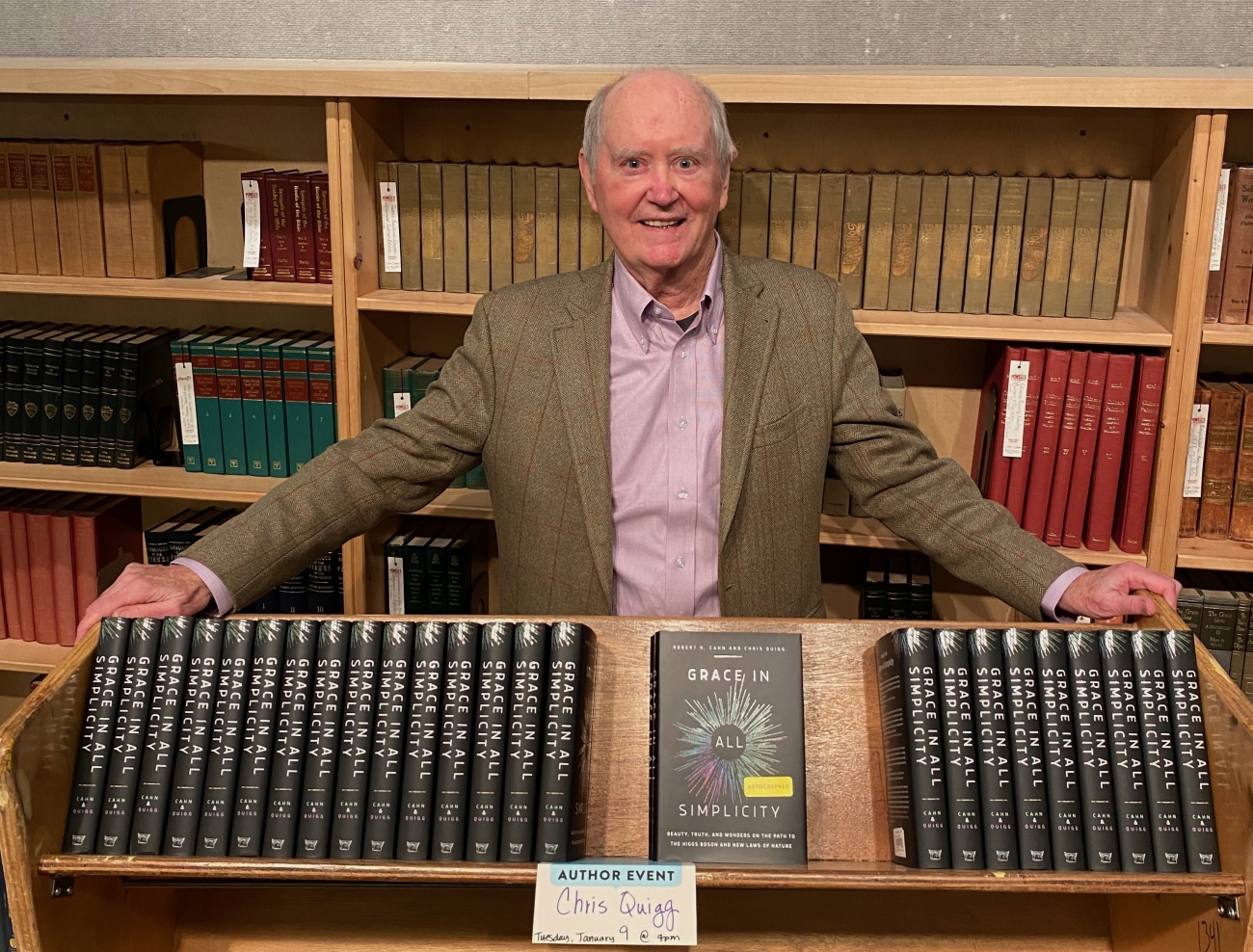
Panos Charitos: More than half a century has passed since the “November Revolution” — the 1974 discovery of the J/ψ that reshaped particle physics. In your recent keynote, you revisited that moment. Why is it so vital to remember 1974 today?
Chris Quigg: Fifty-one years ago, the announcement of the J/ψ catalysed what I would call a phase transition in our understanding of the natural world. From today’s perspective, it’s tempting to imagine that the Standard Model paradigm was already firmly established by 1980. But to those of us who were living through it, it did not feel that way at all.
Experimental hints were fragmentary. Some were misleading. The top quark hadn’t been found. Even the running of the strong coupling wasn’t securely established until the early 1990s. We were living in uncertainty.
I think it’s very important to remember that. One of the profound moments in physics is realising that Nature takes our ideas more seriously than we do. The Standard Model was not handed down in its entirety. Bold theoretical structures were gradually — and sometimes reluctantly — compelled by experiment. That’s a lesson in humility, and also in courage.
Panos Charitos: You’ve reflected candidly on the high expectations surrounding supersymmetry at the start of the LHC. Looking back, how do you view that period of optimism?
Chris Quigg: It’s natural to be hopeful when a major new instrument comes online. Enthusiasm is not a flaw; it’s one of the engines of progress in our field.
There was even a claim — with some basis in arithmetic — that eight minutes of running would be enough to find supersymmetry. Well, it didn’t happen in eight minutes. It didn’t happen in eight years. And we’re still looking.
It’s good to acknowledge that our early expectations were ambitious. We do ourselves a disservice if we present speculation as inevitability. That doesn’t mean we were foolish. But it does mean we have to be willing to say that perhaps some of us were a little over-the-top.
That kind of honesty is important — for our credibility within the community, for the students we hope to attract, and for the wider world that supports what we do.
Panos Charitos: In your recent work, you’ve urged theorists to look for “soft spots” in our understanding — places where our explanations are not fully principled. What do you mean by that?
Chris Quigg: I mean that we should be honest about where our stories rely on patches.
Take as an example supersymmetry. It’s a beautiful idea. But to make it resemble our world, we have to introduce additional features, such as R-parity to ensure proton stability, mechanisms to address the μ-problem, and ways to control flavour-changing neutral currents. Those additions may turn out to be profound — or they may signal that something more fundamental is missing.
Or consider cosmology. Inflation, dark matter, dark energy — these ideas address real observational facts. But they are still works in progress. That’s not a criticism. It’s an invitation.
We should actively seek out these “soft spots.” We should confess that we do not yet know what determines the particle content or gauge groups of the Standard Model. That confession is not weakness; it’s where discovery begins.
Panos Charitos: Let’s turn to the Higgs. You’ve described our current phase as “forensic.” Does that imply the era of big discovery is over?
Chris Quigg: Not at all. The phrase belongs to my colleague Joel Butler — who watches far too many detective shows — but it captures something real.
First we asked: does this particle exist? Now we ask: to what degree does it match the simplest Standard Model description? And what’s truly remarkable is that the 125 GeV particle fits the textbook description uncannily well. We shouldn’t be bored by that. We should be amazed and delighted. But forensic work doesn’t replace exploration. It accompanies it. We are refining branching ratios, probing self-couplings, looking for small deviations — “little nibbles,” if you like — that could point toward new mechanisms. At the same time, we’re still searching for additional Higgs states, for compositeness, for signs that the simple picture is incomplete. The exploratory phase never really ends.
Panos Charitos You’ve long advocated for an electron-positron Higgs factory — yet you’ve also said that you periodically question that conviction.
Chris Quigg: Yes. Every now and then, I lock myself in a room and ask whether it’s still true. I still believe that the Higgs is so central to our understanding that it deserves a different look — a clean environment where we can measure absolute branching fractions and the total width with high precision.
But scientific arguments must be renewed, not repeated out of habit. We have to ask ourselves: given the evolving capabilities of the LHC, and given realistic constraints, is this still what we want most? That re-examination is not doubt. It is discipline.
During my time working on the SSC, I learned two rules. First: never tell a lie. Second: express yourself clearly enough that you cannot be misunderstood. Lay out projections and scenarios, and acknowledge anticipated objections and possible complications honestly. That’s part of taking our own ideas seriously.
Panos Charitos: Some critics argue that if new physics were really nearby, we would already have seen it. How do you respond?
Chris Quigg: I think it’s healthy to be slightly skeptical of our own ideas — but not dismissive. History teaches us that sometimes signals are obvious, and sometimes they are subtle. The W and Z bosons were required by consistency; the challenge was to find them. In other cases, small anomalies accumulated over time.
We must be clear about where we make progress and where we don’t. Precision measurements may not guarantee enlightenment at a specific decimal place, but they sharpen the questions. If we were to discover that a Higgs branching ratio differed by 50%, that would clearly demand a new mechanism. Smaller deviations could be equally profound, but require more patience.
Panos Charitos: You’ve spoken with particular passion about the origin of fermion masses — even joking about awarding a Nobel Prize in chemistry.
Chris Quigg: Only half joking, really. If we could establish beyond doubt that the Higgs field is responsible for the electron’s mass, that would amount to much more than a triumph for high-energy physics. It would illuminate something profoundly fundamental about the world we inhabit. The electron mass is not an abstract parameter: it helps determine the size of atoms, the structure of matter, and, in a very real sense, the conditions that make chemistry and life possible. So if we were to understand this connection definitively, we would not simply be learning something about particle physics — we would be clarifying why ordinary matter is stable and why the material world takes the form it does.

For Chris Quigg, flavour physics remains one of the Standard Model’s great unfinished stories: rich in precision, but still waiting for the deeper idea that could unify what we know about quarks and leptons. The same physics that governs the electron’s mass also determines the structure of atoms, the chemistry of molecules — and, ultimately, the living matter we encounter in everyday life.
That is why I sometimes say, only partly in jest, that such a discovery would deserve a Nobel Prize in chemistry. It would connect the microscopic mechanism of mass generation to the entire architecture of the visible world.
And the story does not end there. Once one begins to ask how the Higgs field gives mass to fermions, one is naturally led to other deep questions about the Higgs sector itself. For example, measuring the Higgs self-coupling is not just a technical objective for a future collider programme. It bears directly on our understanding of the Higgs potential and, therefore, on the history of the early universe.
That opens a particularly fascinating line of inquiry: whether the electroweak phase transition may have played a role in generating the matter–antimatter asymmetry we observe today. In other words, collider measurements of the Higgs boson may help us probe not only the internal consistency of the Standard Model, but also the cosmic processes that shaped the universe in its earliest moments. To me, that is one of the most exciting things about this field — the way apparently specialised measurements at colliders can speak to the largest imaginable questions, linking the structure of matter to the history of the cosmos.
Panos Charitos: You’ve also expressed a “quiet frustration” with flavour physics. Could you elaborate on that?
Chris Quigg: Yes—“frustration” may be too strong a word, but there is certainly a sense of incompleteness. At least twenty parameters of the Standard Model are associated with flavour: the masses of quarks and leptons, the elements of the CKM matrix, and their neutrino-sector counterparts. Over the years, we’ve measured many of these quantities with extraordinary and steadily improving precision. In that sense, it’s been a remarkable experimental success.
And yet, I find it difficult to articulate the deeper, organising question behind all this information. What is the underlying principle that determines these values? Why do the fermions have the masses and mixings that they do? The Standard Model accommodates them beautifully, but it does not explain them.
Another aspect that has always struck me is the relative separation between the quark and lepton communities. These sectors are often studied in parallel, but not always in concert. I have a lingering suspicion that if we were to truly combine what we know about both—placing them within a single, coherent framework—there might be something important waiting to be uncovered.
Of course, there has been no shortage of theoretical ideas. Many of them are imaginative, some are elegant, and most are likely incomplete or simply wrong. But that is the nature of exploration. To me, this is not a failure of the field—it is unfinished business. It suggests that flavour physics still holds the potential to reveal something fundamental, perhaps even transformative, about the structure of the theory.
Panos Charitos: Finally, what would you say to the next generation entering the field?
Chris Quigg: Some imagine that, once the keystone of the Standard Model of particle physics—the Higgs boson—has been set, our subject is over. Others worry that we may be at an impasse because no comparable wonders have appeared, leaving us without well-defined clues to a more complete paradigm. I am neither so readily satisfied nor so easily discouraged. We have much more to learn. I hope for stories of ferment, promise, invention and discovery.
Particle physics is a global human effort. What we discover belongs to everyone. But progress requires discipline — the discipline to test our principles, to question our assumptions, to acknowledge uncertainty, and to renew our arguments.
That, to me, is what it means to take our ideas seriously.


