
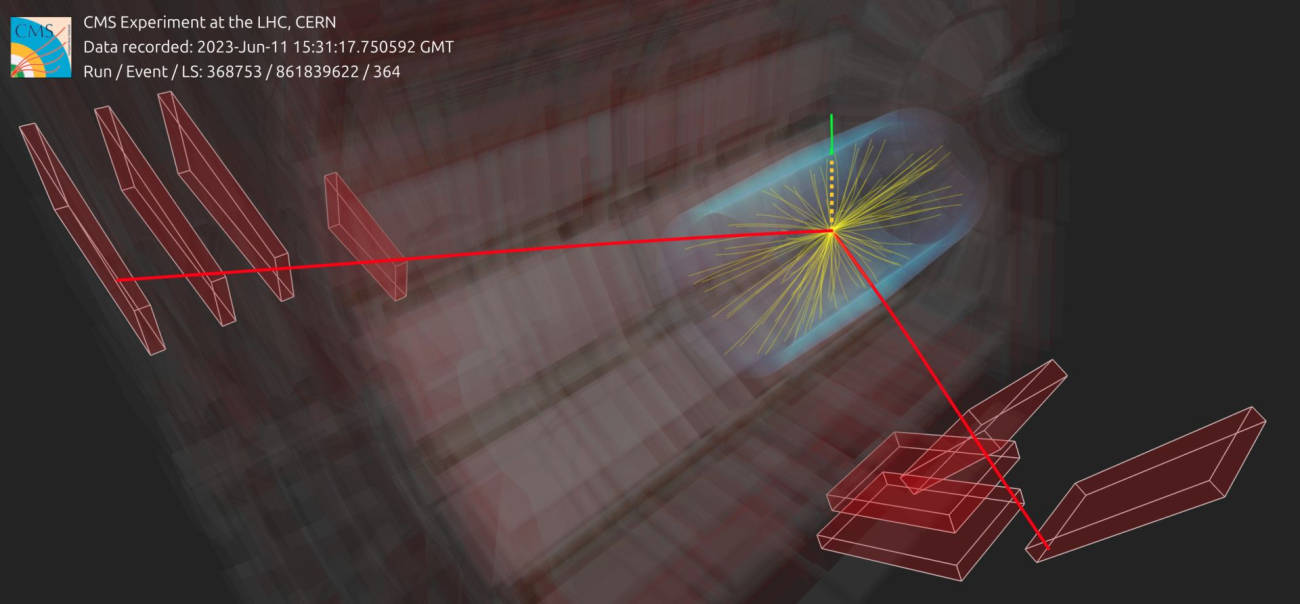
The search for this elusive process has been underway for many years. The CMS results presented here represent the most sensitive study to date, pushing the boundaries of what can be measured at the LHC. The findings are consistent with standard model predictions and suggest that a definitive observation of the H → Zγ decay could be achieved within the first years of operation of the High-Luminosity LHC (HL-LHC).
The 2012 discovery of the Higgs boson at CERN by ATLAS and CMS was a milestone in the understanding of the laws of the universe - but it marked only a beginning. With a mass of 125 GeV, the Higgs boson is light enough to be produced abundantly at the LHC, yet heavy enough to decay into a wide variety of other particles. Precise measurements of the rates at which it decays into these different final states provide some of the most stringent tests of the standard model and offer powerful opportunities to uncover signs of physics beyond our current understanding.
One of the rarest and most intriguing decays of the Higgs boson occurs with the production of a Z boson and a photon. This decay is particularly noteworthy because it is the only process that directly involves all three neutral bosons of the standard model: the photon (the mediator of electromagnetism), the Z boson (a mediator of the electroweak interaction), and the Higgs boson. Unlike many other decays, this one does not occur directly but proceeds via a loop of virtual particles, as shown in Figure 1 (left). Even heavy, yet-to-be-discovered particles can participate in the loop, providing a particularly sensitive window into potential new physics.
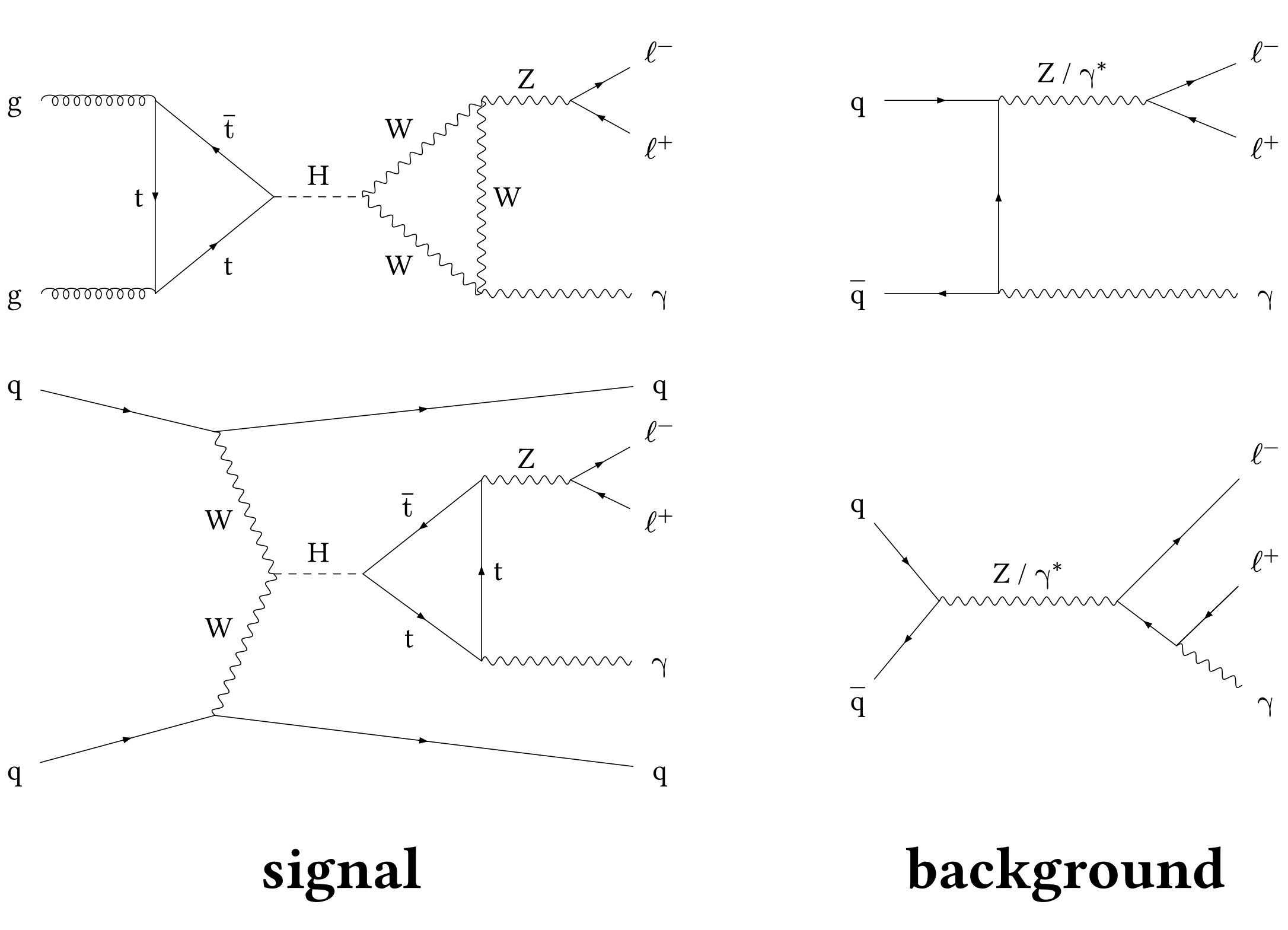 Figure 1: Examples of Feynman diagrams illustrating background and signal processes. In signal processes, some Higgs boson production modes include additional particles in the final state that are used for categorisation, as seen in the bottom-right diagram.
In particle physics, confidence in a result is quantified by its statistical significance, typically expressed in units of standard deviations (σ), which measure the probability that an observed signal arises from random background fluctuations. By convention, evidence for a new phenomenon is established at more than 3σ, while an observation requires at least 5σ, corresponding to fluctuation probabilities of about 0.13% and 0.00003%, respectively. Despite more than a decade of data taking and the production of over 20 million Higgs bosons — including some in datasets still to be analysed — the H→Zγ decay has not yet been observed.
The search has, however, already reached an important milestone. CMS and ATLAS have combined their search results for this rare decay from the LHC Run 2 datasets (138 fb−1), reaching a statistical significance of 3.4σ and therefore claiming evidence. The ratio of the measured number of events to the standard model prediction, called “signal strength”, was found to be μ = 2.2 ± 0.7, deviating from the theoretical expectation (μ = 1.0 ± 0.6) and adding further interest to the new results. More recently, ATLAS has reported updated H→Zγ results using part of its Run 3 dataset (2022-2024), reaching a combined Run 2 and Run 3 observed significance of 2.5σ and measuring a signal strength of μ = 1.3+0.6−0.5.
The challenge is the process's extreme rarity. The H->Zγ occurs approximately once every thousand Higgs boson decays. In turn, the Z boson also decays into other particles: only when these are a pair of electron-positron or a pair of muon-antimuon, which happens in total slightly less than 7% of the time, the decay can be reconstructed with the precision required for this analysis. As a result, there are only about 80 Higgs bosons every million that can be well measured in Zγ.
In addition, other processes can produce events with the same final-state particles, making them experimentally indistinguishable from the signal. These background events mainly arise from collisions between two protons that directly produce a Z boson, in association with either a photon or jets misidentified as photons. For the analysis described here, consisting of Run 2 and early Run 3 data for a total integrated luminosity 200 fb−1, approximately 300 H → Zγ events are expected, compared to about 80 000 background events. Advanced analysis techniques are therefore required to measure this rare signal with maximal sensitivity.
The photon and the pair of leptons are combined to determine the H boson candidate invariant mass. As shown in Figure 2, the H→Zγ appears as a peak at 125 GeV, the mass of the Higgs boson, while the background follows a smoothly falling distribution, as it does not originate from a single particle. To avoid bias due to signal expectations, the analysis is performed in a blind manner. This means that the region around the Higgs boson mass is not examined in data until all analysis procedures have been finalised and validated using simulations and data from regions outside the signal region (sidebands).
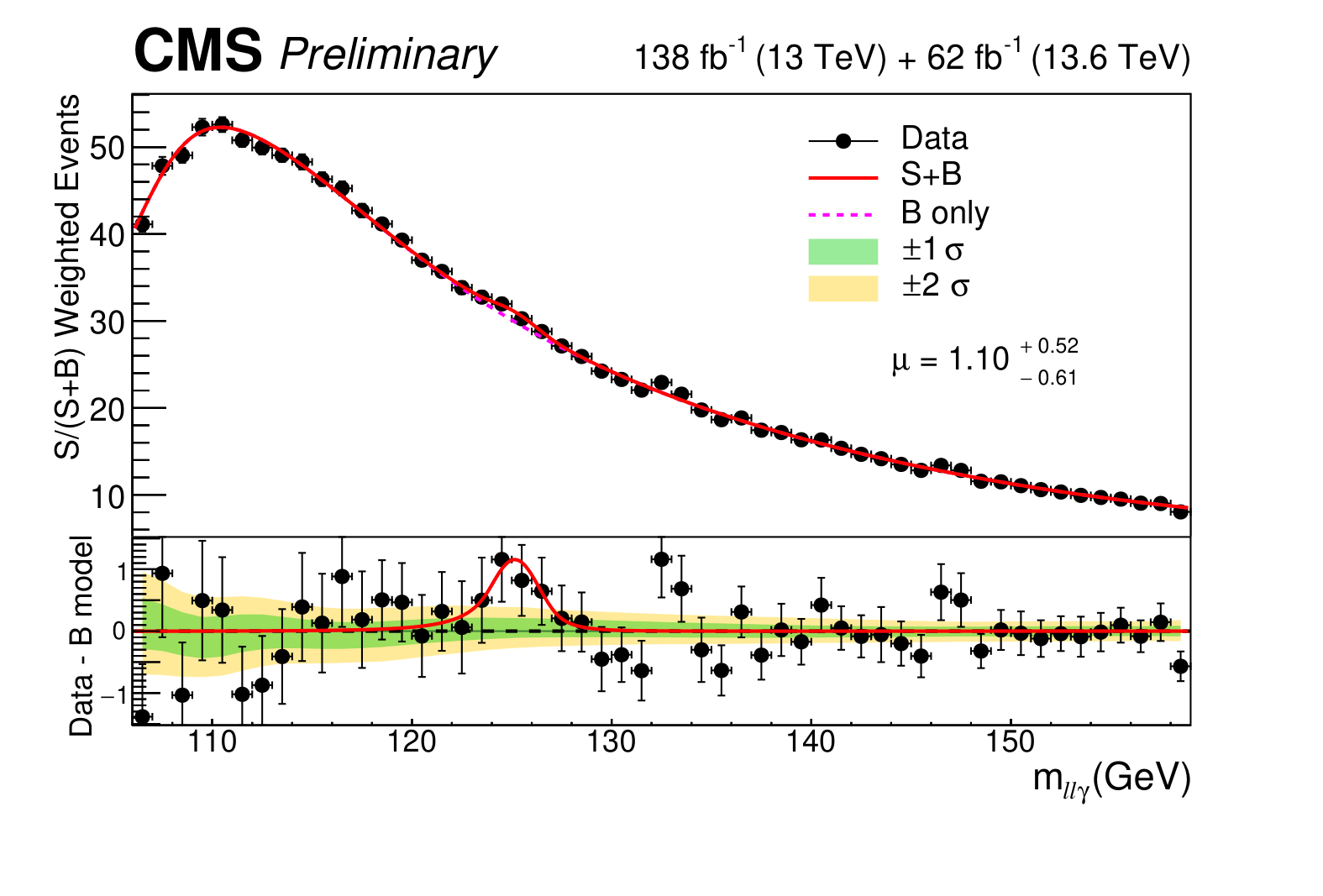 Figure 2: Invariant mass of the final state particles in a simultaneous fit of signal plus background model for all categories of the analysis.
To enhance the sensitivity of the analysis, events are divided into several categories targeting different Higgs boson production mechanisms. This categorisation is achieved through orthogonal selections based on relevant kinematic observables. The production mechanisms include gluon–gluon fusion (ggF), characterized by low jet multiplicity and little missing transverse energy (a signature of particles such as neutrinos that escape detection and therefore leave an apparent imbalance in the event); vector boson fusion (VBF), featuring two additional forward jets from the scattered quarks; associated production with a W or Z boson, where additional leptons from the boson decay or missing transverse energy from neutrinos can be present; associated production with a top–antitop quark pair (ttH), featuring additional jets and/or leptons from the top quark decays.
The presence of additional particles in VBF, VH, and ttH production modes leads to more distinctive event topologies than background processes, thereby increasing the signal-to-noise ratio in these categories and, consequently, the overall analysis sensitivity. Events classified as ggF and VBF are then further divided using boosted decision trees (BDTs) trained on simulated samples of signal and background. The BDT score is used to define subcategories, with higher-score regions corresponding to a greater signal purity and lower-score regions being more background-dominated.
The observed number of H→Zγ events is extracted by fitting the invariant mass shape for signal and background to the data, where one expects to find a peak in correspondence of the Higgs boson mass. The signal shape is obtained from simulation and is described with a parametric function. The background is estimated directly from the data sidebands and is modelled by several possible functional forms. All categories are fitted simultaneously to extract the signal strength. The Higgs boson mass is fixed in the fit to mH=125.38 GeV, the most precise value measured by CMS at the time of publication. The choice of the background functional form is included as an additional source of uncertainty in the final result.
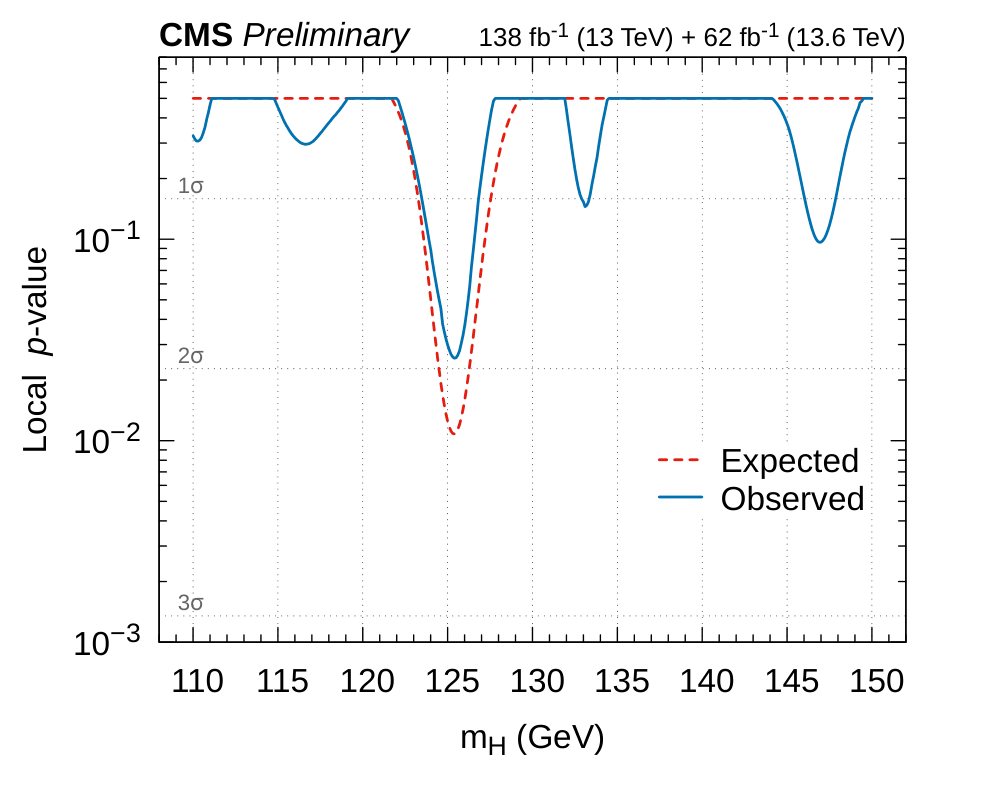 Figure 3: Local p-value scan showing the likelihood of a random fluctuation of the background leading to the observed data at a given Higgs boson mass hypothesis. The observed significance at the Higgs boson mass of 125 GeV is 1.9σ, consistent with theoretical expectations and below the thresholds required for evidence (3σ) and observation (5σ).
This latest CMS analysis represents a major step forward. For the first time, it includes data from part of Run 3 of the LHC. However, the improvement in sensitivity is not driven solely by the addition of new data. The Run 2 dataset has been reprocessed with improved calibrations, upgraded tagging algorithms, and refined analysis strategies, squeezing every bit of information from the full joint sample. In particular, the analysis employs additional triggers, refined event categorisation using advanced machine-learning techniques targeting all Higgs boson production modes, and an extended background validation strategy. As a result, despite using only a fraction of the available Run 3 data (2022-2023), the analysis achieves a sensitivity comparable to that of the most precise measurement of this rare decay to date, including the recent ATLAS results. Together, these advances show that the LHC experiments are steadily approaching the sensitivity needed to establish the H→Zγ decay.
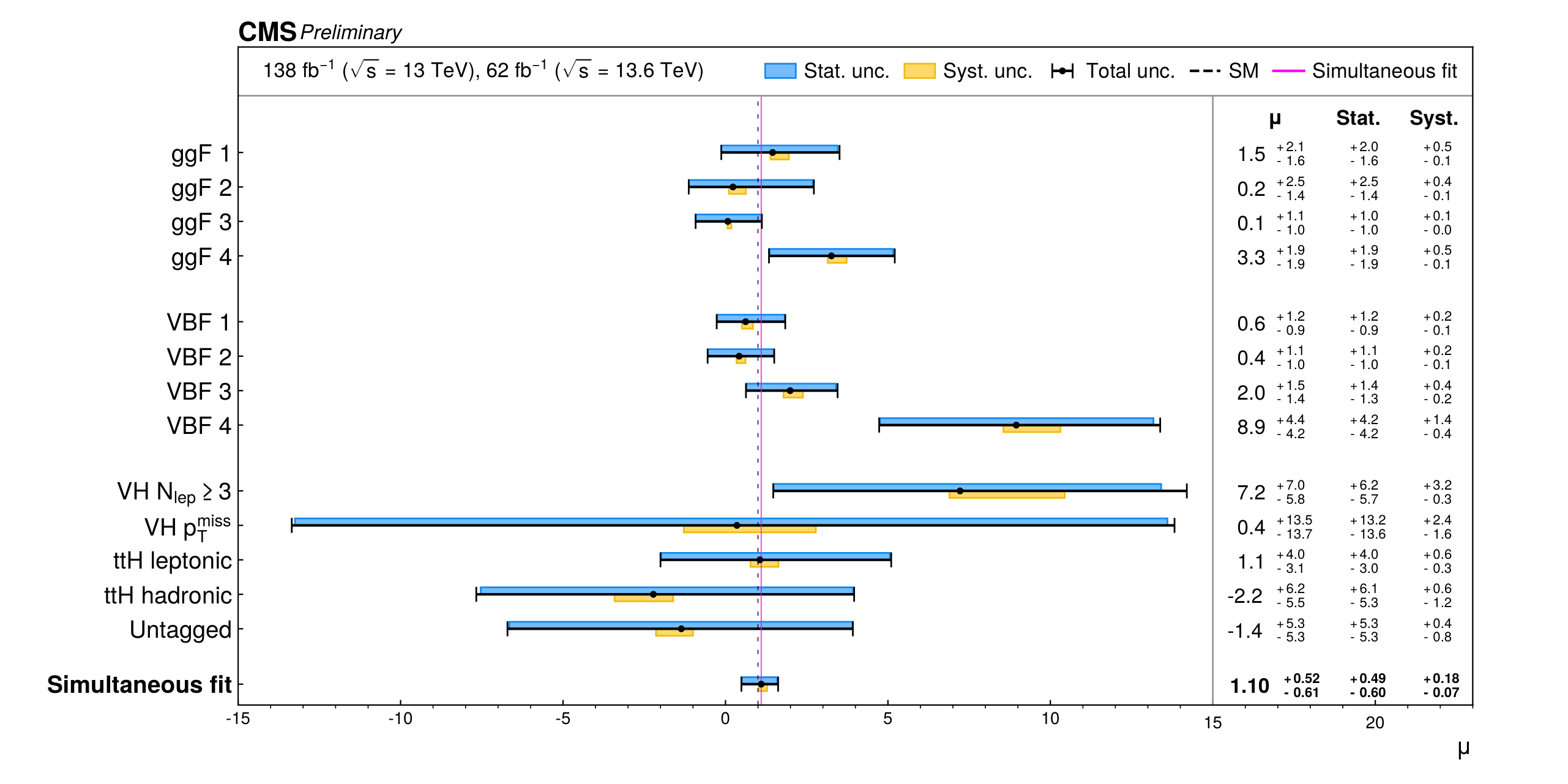 Figure 4: Compatibility of the results across event categories, obtained from independent fits performed in each category, as opposed to a simultaneous fit of the full analysis. The figure demonstrates good consistency of the signal strength measurement across all categories.


