
ALICE reveals quark-gluon plasma energy loss in OO collisions
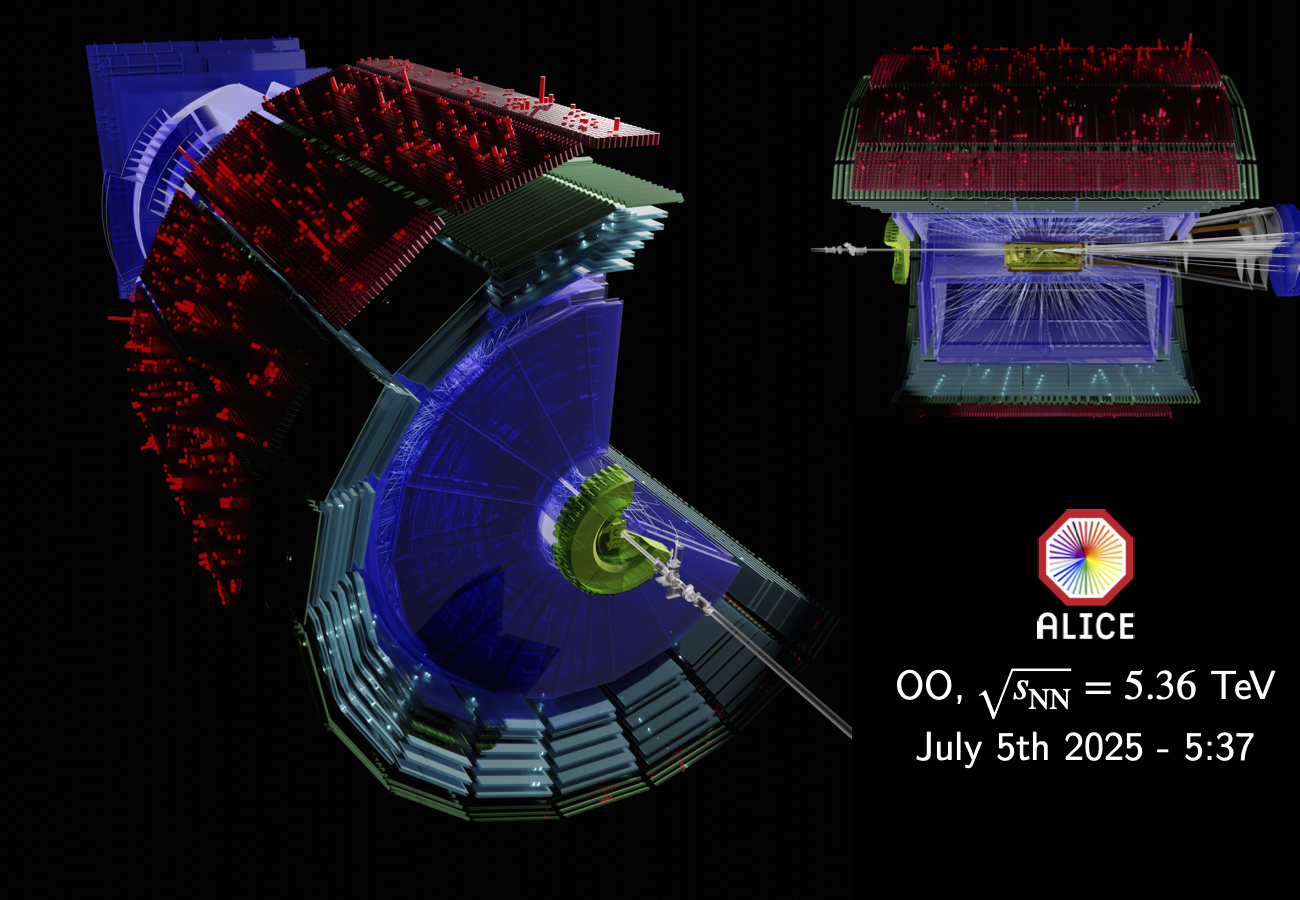
A new state of matter
Colliding heavy ions, such as lead, at nearly the speed of light in the LHC allows the creation of a new state of matter called the quark-gluon plasma (QGP). This near-perfect liquid of quarks and gluons is created because the extreme temperatures reached in these collisions are large enough to deconfine the quarks and gluons normally bound in hadrons. Studying the QGP offers unique insights into our early universe, only a few microseconds after the Big Bang, with temperatures more than 100,000 times hotter than in the centre of the Sun.
Parton energy loss: A smoking gun for QGP formation
Over the last decade, this new state of matter has been studied at the LHC with increasing precision [1], revealing the microscopic and macroscopic properties of this medium. In each year of LHC operation, about one month was dedicated to heavy-ion operation, where lead ions serve as the main workhorse driving the experimental program forward. One key observable is parton energy loss that is not only a “smoking gun” for the creation of the QGP, but also a key probe for its microscopic properties: Partons created in the initial hard scattering of the collision traverse the formed QGP and lose energy through interactions with the constituent partons of the medium. As partons fragment into sprays of hadrons (“jets”), this energy loss can be observed as a reduction of the jet energy as a whole, and in the spectra of individual hadrons.
This energy loss is commonly quantified by comparing the production yields of jets or hadrons in heavy-ion collisions with those in proton-proton (pp) collisions, where the latter serves as a reference for a system where the QGP should not be formed. In particular, the nuclear modification factor RAA is used, which is an appropriately scaled ratio of the production yields in heavy-ion collisions with respect to pp collisions. The scaling is chosen in a way that deviations from unity indicate the presence of nuclear effects in the collisions, i.e. RAA < 1 signals suppression of particle production. For Pb-Pb collisions, significant suppression of the jet and hadron production cross sections has been observed experimentally, highlighting that the QGP is formed in this system.
What is the smallest system that can produce a droplet of QGP?
While significant energy loss has been observed for collisions of heavy ions such as lead (Pb-Pb) and xenon (Xe-Xe), no clear signals of energy loss have been observed in smaller collision systems, such as for example proton-lead collisions. It is therefore natural to ask: What is the smallest system that can produce a droplet of quark-gluon plasma?
To answer this question, the LHC collided oxygen ions for the first time in July 2025. Oxygen sits at a frontier for these energy loss searches, providing a collision system that is larger than p-Pb but significantly smaller than Pb-Pb. In addition to oxygen-oxygen collisions at a centre-of-mass energy of 5.36 TeV per nucleon pair, the LHC also provided proton-oxygen collisions at a centre-of-mass energy of 9.62 TeV per nucleon pair.
ALICE probes partonic energy loss with neutral pions
New experimental results from the ALICE collaboration, recently published as a preprint and submitted for publication [2], provide evidence of QGP-induced energy loss in oxygen-oxygen collisions. This is a significant finding, as it highlights that the formation of a QGP droplet, previously thought to be reserved for collisions of the largest nuclei, is possible in collisions of nuclei as small as oxygen, which is 13 times less massive than lead. This has been achieved by measuring neutral pion production in pO and OO collisions, as well as in the pp reference system.
Neutral pions are well-understood, calibrated and abundantly produced particles at the LHC, which can be reconstructed via their decay to two photons with the ALICE electromagnetic calorimeter (EMCal). They are sensitive to parton energy loss because they hadronise from the outgoing parton during fragmentation. This makes them an excellent probe for searching for a parton energy-loss signal in OO collisions.
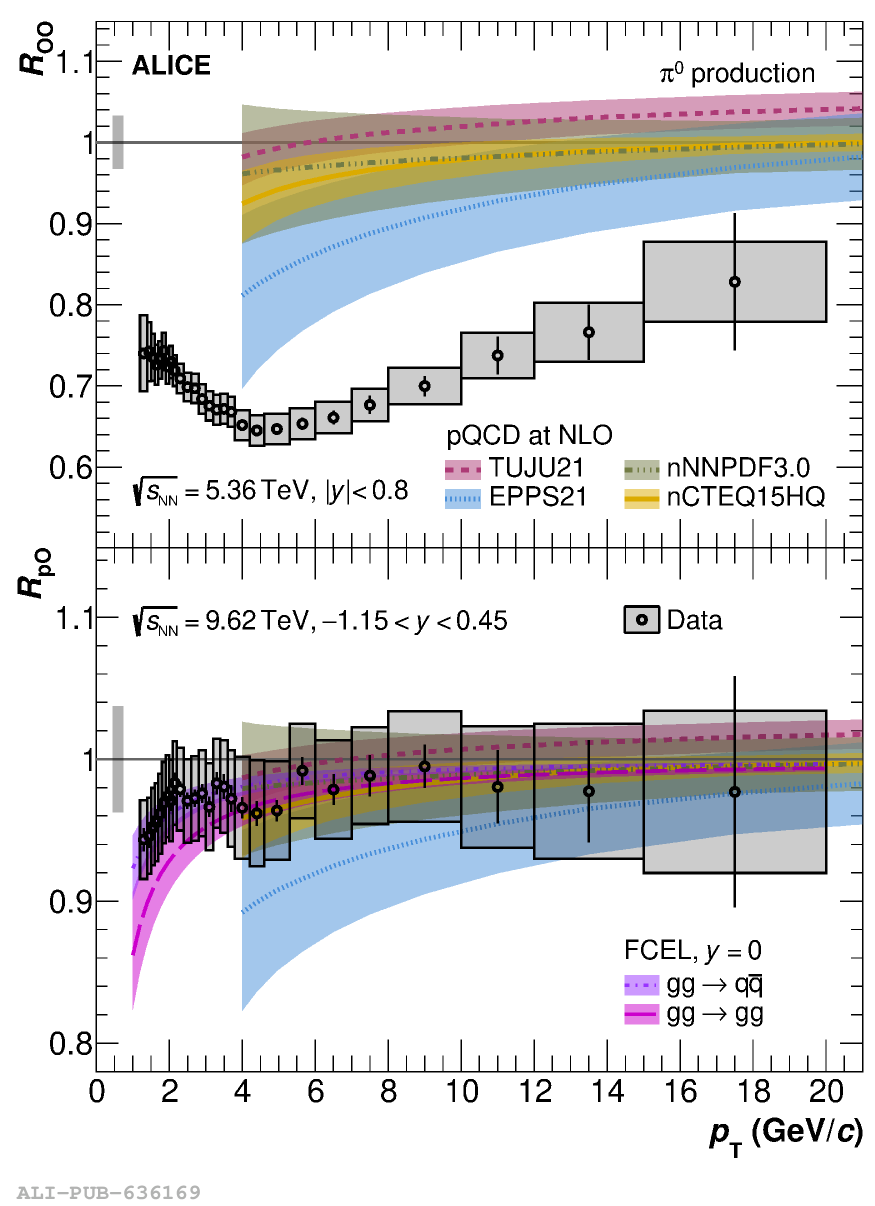
The top panel of the figure above shows the nuclear modification factor, ROO, for π0 production in OO collisions at a centre-of-mass energy of 5.36 TeV per nucleon pair. The line at unity indicates the expectation in the absence of any nuclear effects, i.e. a scenario where a collision of ions is merely a superposition of many pp collisions.
Deviations from unity indicate the presence of nuclear effects. As can be seen, the measured neutral pion ROO is significantly reduced with respect to unity — a clear indication for the presence of nuclear effects. But how do we know that these deviations originate from parton energy loss and not another effect?
Disentangling energy loss from cold-nuclear matter effects
The difficulty in answering this question is illustrated by the curves in the top panel, which show pQCD predictions where no parton energy loss is implemented. Instead, deviations from unity arise from the initial parton densities encoded in nuclear parton distribution functions (nPDFs), which are modified relative to the proton PDF, e.g. due to gluon shadowing in the nucleus. As can be seen, sizeable suppressions can be achieved through these so-called cold-nuclear matter (CNM) effects. Unfortunately, these predictions are subject to sizeable uncertainties, underscoring the lack of experimental data to constrain nPDFs for oxygen.
This means that it is not enough to show a deviation from unity to make definitive statements about the presence of energy loss; instead, one needs to observe a significant suppression beyond that predicted by models incorporating CNM effects. To tackle this problem, ALICE also measured, for the first time, the nuclear modification factor RpO for neutral pion production in pO collisions at a centre-of-mass energy of 9.62 TeV, as shown in the bottom panel of Figure 1. While this ratio is sensitive to CNM effects, the system is expected not to be large enough to lead to significant parton energy loss. Therefore, the measurement in this system offers a data-driven way to constrain the magnitude of CNM effects in oxygen, and one indeed sees no sizeable suppression within uncertainties at high transverse momentum.
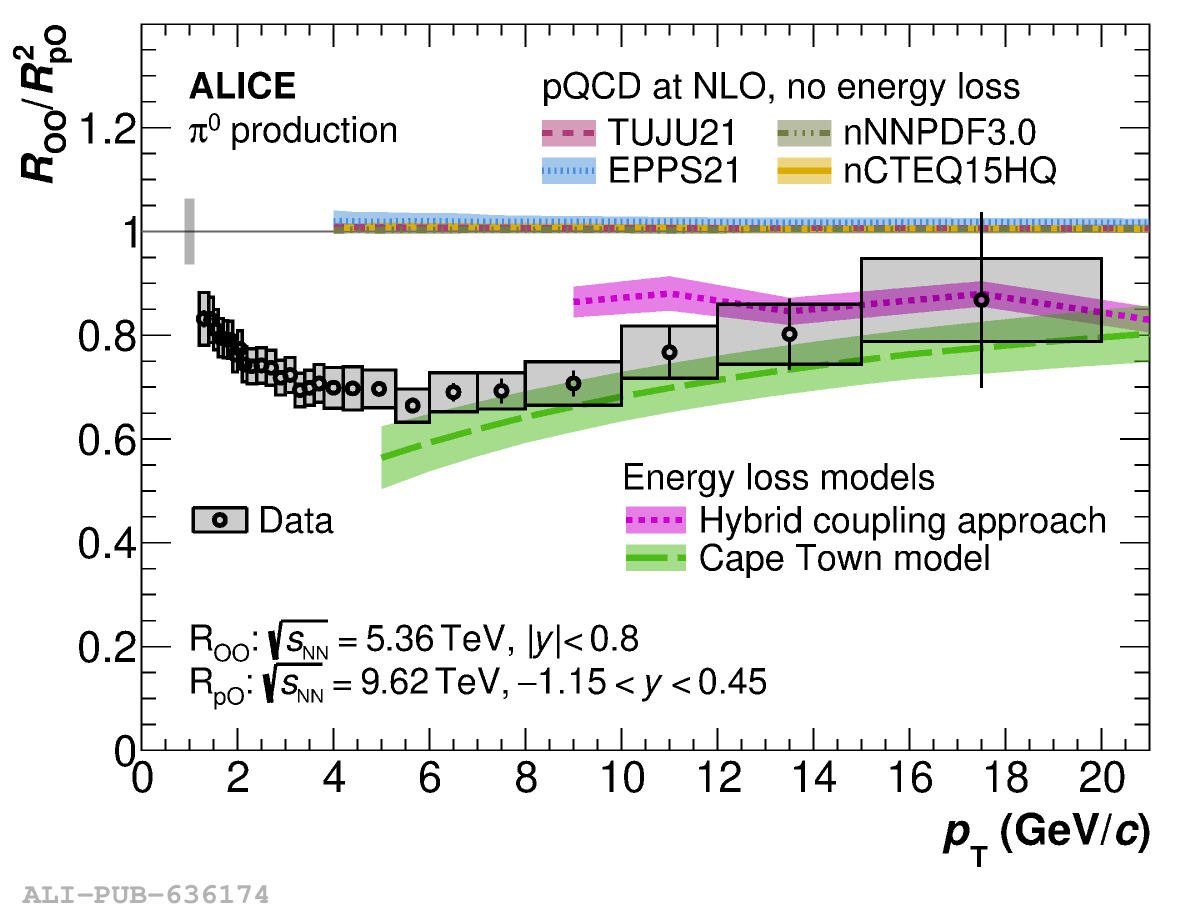
As a final step, the double ratio ROO/RpO2 is constructed, which is shown in Figure 2. The squaring of RpO accounts for the two oxygen nuclei present in OO collisions, each contributing CNM effects comparable to those in a single pO collision. This ratio offers excellent cancellation of CNM effects, as is highlighted by the “no energy loss” pQCD predictions all centred around unity with small uncertainties.
Remarkably, the measured double ratio deviates from the baselines without energy loss, with a significance of 4.9σ, highlighting that CNM effects cannot explain the observed suppression. In addition, theoretical models incorporating parton energy loss describe both the magnitude and shape of the suppression. This corroborates the evidence for parton energy loss in the smallest collision system studied so far, indicating that a QGP droplet can be formed in much smaller systems than previously imagined – opening a new chapter in the exploration of strongly interacting matter and our understanding of QGP formation thresholds.
Further Reading
[1] ALICE Collaboration, “The ALICE experiment: a journey through QCD,” European Physical Journal C 84, 813 (2024). DOI: 10.1140/epjc/s10052-024-12935-y. arXiv:2211.04384 [nucl-ex].
[2] ALICE Collaboration, “Evidence for parton energy loss in oxygen-oxygen collisions at √sNN = 5.36 TeV,” arXiv:2606.19967 [nucl-ex] (2026), submitted to Physical Review Letters, doi:10.48550/arXiv.2606.19967.


