
New ATLAS and CMS searches close the gap for compressed higgsinos
Supersymmetry plays a prominent role in the landscape of models that push beyond the Standard Model. Higgsinos, the supersymmetric partners of the Higgs boson, may help in addressing a number of unsolved puzzles, particularly if their masses are near the electroweak scale. Not only would they provide a mechanism to stabilise the Higgs boson mass, but they could also provide a dark matter particle candidate consistent with the observed thermal relic density.
An extensive search program has been carried out in search of supersymmetry at the LHC, providing important constraints and targets for further searches. Low mass superpartners are constrained, but a sector featuring higgsino states with small, “compressed” mass spectra that yield low-momentum signatures remains largely uncovered, due to challenges in particle reconstruction and identification that severely limit signal acceptance.
Higgsino states would mix with the superpartners of the electroweak gauge bosons to form electrically neutral and charged particles known as neutralinos (χ̃01, χ̃02) and charginos (χ̃±1). Charginos and neutralinos are pair-produced, and their mass hierarchy is assumed to be m(χ̃02) > m(χ̃±1) > m(χ̃01), with Δm(χ̃±1, χ̃01) = Δm(χ̃02, χ̃±1). The lightest chargino (χ̃±1) and the second-lightest neutralino (χ̃02) decay to the lightest neutralino (χ̃01), a stable massive particle representing the dark matter candidate.
Using the full Run 2 datasets, the searches presented here target higgsino production in association with a high-momentum jet from initial-state radiation. Although this requirement reduces the signal acceptance, it enforces the higgsino production system to be oriented in one direction opposite of the jet, making it easier to detect the momentum of invisible χ̃01 particles as “missing transverse momentum” and thus enhancing the signal sensitivity.
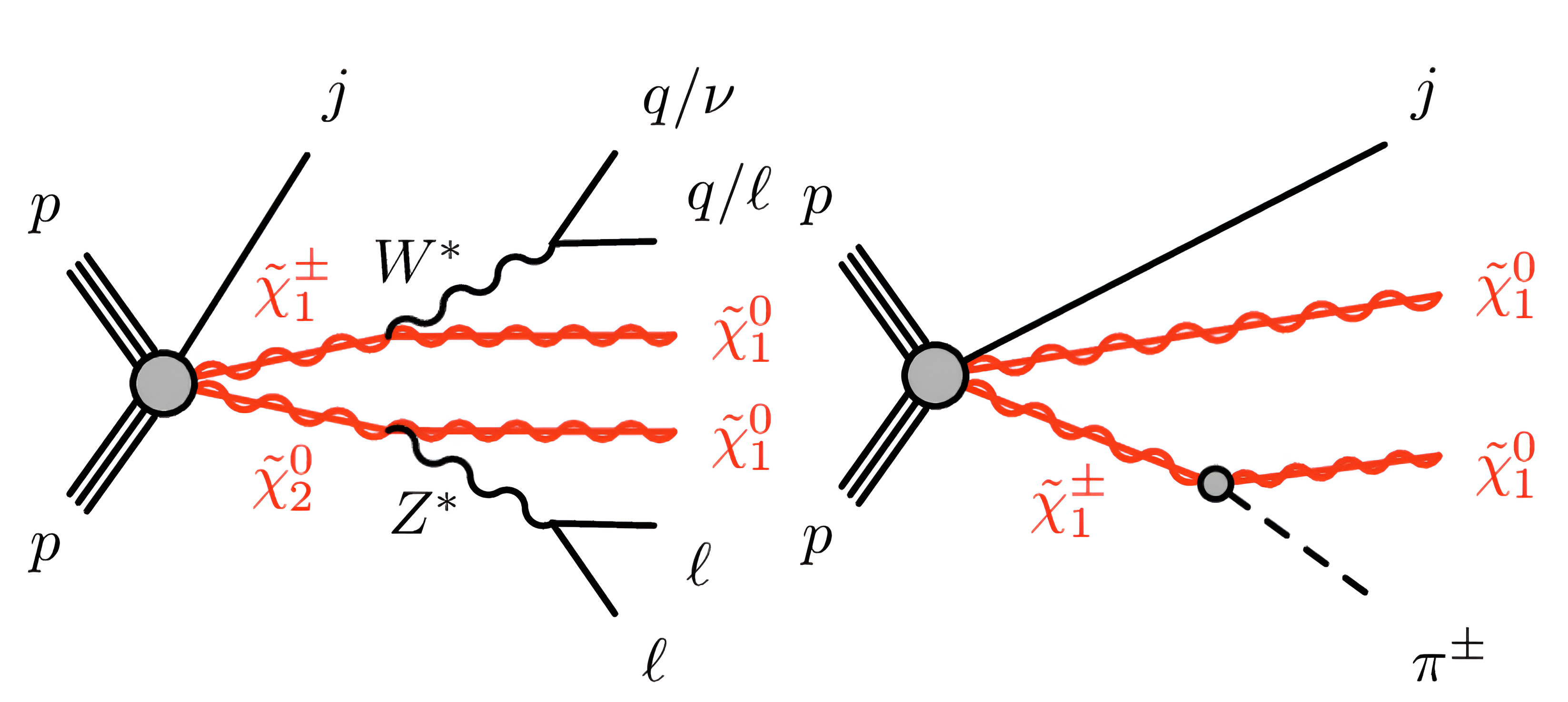
Figure 1: Example diagrams for compressed-higgsino production in association with a jet from initial-state radiation. The left diagram shows χ̃±1χ̃02 production with subsequent decays into soft fermions. The right diagram, relevant for very small mass splittings, shows χ̃±1χ̃01 production where the χ̃±1 can be long-lived and decay into a soft charged pion. The χ̃01 particles remain undetected, producing a missing transverse momentum signature.
ATLAS+CMS Soft Leptons
To search for models with a mass difference of a few GeV between the χ̃02 and χ̃01, the standard method is to identify the low-momentum lepton pair emitted from the χ̃02 → ℓ+ℓ−χ̃01 decay, in addition to the missing transverse momentum originating from the invisible χ̃01 particles. However, identification of leptons with a few GeV has faced experimental difficulties due to the significant amount of low-momentum hadron background at the LHC, leading to limited sensitivity to higgsinos. The two experiments have overcome this challenge by developing state-of-the-art low-momentum lepton identification algorithms.
The “one-lepton-one-track” (1ℓ1T) [1] search from the ATLAS experiment introduces dedicated low-momentum electron and muon identification algorithms developed using neural networks (NNs). The new algorithms exploit information from inner-detector tracks and calorimeters as inputs to the NN, maximising the separation between leptons and background hadrons. The algorithms are applied to one of the two leptons emitted from the higgsino decay, with momenta as low as 0.5 GeV for electrons and 1 GeV for muons, beyond the standard reconstruction thresholds. This results in a signature consisting of one lepton and one lepton-like track. In addition, a parametrised NN is used for event classification by exploiting the kinematic features of these signatures, which strongly depend on the higgsino mass difference, thereby further enhancing sensitivity. The 1ℓ1T search excludes a region with 0.8 GeV < Δm(χ̃±1, χ̃01) < 2.0 GeV, marking it as the first ATLAS search to probe such regions. The limits reach up to a maximum of m(χ̃±1) = 132 GeV for Δm(χ̃±1, χ̃01) = 1.8 GeV.
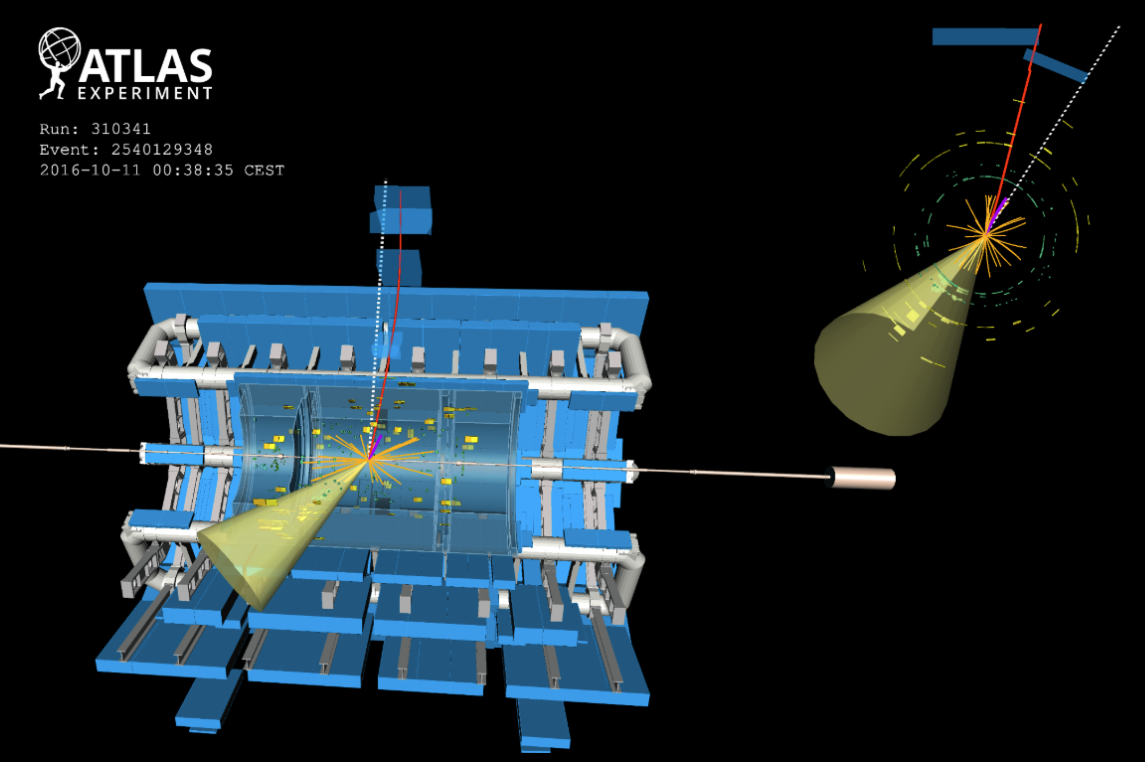
Figure 2: A candidate higgsino event in the signal region of the ATLAS 1ℓ1T search, requiring one standard muon (red) and one muon-like inner-detector track (purple) [1]. The dashed white line indicates the missing transverse momentum, recoiling off the high-pT jet illustrated by the yellow cone.
The CMS “ultra-soft-electrons” search [CMS-EXO-23-017] extends a previous version of the two-light-lepton opposite-sign (2ℓOS) search by using a dedicated electron reconstruction and identification algorithm. Electrons in CMS are reconstructed using the standard Particle Flow (PF) algorithm; to recover the efficiency loss for low-transverse-momentum electrons, an additional algorithm (“LP electron reconstruction”) was specifically developed. The LP electron candidate reconstruction starts with a combination of two boosted decision trees (BDTs), which are trained on samples of low-pT electrons, resulting in looser reconstruction requirements than those used for PF electrons. Multivariate identification algorithms are then developed independently for both the PF and LP candidates. Thanks to this new extension, the electrons (muons) are required to have pT > 1 (3.5) GeV, and the exclusion limits at 95% confidence level extend the LEP exclusion in chargino mass down to Δm(χ̃±1, χ̃01) of 0.5 GeV.
The “ultra-soft-muon” search [CMS-SUS-24-003] contributes as the muonic component of the CMS program, recovering events where muons with pT as low as 2 GeV, or emitted with a small angle between them, spoil their isolation. The analysis identifies pairs of muons where at least one muon can only be reconstructed in the endcap, due to its small pT; collinear dimuon pairs with small opening angle; and isolated inner-tracker tracks as stand-ins when one lepton is not fully identified. BDT discriminants combine the dimuon mass, angular separation, event recoil, and track information to reject Standard Model and misreconstruction backgrounds.
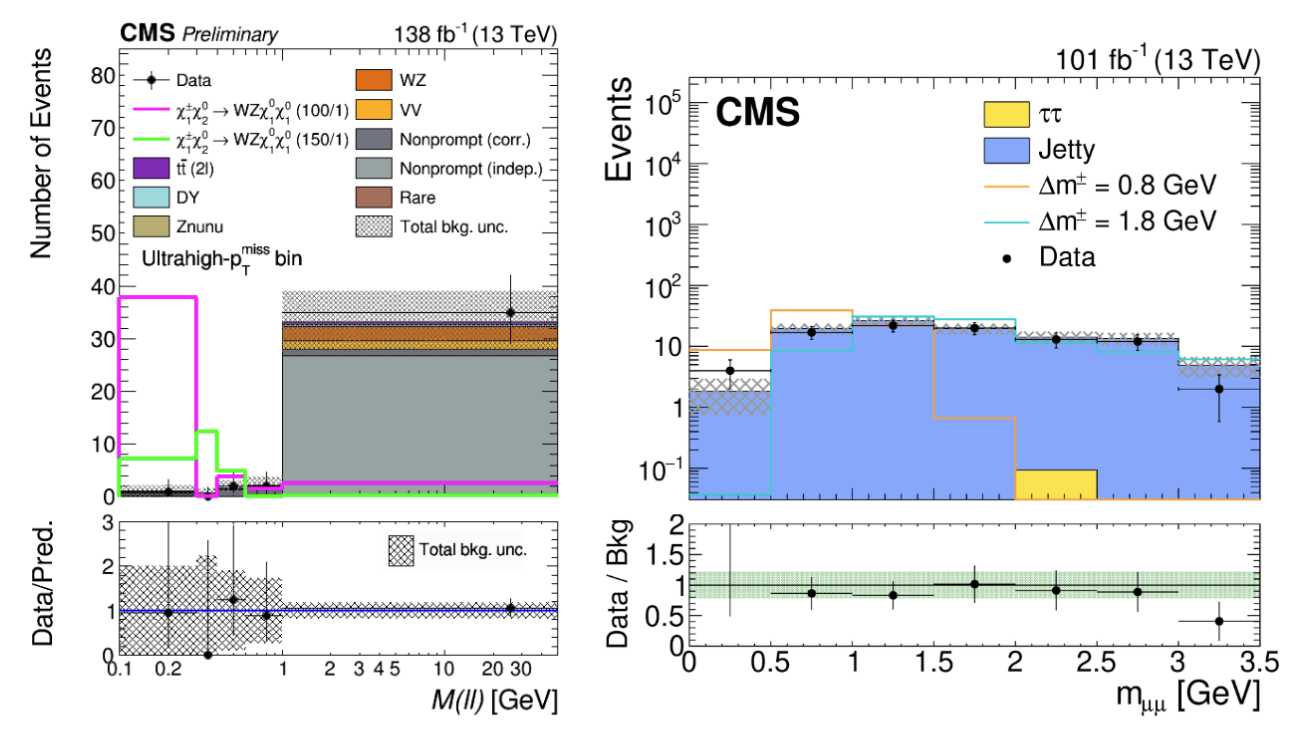
Figure 3: (Left) Ultra-soft-electrons search [2]: postfit m(ℓℓ) distribution of the dielectron signal region for the ultrahigh missing transverse energy selection. Prefit signal distributions from similar signal model (wino/bino) hypotheses are shown. (Right) Ultra-soft-muon search [3]: prefit expected and observed dimuon invariant-mass distribution in the signal region, shown with two representative higgsino signal benchmarks.
ATLAS+CMS Displaced Track
For a lower mass difference between the χ̃±1 and χ̃01, a “displaced track" search strategy is exploited. With a Δm(χ̃±1, χ̃01) between 0.3 and 1 GeV, the χ̃±1 has a non-negligible lifetime and can travel a few millimetres before decaying into an invisible χ̃01 and a low-momentum charged pion (momentum lower than 5 GeV). The experimental signature is a track from the pion with a large transverse impact parameter and high missing transverse momentum from the neutralinos.
CMS [4] addresses the historical sensitivity gap soft-pion signature with an isolated low-momentum track, using a parameterized multi-class neural network that exploits track kinematic and displacement related variables to sort tracks into signal-like pions, tau-decay tracks, prompt or secondary tracks from the primary vertex, and spurious (fake track) categories. The tau-track class provides a signal-like proxy for checking how well the simulation models displaced, isolated tracks. A second machine-learning step then refines the simulation, with a regression network morphing track observables so that the corrected simulation better matches data in control samples. With the Run 2 data, CMS excludes chargino masses up to 185 GeV and mass splittings from 0.28 to 1.15 GeV for a 100 GeV chargino, demonstrating sensitivity in the narrow region between conventional soft-lepton searches and disappearing-track signatures.
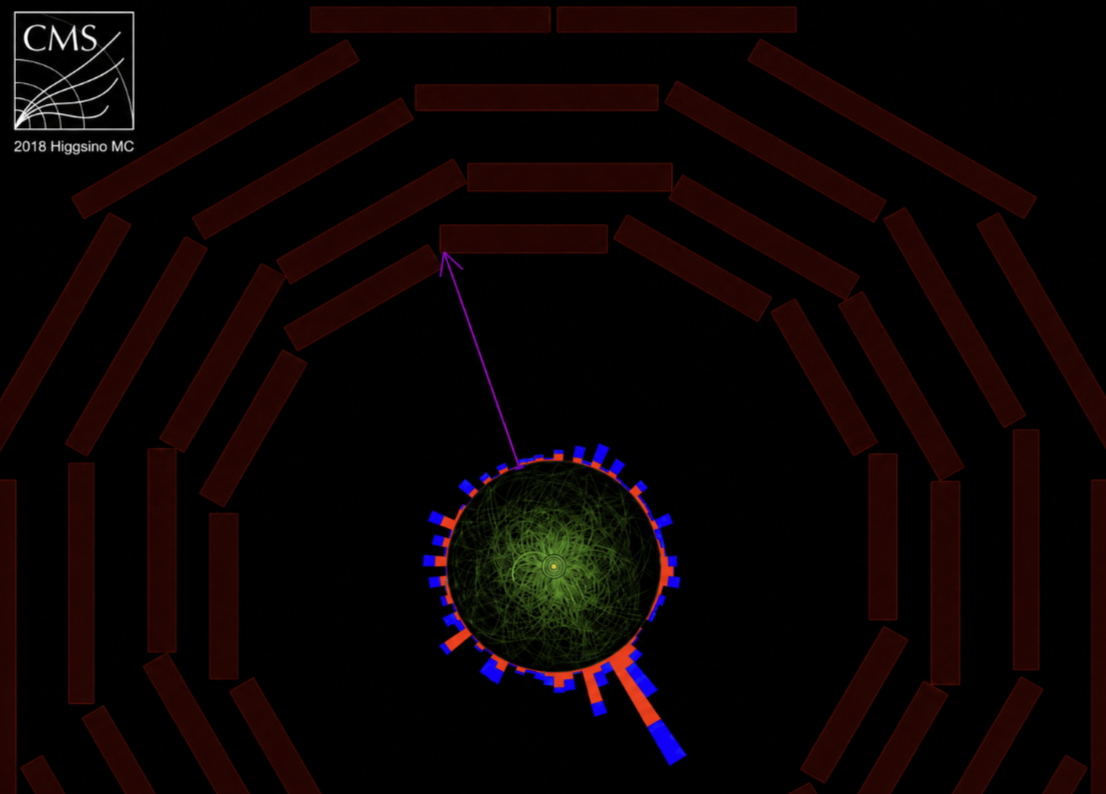
Figure 4: A higgsino event featuring a low-pT track resulting from the decay of a chargino to a soft pion, on top of a high-density background of soft tracks in green. The missing transverse momentum vector is shown in purple, recoiling off the ISR jet whose electromagnetic (hadronic) calorimeter deposits are shown as the largest red (blue) towers. This simulated event falls into the signal region of the CMS soft displaced track search [4].
To reconstruct this elusive signature, the ATLAS experiment developed a two-level neural network technique [1]. A NN focuses on separating the signal from the Standard Model background by using the overall event topology information based on missing transverse momentum and jets, while a second NN aims to select the displaced track from the pion from tracking information, such as impact parameters and isolation. The displaced track search is sensitive to mass splittings of 0.3 GeV < Δm(χ̃±1, χ̃01) < 1.2 GeV. It extends previous ATLAS exclusion limits up to chargino masses of 199 GeV for a mass splitting Δm(χ̃±1, χ̃01) of 0.6 GeV, surpassing the previous ATLAS reach by 30 GeV.
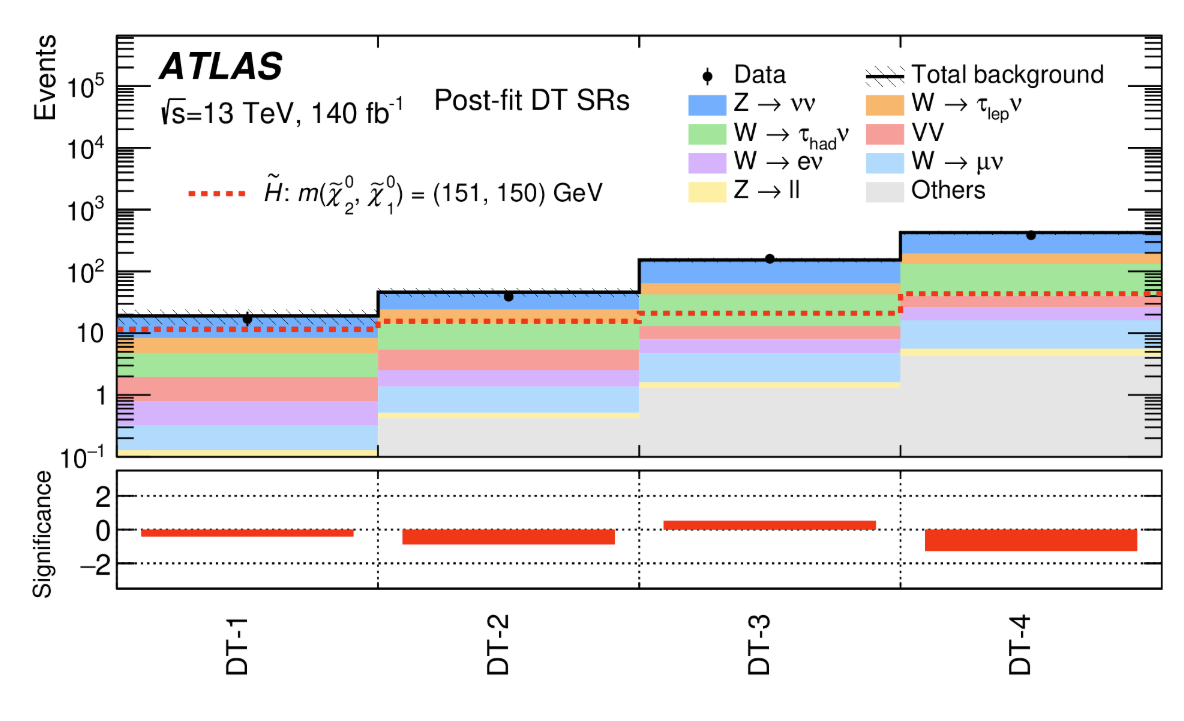
Figure 5: The data, estimated background, and expected signal event yields in the signal regions of the ATLAS displaced track search [1]. The signal regions are defined by requirements on the two NN output scores.
Conclusions/Next Steps
Together, the latest ATLAS and CMS searches mark an important milestone in one of the most compelling and challenging corners of the LHC supersymmetry program. Despite the significantly larger backgrounds at the LHC, the ATLAS and CMS searches now surpass the nearly quarter-century-old LEP2 constraints on the higgsino mass for all values of the mass splitting. Meeting this challenge required both collaborations to exploit a new final state as well as new reconstruction approaches and modern machine learning techniques to extend lepton identification to lower transverse momenta than had previously been possible.
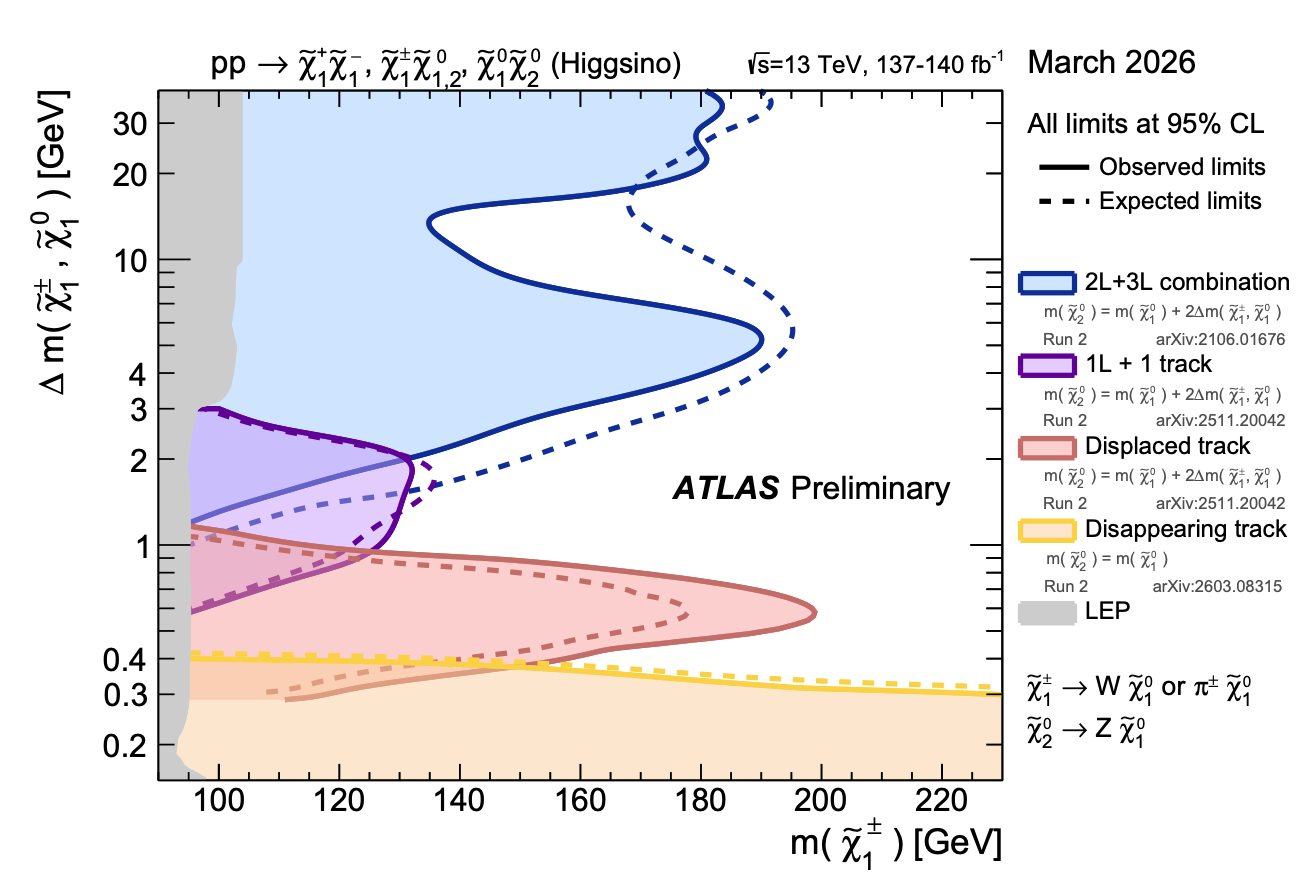
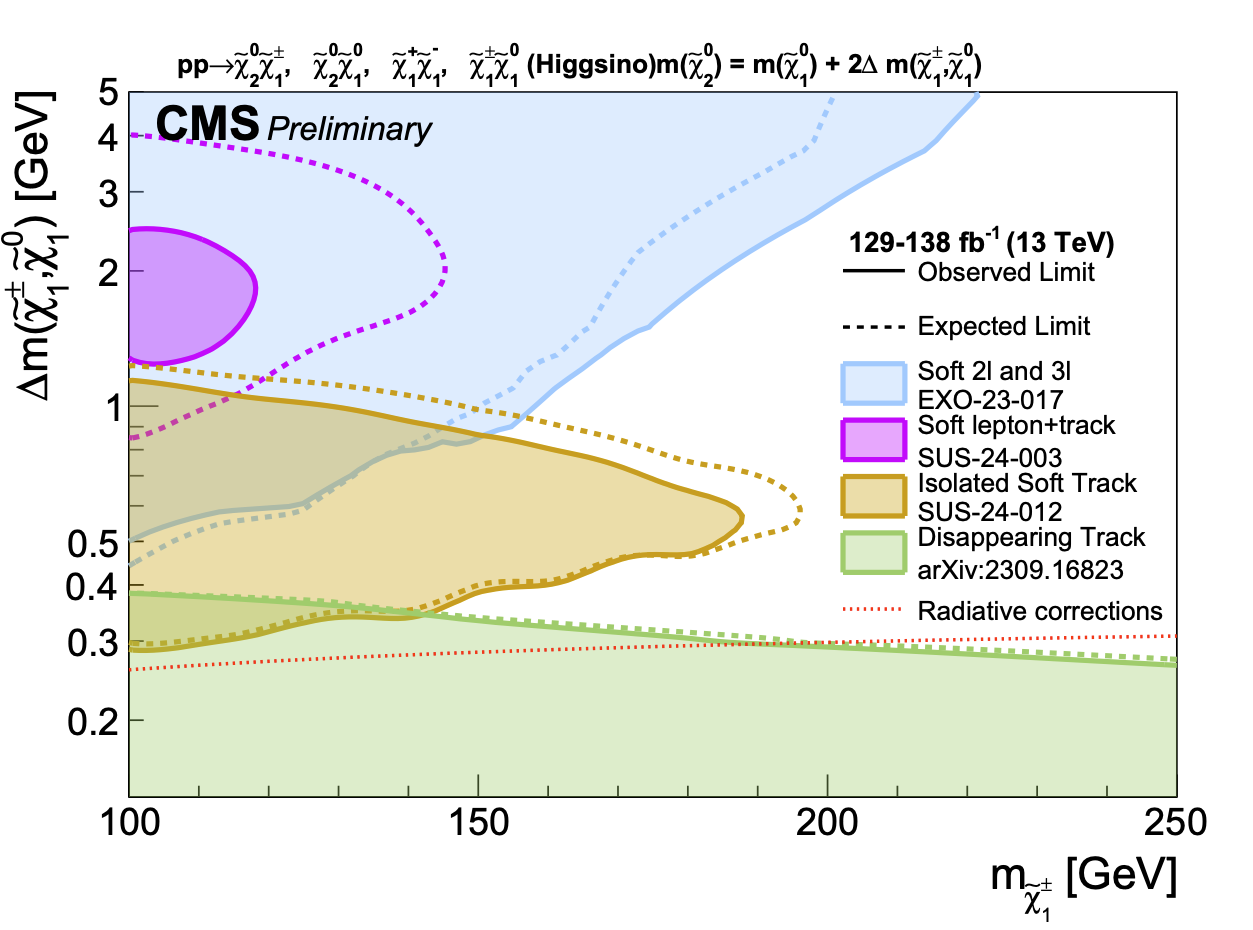
Figure 6: Summaries of the ATLAS [5] (left) and CMS [6] (right) constraints on the higgsino masses in the m(χ̃±1) vs. Δm(χ̃±1, χ̃01) plane. The new ATLAS results from the 1ℓ1T and displaced track searches are shown in purple and red, respectively. The new CMS results from the 2ℓOS searches with ultra soft electrons, ultra soft muons, and from the displaced track signature are shown in blue, violet, and yellow respectively. Together, these results fill in the “higgsino gap” that previously existed between searches using standard leptons and the disappearing track signature, and supersede the constraints from the LEP2 experiments (grey).
While an important gap has been closed, the door to discovering compressed higgsinos at the LHC remains wide open. The searches presented here are based on the Run 2 dataset, leaving considerable room for increased sensitivity with the inclusion of Run 3 data. Armed with new analysis techniques, soft lepton identification algorithms, and twice the data, the race is on to search for even higher-mass higgsinos. While the remaining parameter space is experimentally demanding, it is also where light higgsinos may still be hiding. As future Run 3 searches push deeper into this territory, natural supersymmetry and light higgsinos are bound to face increasing scrutiny or, perhaps, even begin to reveal themselves in the data.
Acknowledgements
Among the scientists who played a key role in carrying out the analyses featured in this article, we would like to acknowledge in particular the doctoral students for whom these results formed a central part of their thesis work. From ATLAS, these are Hiroaki Hibi from Kobe University, Sicong Lu and Kaito Sugizaki from the University of Pennsylvania. From CMS, these are Panos Katsoulis from the University of Ioannina, Peter Meiring from the University of Zurich, Yuval Nissan and Moritz Wolf from the University of Hamburg, and Wesley Terrill from Carnegie Mellon University. While many colleagues and students contributed to different aspects of these results, the names highlighted here reflect those doctoral thesis contributions most directly connected to the analyses discussed in this article.
Further Reading
[1] Search for higgsinos in compressed mass spectra using low-momentum tracks in pp collisions at √s = 13 TeV with the ATLAS detector; arXiv:2511.20042; ATLAS briefing: Surpassing LEP limits in searches for higgsinos
[2] Search for new physics with compressed mass spectra in final states with soft leptons and missing transverse energy in proton-proton collisions at √s = 13 TeV; CDS record
[3] Search for Higgsinos in final states with low-momentum lepton-track pairs at 13 TeV; arXiv:2511.16394
[4] Search for electroweakinos in compressed-spectrum scenarios with low-momentum isolated tracks in proton-proton collisions at √s = 13 TeV; arXiv:2604.25604
[5] SUSY March 2026 Summary Plot Update — ATL-PHYS-PUB-2026-003
[6] CMS Summary plot on Higgsino searches


