
One summer, a world of possibilities: CERN’s Summer Student Programme 2026
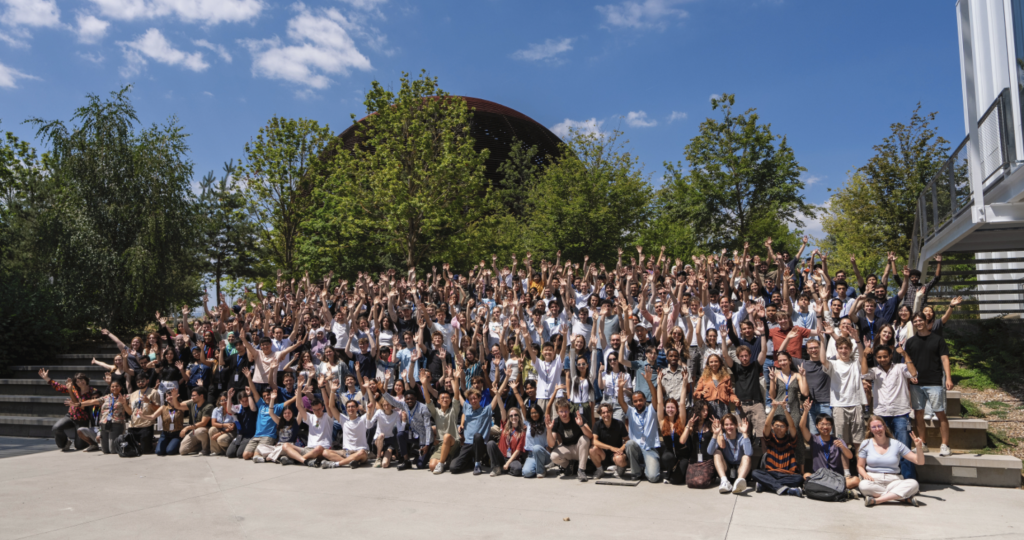
More than 320 students representing over 90 nationalities joined CERN’s Summer Student Programme in 2026. Selected from more than 21,000 applicants, they came to CERN through programmes open to students from Member and Associate Member States as well as a dedicated route for students from Non-Member States. Together, they spent the summer learning, contributing and discovering what it means to be part of a truly international scientific community.
With the 2026 programme now concluded, the lecture rooms are quieter, projects have reached their final milestones, and the students have taken the road home. Yet the end of CERN’s Summer Student Programme is not simply a moment of departure. It is also the beginning of hundreds of new trajectories—shaped by the knowledge gained, the questions asked, and the friendships formed during an extraordinary few weeks.
For between eight and 13 weeks, the students became part of CERN’s scientific and technical community. Working alongside physicists, engineers, computer scientists, theoretical physicists and technicians, they contributed to real projects across the Organisation. Some analysed data or developed software; others tested technologies, worked with complex instruments or helped solve engineering challenges. Each arrived with a different background and field of expertise, but all shared the same opportunity: to move beyond the lecture hall and experience science as it is actually made.
The assignments varied, but the spirit was the same. Students learned by taking part—by testing an idea, encountering an unexpected result, discussing a problem with a supervisor or discovering that progress in science is often built patiently and collectively. In this sense, the programme was much more than an internship. It offered a first-hand view of how ambitious science advances through curiosity, precision, persistence and cooperation across disciplines and borders.
A classroom without walls
Alongside their project work, the students followed an extensive programme of lectures delivered by CERN scientists and visiting experts. The breadth of the 2026 series reflected the scale and diversity of CERN’s scientific endeavour.
The programme began with introductions to the particle world, detectors, accelerators and beam dynamics, before moving through superconducting magnets and radiofrequency technologies, statistics, cosmology, data acquisition, theoretical concepts and the long journey from raw data to physics results.
Later lectures explored the Standard Model, heavy-ion collisions, neutrinos, antimatter, astroparticle physics, flavour physics, future colliders and ideas that could take physics beyond today’s theories. Sessions on healthcare applications also demonstrated how knowledge and technologies developed for particle physics can travel well beyond the laboratory and contribute to society.
Learning continued outside the auditorium. Visits introduced students to CERN’s accelerators and experimental areas; workshops and discussion sessions created space to ask questions and exchange ideas; and poster sessions gave them the opportunity to explain their own work. Each student also prepared a report at the end of their stay—a record not only of what they had learned, but of what they had contributed.
The programme’s scientific value was matched by its human dimension. This year’s cohort brought together students representing more than 90 nationalities, including participants from CERN Member and Associate Member States and students selected through the dedicated Non-Member State programme. Students from Canada, Japan and the United States joined through their respective national schemes.
These different routes converged at CERN, creating one summer community. In offices, laboratories and lecture halls—and over coffee or meals—ideas crossed borders easily. Students whose journeys began thousands of kilometres apart found themselves working on related problems, comparing experiences and discovering a shared language in science.
This international character is not an incidental feature of the programme; it lies at the heart of CERN’s mission. Science becomes stronger when knowledge can circulate, when different perspectives meet, and when young people can imagine themselves as part of a community larger than their university, discipline, or country.
From points on a map to individual journeys
The programme’s scale can be expressed in numbers, but numbers alone cannot capture the people behind it. An interactive map offers another way to explore the 2026 cohort and the many paths that led its members to CERN.
Through the profiles of students who kindly chose to participate, readers can discover where their journeys began, what they study, the projects they worked on and the questions or ambitions that guide them. Each point on the map represents more than a place of origin: it opens onto a personal trajectory shaped by curiosity, effort and the willingness to venture into the unknown.
Taken together, these stories reveal both the programme’s diversity and the shared aspirations connecting its participants. They remind us that the future of science will not emerge from one laboratory or one country, but from a global community able to learn from one another and work together.
An ending—and perhaps a beginning
For some students, their summer at CERN may confirm a path they already hoped to follow. For others, it may reveal an unexpected direction: a new research field, a different application of their skills or a deeper understanding of the kind of work that inspires them. The knowledge, confidence and contacts developed here can continue to shape their choices long after the final lecture and project report.
Many former Summer Students have returned to CERN later in their careers—as doctoral students, fellows, engineers, researchers and members of the experiments and teams that first inspired them. Others have carried what they learned into universities, laboratories and organisations around the world, extending the programme’s impact far beyond the CERN site.
As we say goodbye to the class of 2026, we hope to follow the students’ journeys and to welcome many of them back to CERN in the years ahead. Wherever their paths lead, they leave as part of a community connected by a remarkable summer—and by the conviction that asking fundamental questions about our Universe is an endeavour without borders.
Thank you to all the students who brought their enthusiasm, ideas and perspectives to CERN this summer, and to the supervisors, lecturers, organisers and colleagues who shared their time and knowledge with them.
The projects may have ended, and the suitcases may be packed, but the questions, friendships and possibilities opened during this summer are only beginning.
Explore the students’ profiles and journeys: Interactive map
Discover the lecture programme: CERN Summer Student Lecture Programme 2026
Note: If you want to join CERN’s Summer Students Programme in 2027, applications will open in November 2026.
Learn more: Summer Studentship – careers.cern