
Michelangelo Mangano on the past and present of the LHC physics programme
by Panos Charitos (CERN), based on a CMS Week talk by and a subsequent interview with Michelangelo Mangano (CERN)
More than fifteen years into its physics programme, the LHC has transformed our understanding of the subatomic world—but not always as expected. Alongside the discovery and increasingly precise study of the Higgs boson, the absence of long-anticipated signals of new physics has prompted physicists to reconsider established assumptions and develop new ways of searching, measuring and interpreting results. Drawing on a talk delivered during CMS Week and a subsequent interview, CERN theorist Michelangelo Mangano reflects on how the LHC has reshaped the relationship between theory and experiment, precision and discovery, and ultimately between what has been established as fact and what remains conjecture.
A machine after everything
When the Large Hadron Collider was preparing to begin operations, it was not perceived simply as CERN’s next machine after LEP. Michelangelo Mangano described it more forcefully: “It wasn’t just the next machine after LEP. It was the next machine after everything.” The phrase captures the scale of the expectation. LEP had completed a programme of extraordinary electroweak precision. The Tevatron was still operating and would continue to produce important results for another decade. HERA, BaBar and Belle each probed different aspects of the Standard Model. Yet the LHC was expected to rise above this landscape and settle the question that all previous machines had left open: how electroweak symmetry is broken.
Mangano began his CMS Week talk by returning to the moment when these expectations were first being formulated. “It is really a rather remarkable historic event,” he said, referring to the way the field’s perspective had evolved over the years of LHC operation.
Shortly before the machine started, he and Fabiola Gianotti had prepared a seminar on the physics prospects for its first one or two years, later developed into a paper informally known as “Mangianotti”. Its conclusion captured the prevailing sense of possibility: “The LHC offers the potential for very interesting physics and major discoveries right from the beginning.”
The scale of the anticipated leap was extraordinary. For some Standard Model processes, Mangano recalled, a single day of LHC data would correspond to roughly ten years of operation at previous machines. “SUSY may be discovered quickly, while a light Higgs boson will be much more difficult to observe,” the paper suggested. “Unexpected scenarios and surprises may also be around the corner at an unprecedented collider exploring a completely new territory.”
Its guaranteed deliverable was not, strictly speaking, the discovery of a Higgs boson with precisely the properties predicted by the Standard Model. It was the conclusive exploration of the Higgs mechanism. If no Higgs boson appeared, some other phenomenon would have to intervene before the theory lost consistency at high energy. This was the content of the famous no-lose theorem: either the Higgs would be found, or something else would appear in its place.
Around that guarantee clustered a much wider constellation of expectations. Supersymmetry, compositeness, extra dimensions and new heavy gauge bosons had become central reference points for imagining what might lie beyond the Standard Model. Naturalness suggested that the electroweak scale should not stand isolated, protected only by a seemingly miraculous cancellation of quantum effects. The new machine was expected to expose the mechanism that resolved this tension. “The expectation was huge,” Mangano recalled. If the accelerator and the detectors worked, the Higgs sector would be clarified and leading ideas for new physics would be pushed to the limit of their credibility.
The programme that emerged has been both less spectacular and more profound than this narrative anticipated. The LHC discovered a Higgs boson in 2012 and has since measured its properties with a precision and breadth that would have been difficult to imagine when the machine was designed. Yet the apparently easier part of the programme—the prompt appearance of supersymmetry or another unmistakable new framework—has so far produced a vast territory of exclusions rather than a new theory. The significance of the LHC therefore lies not only in what it found, but in the intellectual reorganisation forced by what it did not find.
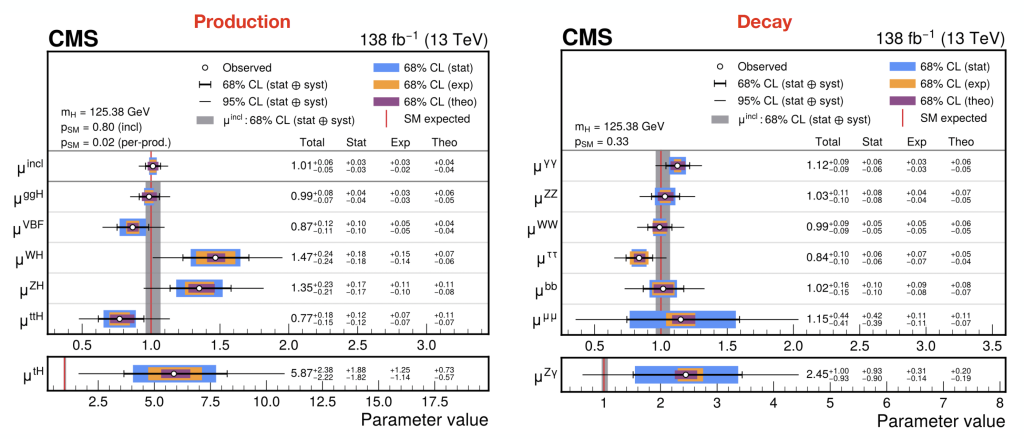
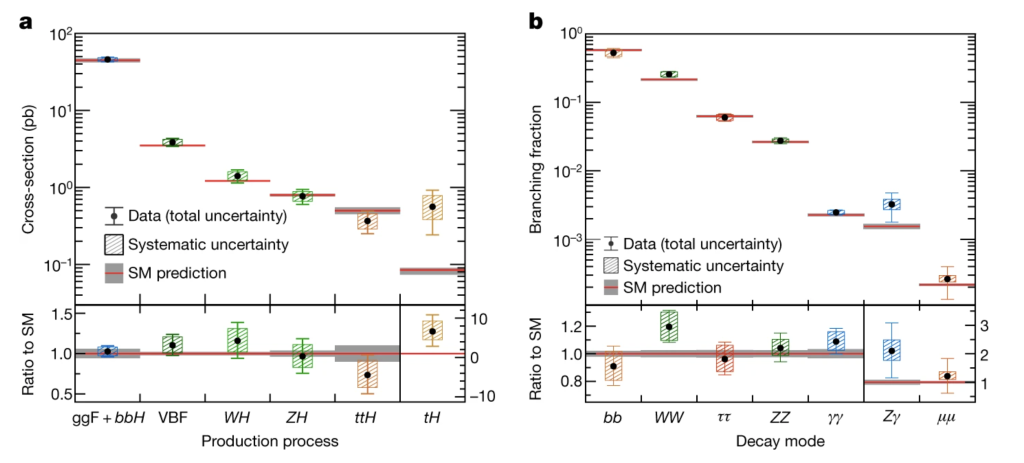
Measurements by CMS (top) and ATLAS (bottom) map Higgs-boson production and decay using the full LHC Run 2 datasets. CMS presents the measured signal strengths for the principal production modes and decay channels, while ATLAS reports production cross-sections and branching fractions together with their ratios to Standard Model predictions. Across both experiments, the results are consistent with the Standard Model and illustrate the precision achieved since the Higgs boson’s discovery. Sources: CMS Collaboration, arXiv:2602.18611 (2026); ATLAS Collaboration, Nature607, 52–59 (2022), Fig. 2.
The contrast between the two sides of the programme is now striking. The Higgs measurements have advanced much further than even relatively recent projections anticipated. Mangano singled out the Higgs self-coupling as “the holy grail of Higgs properties” and pointed to the extraordinary progress compared with projections made only a few years earlier, during the previous European Strategy process.
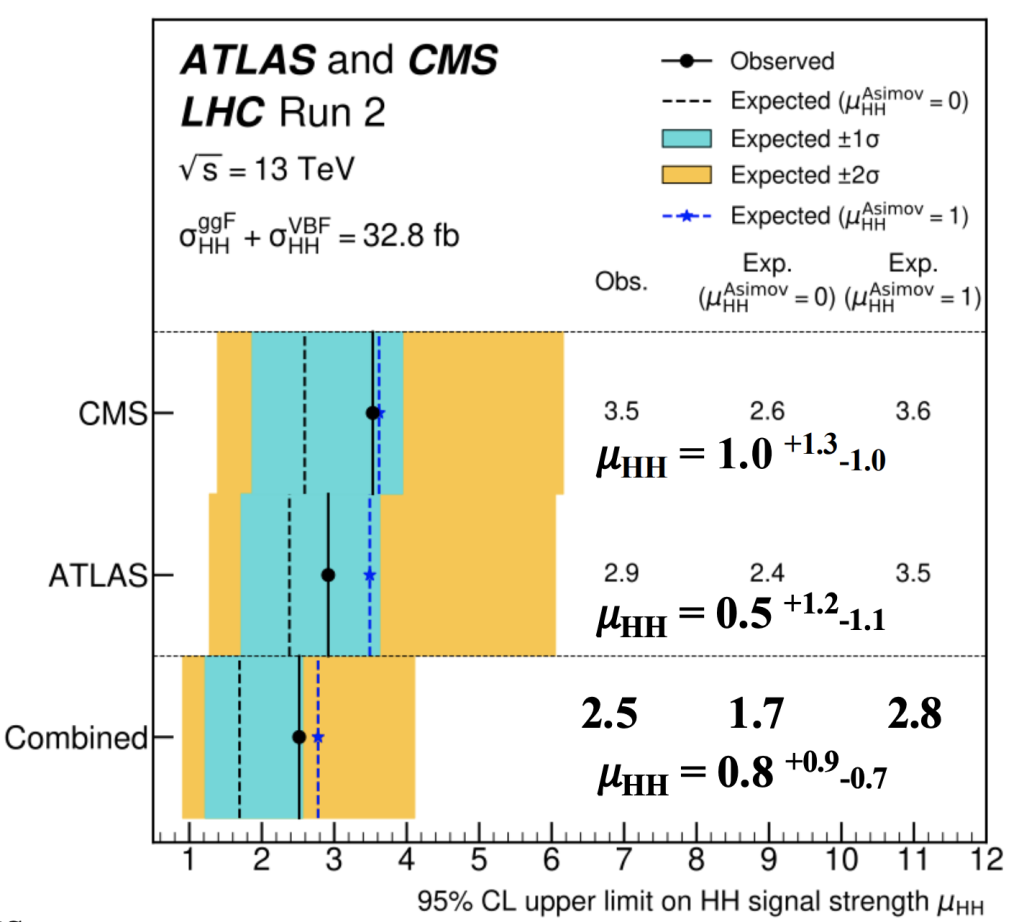
Combined ATLAS and CMS Run 2 constraints on Higgs-boson pair (HH) production at 13 TeV. The combination of several decay channels sets an observed upper limit of 2.5 times the Standard Model production rate at 95% confidence level, with a best-fit signal strength of . Higgs-pair production is one of the principal processes through which experiments can constrain the Higgs self-coupling. (Image: ATLAS and CMS Collaborations, CERN-EP-2026-011)
Recent Higgs studies, he told the CMS audience, contain a depth and level of detail that would have been almost impossible to imagine before the LHC began. The part once expected to be more difficult—the detailed characterisation of the Higgs boson—has become an increasingly precise and sophisticated scientific enterprise.
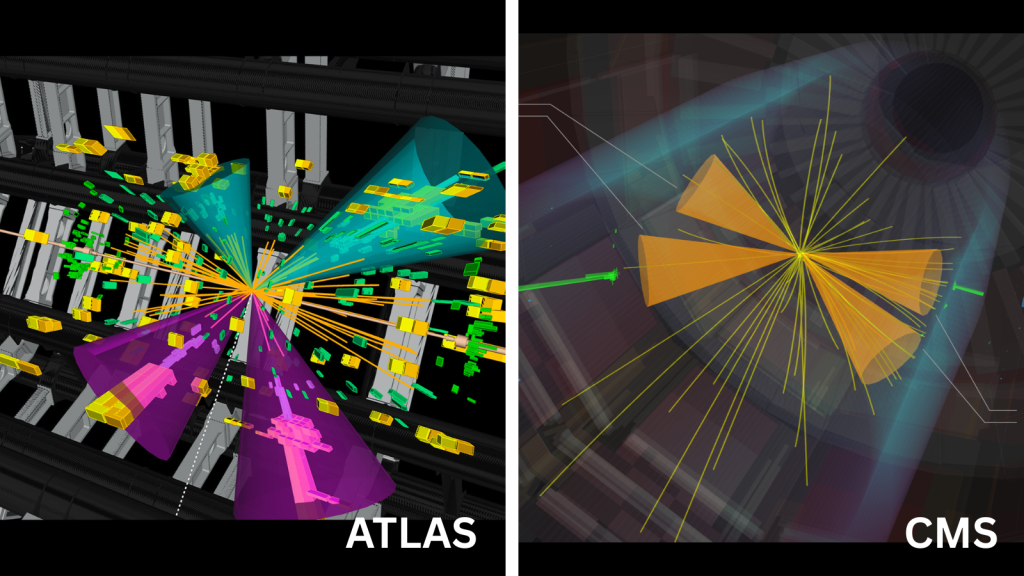
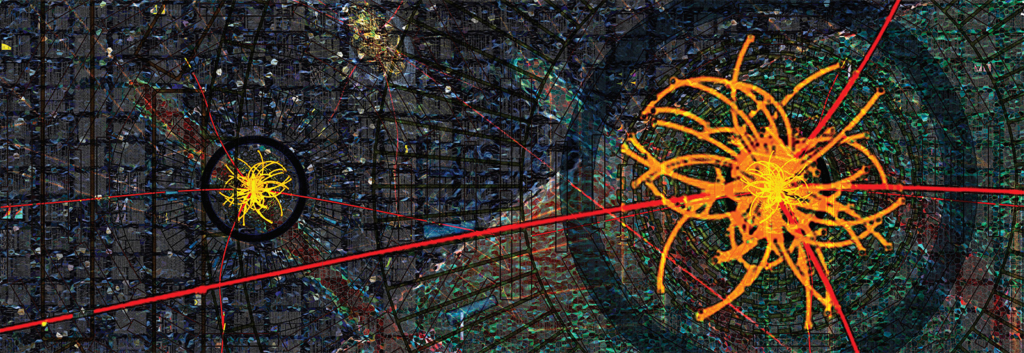
Candidate event displays of double-Higgs boson production as recorded by ATLAS (left) and CMS (right). (Image: CERN)
When absence becomes an event
Mangano returned to a remark made by Guido Altarelli in a 2008 lecture. Altarelli asked whether the LHC might fail to discover the Higgs. It could, he said, but then it would have to discover something else. He also asked whether the collider might find the Higgs and nothing beyond it. That outcome was technically possible, but it was not natural. His final observation now reads almost like a diagnosis of the LHC era: sometimes not finding what we expect is more revolutionary than finding it.
The point is not that the LHC falsified a single prediction. The deeper lesson, Mangano argued, is that “nature is more subtle than we’ve been expecting”. The Higgs discovery itself did not arrive as a complete surprise. By 2011 its possible mass range had narrowed, and suggestive excesses were appearing. The immediate question after July 2012 was whether the new particle was the Standard Model Higgs or something more complex. Its spin, CP structure, couplings, production mechanisms and decay modes all had to be tested.
What changed the theoretical perspective was not the discovery of the Higgs alone. “It’s not the discovery of the Higgs that has changed the perspective; it’s the non-discovery of something else,” Mangano said. The absence of the new particles expected to accompany a natural electroweak scale forced the field to reconsider the status of naturalness itself. Ideas once treated as peripheral— anthropic arguments, cosmological selection mechanisms and models in which the Higgs scale is environmentally or dynamically determined—received renewed attention.
This does not amount to a proof that supersymmetry, compositeness or related frameworks are wrong. They may survive at higher masses, with less conventional spectra or with a degree of fine-tuning that would once have been viewed as unattractive. Mangano remains unwilling to declare such possibilities dead. A one-per-cent tuning may be uncomfortable, he suggested, but it is not logically intolerable. New physics may still be “behind the corner”. The psychological change is nonetheless real. Before the LHC, the question was often which form of new physics would appear. Today, the possibility that none of the canonical answers will appear quickly has become part of the scientific landscape.
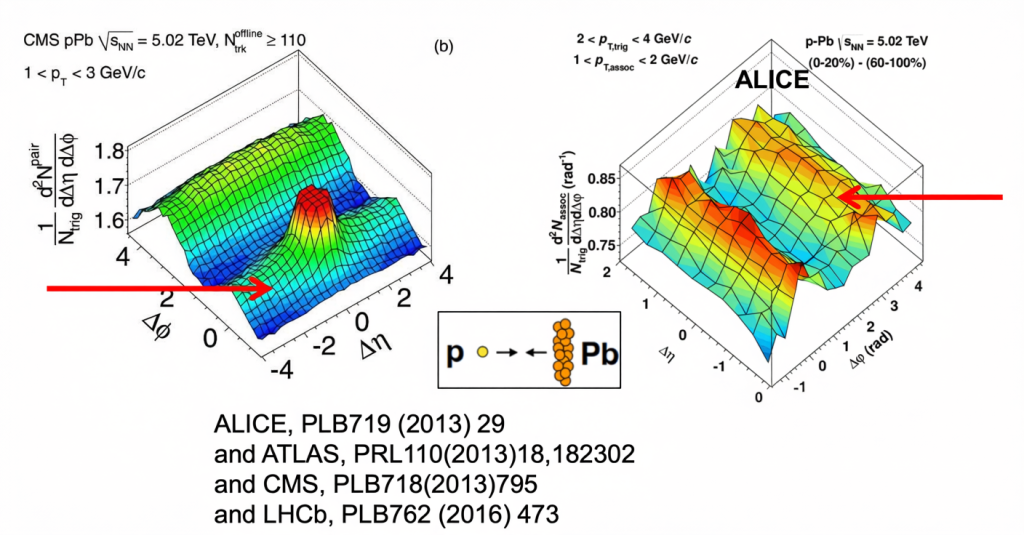
The ridge phenomenon, first observed in high-multiplicity proton–proton collisions and subsequently studied in proton–lead collisions by all four major LHC experiments. The CMS and ALICE measurements shown here reveal long-range angular correlations—including a double-ridge structure—reminiscent of collective flow in heavy-ion collisions. Unexpected in such small collision systems, the phenomenon opened a new field of research, although its microscopic origin remains unresolved. Image: Michelangelo Mangano; plots based on results from ALICE, ATLAS, CMS and LHCb. Plot from Jan Fiete Grosse-Oetringhaus, “A Decade of Collectivity in Small Systems,” presented at Light Ions at the LHC (11/11/2024).
The precision revolution
The LHC also overturned two assumptions about what a hadron collider could achieve. The first was that, apart from the Higgs boson and perhaps incremental improvements in a few known quantities, little genuinely new would emerge from the Standard Model programme. The second was that the proton– proton environment was too complicated for precision physics. Pileup, hadronic backgrounds and complex final states seemed to place an intrinsic ceiling on what could be measured.
The Tevatron had already weakened these prejudices. It measured the W-boson and top-quark masses with impressive accuracy, established the power of silicon tracking and made significant contributions to flavour physics. But the LHC introduced much higher luminosities and pileup, and with them a qualitatively different experimental challenge. On the theory side, the situation looked equally forbidding. Even if sufficiently accurate calculations could be completed, it was uncertain whether their precision could survive the transition into event generators and realistic experimental analyses.
Both judgments proved too pessimistic. The experiments learned to control pileup, measure luminosity at the per cent level and reduce many systematic uncertainties to one per cent or below. In parallel, the theory community, developed next-to-next-to-leading-order calculations for most of the central processes, while resummation, matching and merging techniques advanced rapidly. Mangano compared the theoretical effort to the challenge of constructing and operating the detectors themselves. “If you had forecast the precision we actually have today 15 years ago, you would have been taken as a fool,” he said.
This is not merely a technical triumph. It altered the meaning of the LHC physics programme. Precision measurements at a hadron collider became intellectually central rather than supplementary. They could probe the Standard Model and its possible extensions while guaranteeing a concrete result. A search may end with an exclusion because the object sought is absent. A measurement produces a number. The uncertainty may be larger than hoped, but knowledge has still advanced.
For Mangano, this matters particularly for younger researchers. Precision is not a consolation prize in the absence of discovery; it is a demanding programme in its own right. “You are measuring a number,” he said. “You may not be as precise as you wanted, but if you are good enough, and if you are smart enough, you can be that precise.” The challenge is experimental, theoretical and conceptual at once.
From benchmark theories to a new ecology of searches
The lack of canonical signals also changed how searches were organised. For many years, results were presented primarily through complete theoretical frameworks: supersymmetry, compositeness, grand unification, extra dimensions or new heavy gauge bosons. As the simplest manifestations of these ideas failed to appear, experimentalists and theorists developed a more flexible ecology of interpretation.
Simplified models isolate the minimal ingredients of a possible signature—missing transverse momentum, jets, leptons, resonances or displaced objects—without committing to an entire ultraviolet theory. Effective field theories describe the indirect influence of heavy new physics through deviations in Standard Model observables. Recasting allows analyses to be reinterpreted in models that the experiments did not originally test.
The distinction between these approaches is important. Simplified models parameterise the characteristic features of a possible BSM final state and allow experimental results to be expressed without adopting the full machinery of a particular theory. EFTs, by contrast, describe indirect signals that may appear as small deviations from predicted Standard Model behaviour.
This shift was driven jointly by experiment and theory. One of its consequences was a much more efficient use of both the data and the experimental resources. Model-independent parameterisations enabled theorists to participate directly in the interpretation of results and to extend them to a wide variety of theoretical scenarios. Experiments could concentrate on a manageable set of canonical benchmarks, while reinterpretation made it possible to generalise the conclusions. Mangano described the result as “a broader and more educated theory participation”.
These tools represent more than a change of notation. They altered the relationship between theory and experiment. Recasting enables theorists to confront new models with real data without requiring a collaboration to repeat an analysis for every proposal. Experiments, in turn, are encouraged to preserve information in forms that remain usable beyond the original benchmark. HEPData, Rivet, public likelihoods, open-data initiatives and reusable analysis frameworks are part of this transformation.
The dedicated use of repositories such as HEPData, together with public and reusable implementations of analyses through tools such as Rivet, created a more persistent record of experimental results. These practices have since developed into a broader open-data framework.
They have not, in themselves, produced a discovery. But they have greatly improved the representation, preservation and reusability of the information contained in an analysis. The scientific value of a result no longer ends with the benchmark interpretation chosen for its first publication.
In Mangano’s view, this cultural development has allowed the community to optimise the exploitation of LHC data to an unprecedented degree.
Mangano described the result as a “win-win” for both communities. Theorists become more familiar with detector realities, selection effects and experimental uncertainties. Experimentalists become more attentive to the information required for broad reinterpretation. At the sociological level, he argued, this is one of the largest advances in the relation between theory and experiment produced by the LHC.
EFT as archive—and as warning
Effective field theory has become indispensable to precision physics because it provides a systematic language for recording either outcome. If a deviation appears, EFT can identify the classes of interaction that might generate it. If no deviation appears, the same framework can place constraints that remain useful when future models or anomalies are considered. In this sense, EFT is not merely an interpretive tool; it is an archive of what the measurements have established.
In an EFT description, the effects of new physics are represented through additional operators suppressed by powers of a characteristic scale, conventionally denoted by Λ. The new particles themselves are assumed to be too heavy to produce directly, but their presence may still be inferred from small changes in lower-energy observables, in a manner analogous to Fermi’s description of weak interactions before the W boson was directly accessible.
Yet Mangano insisted on an important limitation. An EFT rarely constrains a mass scale alone: its sensitivity depends on a combination of the scale and the strength of the relevant coupling. Strongly coupled phenomena may therefore be constrained far above the collider’s direct reach, whereas weakly coupled particles—or effects entering only through loops—may remain visible only near the energies already accessible through direct production. LEP, for example, placed multi-TeV limits on some contact interactions but did not indirectly exclude weakly coupled supersymmetric particles far beyond its kinematic reach.
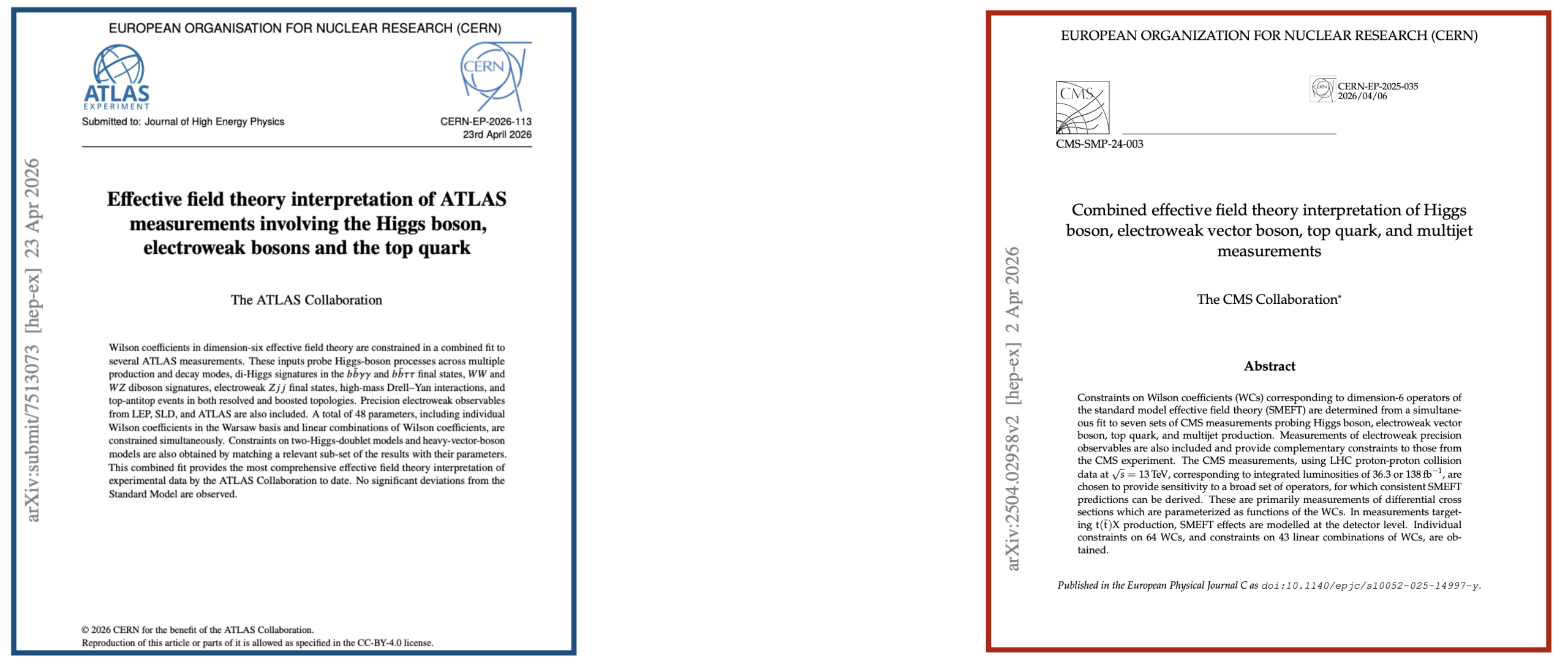
This expanding role is reflected in recent global EFT analyses from both ATLAS and CMS experiments, combining measurements across the Higgs, electroweak and top-quark sectors; the CMS analysis also incorporates multijet measurements. See the ATLAS global EFT analysis and the CMS global EFT analysis.
Precision measurements of processes such as e+e−→μ+μ−, including their angular distributions, produced strong limits on compositeness and four-fermion operators. But they did not generate comparable indirect sensitivity to weakly coupled supersymmetric particles.
For charginos, sleptons and related states, the most powerful constraints remained close to the direct kinematic boundary. The reason was not a failure of EFT, but the structure of the underlying theory: supersymmetry is weakly coupled, and many of its indirect effects arise only through loops.
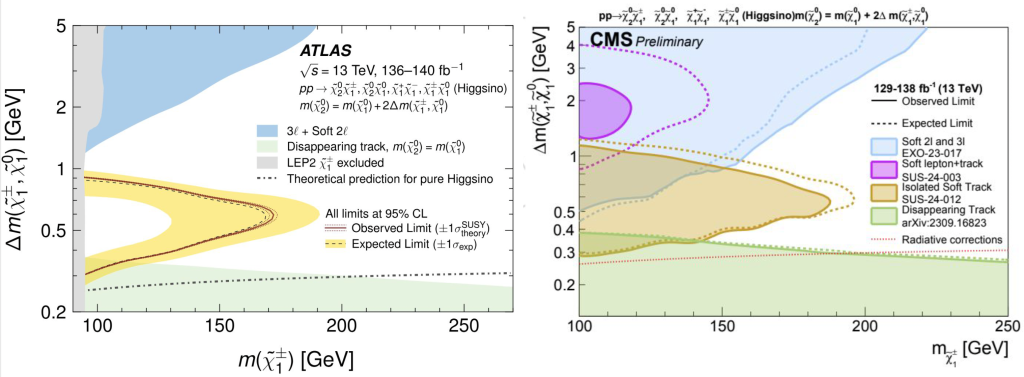
Complementary ATLAS (left) and CMS (right) searches for compressed Higgsinos constrain the chargino mass as a function of the small mass difference between the chargino and the lightest neutralino. The shaded regions represent parameter space excluded at 95% confidence level by searches targeting different experimental signatures. These results illustrate why sensitivity to weakly coupled supersymmetric particles often remains close to the collider’s direct kinematic reach. Sources: ATLAS Collaboration, Phys. Rev. Lett. 132, 221801 (2024); CMS analyses EXO-23-017, SUS-24-003, SUS-24-012 and arXiv:2309.16823. Comparison presented by Zubair Bhatti at WIN 2025 (ATL-PHYS-SLIDE-2025-275, slide 23).
“EFT had absolutely nothing to say about supersymmetry,” Mangano remarked, intentionally overstating the point to make the contrast clear.
The conclusion is not to retreat from EFT. “It has to be done,” Mangano said. “But don’t go 100% blindly on EFTs, and make sure that these huge efforts do not reduce the emphasis on direct searches in the context of very concrete BSM scenarios. Don’t stop looking for the gluino, the squark, the Z′ and everything else, because it is a separate business.” The distinction is deeper than a division of labour between direct and indirect searches. Some phenomena may not be fully captured by an effective expansion at all.
To illustrate the point, Mangano turned to the anomalous precession of Mercury’s perihelion. Before general relativity, one could have attempted to parameterise the disagreement with Newtonian gravity by adding higher-order corrections to the gravitational potential. Each term would require an appropriate scale, and one might organise the expansion using the Schwarzschild radius and powers related to the orbital velocity. With sufficiently precise data on Mercury’s orbit, the coefficients of this expansion could have been fitted.
“But then what do you do with that?” Mangano asked.
Such a parameterisation might have reproduced the precession, but general relativity would not have emerged from it. It would not have revealed that gravity reflects the curvature of spacetime. Nor would it have implied that light should be deflected by a gravitational field.
One might try to improve the model by appealing to special relativity, replacing mass by energy and noting that photons carry energy. But this would still miss the essential geometrical origin of the phenomenon.
“An EFT analysis of Mercury’s orbit would have simply given a model parameterisation,” Mangano said, “but would not have helped us understand what the origin of that effect was, which was general relativity.”
The analogy clarifies both the strength and the limitation of EFT. It can organise deviations, preserve the information contained in precision measurements and constrain broad classes of interactions. But a successful parameterisation is not necessarily an explanation.
A future anomaly at the LHC might be accurately encoded by a set of effective operators and still point towards a conceptual structure that cannot be inferred from those operators alone. The eventual theory might not simply add another term or particle to the Standard Model. It could change the framework in which those terms acquire meaning. With this caution about indirect interpretation, Mangano returned to the collider’s direct reach.
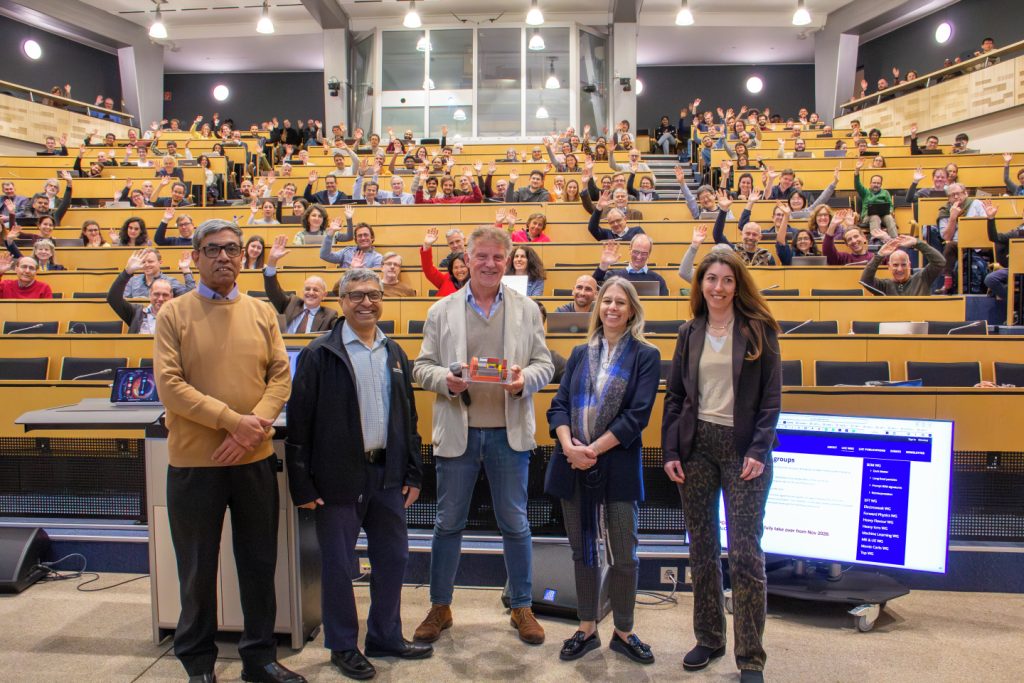
Michelangelo Mangano (centre), holding a LEGO model of the CMS detector, with members of the CMS management team and participants at CMS Week in April 2026. From left: Hafeez Hoorani, CMS Deputy Spokesperson; Sridhara Dasu, CMS Collaboration Board Chairperson; Michelangelo Mangano; Anadi Canepa, CMS Spokesperson; and Florencia Canelli, CMS Deputy Spokesperson. (Image: CMS Collaboration/CERN)
The LHC at the frontier already
Future-collider discussions sometimes present a partonic centre-of-mass energy of around 10 TeV as a distant holy grail. Mangano challenged that framing. Dijet invariant-mass spectra at the LHC already approach this regime; multi-jet final states probe resonant structures at several TeV; angular distributions at the highest masses constrain contact interactions and other possible departures from the Standard Model. The statistics are limited, but the territory is already being explored. “We don’t have to wait for 40 years to see that,” he said.
A search programme of this scale will inevitably produce many two- and three-sigma fluctuations. Their existence is not surprising; their complete absence would be. The correct response is neither to elevate every fluctuation into evidence nor to dismiss each one in isolation. The task is to compare them across experiments, channels and datasets. Coordinated efforts within the LHC BSM community to catalogue excesses and tensions are therefore scientifically important. Run 3 offers the possibility of testing whether any of these patterns persist.
Standard Model physics as new physics
One of Mangano’s most distinctive claims is that the term “new physics” should not be reserved for phenomena lying outside the Standard Model. It should also include phenomena that emerge from the data as unexpected, surprising or poorly understood. “I have a broad concept of what new physics is,” he told the CMS audience. Anything that is not obviously predictable, or that requires deeper study before it can be clarified, has the character of discovery even when it belongs to the Standard Model.
The ridge observed in high-multiplicity proton–proton collisions is a paradigmatic example. Long-range angular correlations and collective behaviour appeared in systems once thought too small to display phenomena reminiscent of quark–gluon plasma dynamics. This was one of the LHC’s first major discoveries, preceding the Higgs. It opened a broad field of research on collectivity in small systems, yet its microscopic origin remains unresolved. “Modelling is not understanding,” Mangano remarked, and understanding is the objective.
The same applies to heavy-flavour production. Analyses often assume that a bottom or charm quark hadronises into different species with fixed probabilities, largely independent of the production environment. LHC measurements show that these fractions vary with transverse momentum and context. At relatively low transverse momentum, charm quarks form baryons far more often than conventional fragmentation models would suggest, even in the central region. “Why on Earth?” Mangano asked. “We don’t know. We don’t have good models for this.”
Exotic spectroscopy provides another example. Tetraquarks, pentaquarks and other unconventional states had begun to emerge at the B factories and the Tevatron, but the LHC transformed the scale of the problem. Are these objects hadronic molecules, compact multiquark configurations or something still more subtle? They belong to QCD, yet their interpretation is not settled. The boundary between Standard Model physics and new physics is therefore less a line between theories than a line between what is understood and what is not.
The standard against which anomalies are judged
A rigorous understanding of QCD is indispensable even when the objective is to discover something beyond it. Every anomaly exists only in relation to a benchmark prediction. Before a deviation can be interpreted as new physics, the Standard Model reference must be sufficiently accurate and its uncertainty credible.
The challenge is not whether QCD is known in principle, but whether it is known with the precision required in a given regime. When extracting the strong coupling, for example, the key question is how robustly the theoretical uncertainty has been assessed. Confidence comes through complementarity: different observables, energies and production mechanisms probe different pieces of the same structure. Agreement among them strengthens the baseline against which future claims will be evaluated.
The discussion of possible toponium effects near the top-pair threshold illustrates this demand. It is not enough to identify a physical mechanism that could exist in the relevant region. One must reproduce the magnitude and shape of the observed structure, distinguish bound-state effects from continuum production and higher-order corrections, and account for detector resolution. A convincing explanation must be quantitative, not merely plausible.
Five sigma and the meaning of discovery
Mangano expressed unusually strong views about the conventional five-sigma threshold. Its origin lies in the spectroscopy of the 1960s, when many new resonances were being reported, and a conservative statistical standard helped distinguish genuine particles from fluctuations or mistakes. It remains useful, particularly when searching over a broad and unknown mass range.
But five sigma is not a mechanical definition of discovery. “I believe that five sigma means pretty much nothing,” he said provocatively, before explaining that a nominal significance acquires meaning only when the calculation is robust, the systematic uncertainties credible and the physical interpretation coherent. A result does not enter the Particle Data Group tables merely because a number crosses a threshold.
The W-boson discovery provides a historical counterpoint. The original UA1 and UA2 papers did not centre their claim on a quoted significance. They presented events with the expected characteristics in a clear theoretical context. The evidence was persuasive because it formed a coherent whole. Statistical safeguards remain essential, but scientific acceptance depends on reproducibility, consistency and intelligibility as much as on a single number.
Precision and discovery as one programme
The distinction between measurements and searches has become increasingly artificial. Precision is the guaranteed deliverable, but the scrutiny required to achieve it is also one of the best ways of discovering the unexpected. The same analysis that measures a Standard Model process may expose an anomaly in a corner of phase space. The same theoretical calculation that sharpens a parameter determination may reveal that the data cannot be accommodated.
This complementarity will define the High-Luminosity LHC. Its promise is not simply a tenfold increase in data. New detectors, triggers and reconstruction techniques may produce large gains in acceptance and efficiency for signatures that are currently difficult to record. In some channels, the effective increase in sensitivity could be closer to a factor of 100 than ten. That leaves real room for discovery.
It will also shape the case for future accelerators. A future electron–positron collider would extend precision measurements of the Higgs, electroweak and flavour sectors into a new domain. A future high-energy hadron collider would enlarge the direct reach for new particles and interactions. These are not competing scientific philosophies. Precision measurements constrain the interpretation of whatever may later be discovered, just as LEP data continue to test explanations of LHC anomalies.
A new particle would not arrive with its theoretical identity written on it. Experiments would see a signature. Determining whether it reflected supersymmetry, extra dimensions, compositeness or an unfamiliar framework would require direct evidence, precision constraints and consistency across many observables. Measurements do not merely consolidate discoveries; they make discoveries intelligible.
The boundary between fact and conjecture
Mangano gives precision a further, epistemological role. Suppose a more accurate measurement still agrees with the Standard Model. It is tempting to say that nothing has changed. Yet greater precision alters the domain over which a statement is established.
Consider whether quarks are elementary or composite. The unrestricted claim that quarks are point-like is a conjecture. What an experiment can establish as fact is that no substructure has been observed down to a particular distance or up to a particular energy. The boundary between these statements is set by experimental reach. Every improvement moves it.
Precision measurements therefore “shift the boundary between fact and conjecture”. A null deviation is not empty. It enlarges the region in which the Standard Model is known to describe nature. This may be one of the deepest achievements of the LHC programme: it does not simply accumulate confirmations but continuously redraws the frontier between what has been demonstrated and what remains assumed.
The SSC and the persistence of theory
The interview also turned to the cancellation of the Superconducting Super Collider. Mangano did not see it as producing a fundamental transformation in the direction of theory. The LHC was already on the table and was approved within a few years. The reference energy changed—from roughly 40 TeV at the SSC to around 14 or 15 TeV at the LHC—but the broad physics questions remained.
The social and institutional consequences were far more dramatic. A laboratory closed, careers were disrupted, infrastructure and funding plans were abandoned, and many researchers had to redirect their work. The episode illustrates that the trajectory of fundamental physics is not determined only by theoretical logic. It depends on institutions, resources and the capacity of communities to survive discontinuities.
Mangano also rejected the idea that major laboratory theory groups have simply declined. Their orientation has changed with the experimental landscape. SLAC has moved strongly towards astrophysics and cosmology; Fermilab has expanded its focus on neutrinos and quantum science. CERN’s Theory Department remains broad, with only part of its activity centred directly on the LHC. The vitality of theory lies not in permanent attachment to one machine but in the ability to follow the frontier as it moves.
AI and the risk of losing the ladder
Artificial intelligence and automated computation will shape the next phase of the field. They can improve detector operation, accelerate calculations, optimise analyses and expose patterns that would otherwise remain hidden. But Mangano identified a danger: by delegating a task to a tool, scientists may stop learning how to perform it.
A one-loop calculation can now be generated with software such as MadGraph. This is an extraordinary capability, but obtaining the result is not the same as understanding the calculation. A theorist who hopes to move from one loop to two loops must know the methods, cancellations and structures involved in the first step. Otherwise, the knowledge needed to go beyond the tool may disappear.
The problem is not unique to theory. It applies to reconstruction, detector design, data analysis and every activity touched by automation. “There is a delicate balance,” Mangano said, “between using the intelligence of AI without losing the skills that are needed to progress beyond AI.” The image is almost historical: a field can use a ladder to climb, but it must not throw away the ladder before it understands how to build the next one.
A programme transformed by experience
Thousands of papers have emerged from the LHC experiments, and only a fraction concern the Higgs boson or direct searches for new physics. Most document measurements of Standard Model processes, flavour phenomena, heavy-ion collisions, hadron spectroscopy and forward physics. The programme also extends far beyond ATLAS and CMS. ALICE, LHCb, LHCf, TOTEM, MoEDAL, FASER, SND@LHC have turned the collider into a broad laboratory for fundamental physics.
The LHC did not fulfil every expectation formed before its construction. It achieved something more consequential: it transformed the field’s understanding of what a hadron collider can do. It demonstrated that precision is possible in an environment once considered prohibitively complicated. It forced the development of calculations of unprecedented sophistication. It created new systems of data preservation, reinterpretation and exchange between theory and experiment. And it opened unexpected areas of QCD that remain conceptually unsettled.
Most importantly, it changed what we mean by new physics. New physics may be a new particle, but it may also be an unforeseen Standard Model phenomenon, a deviation requiring a new conceptual framework or a domain of nature exposed only because measurements became more precise. The LHC’s legacy cannot be reduced to a single discovery. It lies in the enlargement of the field’s questions, methods and standards of understanding.
Run 3 continues, the High-Luminosity LHC lies ahead, and new experimental and theoretical capabilities are still emerging. Mangano ended his talk with a characteristically understated challenge to any sense of disappointment: “There are still 20 years, so why complain?”