
Taking ATLAS apart to build its future
by Panos Charitos (CERN)
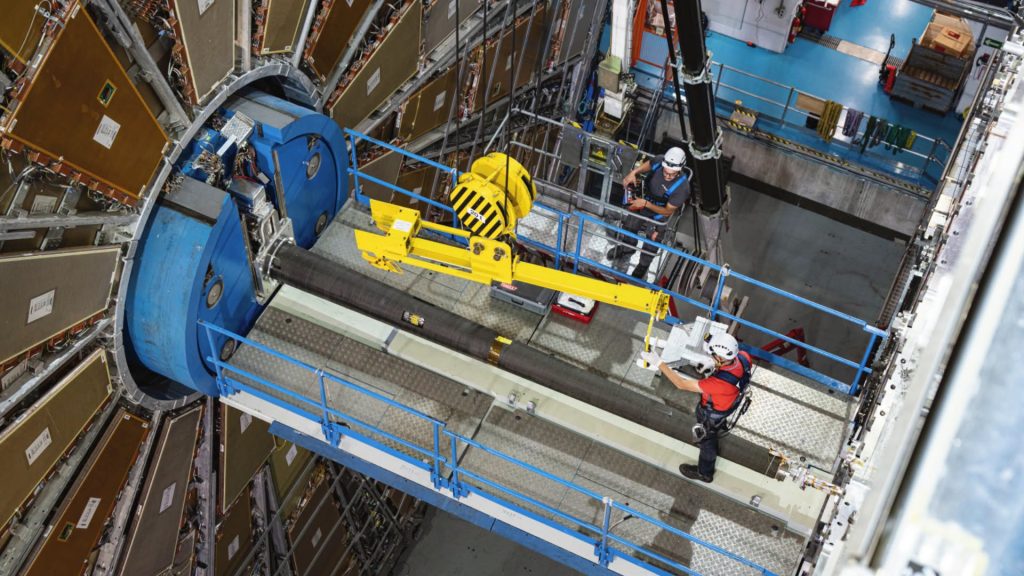
In the first weeks of Long Shutdown 3, ATLAS crossed a point of no return. Its technical coordination team describes the choreography, tension and unexpected joy of dismantling—and rebuilding—the detector for the High-Luminosity LHC. Credit: CERN.
At 05:52 on 27 June 2026, ATLAS completed Run 3. Two afternoons later, its electronic logbook recorded the beginning of a transformation planned for years: racks were switched off, equipment removed and the first cables cut. For Martin Aleksa, the experiment’s Technical Coordinator, this marked the decisive moment. “Once cables are cut and equipment is removed, there is no way back to the old ATLAS,” he says. “We found the Higgs boson and took data with this detector for so many years. Now we are taking it apart—and returning to a functioning detector will take a lot of work.”
Over the next four years, the collaboration will remove major components, install new detectors and electronics, renew their services and commission the transformed experiment for the High-Luminosity LHC (HL-LHC). Long Shutdown 3 (LS3) extends from the collision point to the surrounding underground and surface infrastructure. Deputy Technical Coordinators Michel Raymond and Stefan Schlenker bring complementary perspectives in our discussion: Raymond oversees installation and scheduling, while Schlenker focuses on controls, detector safety and electronics.
Ten years to reach the starting line
Scheduling began in 2016, balancing the available accelerator time against each project’s requirements. “The two plans have to converge. That is easy to say and difficult to do,” Raymond explains.
A detailed review in October 2023 established a sequence that has remained broadly stable. The challenge is not only to fit thousands of tasks into four years, but also to control co-activity: an “army of people” cannot disconnect electronics and move equipment through the same few hundred square metres at once.
After a week of post-run tests, most equipment that could be isolated was electrically locked out. Within two to three weeks, an estimated 80 to 90 per cent of the targeted electronics had been removed from many racks. Years of planning had become visible underground.
The governing principle sounds simple: remove the old equipment before installing the new. Old and new services often share the same cable trays and access routes, so installing new services too early could block later work. “We are not going to invent new cable trays,” Raymond says. “Sometimes we have to be patient: use the first months for removal, then install progressively.”
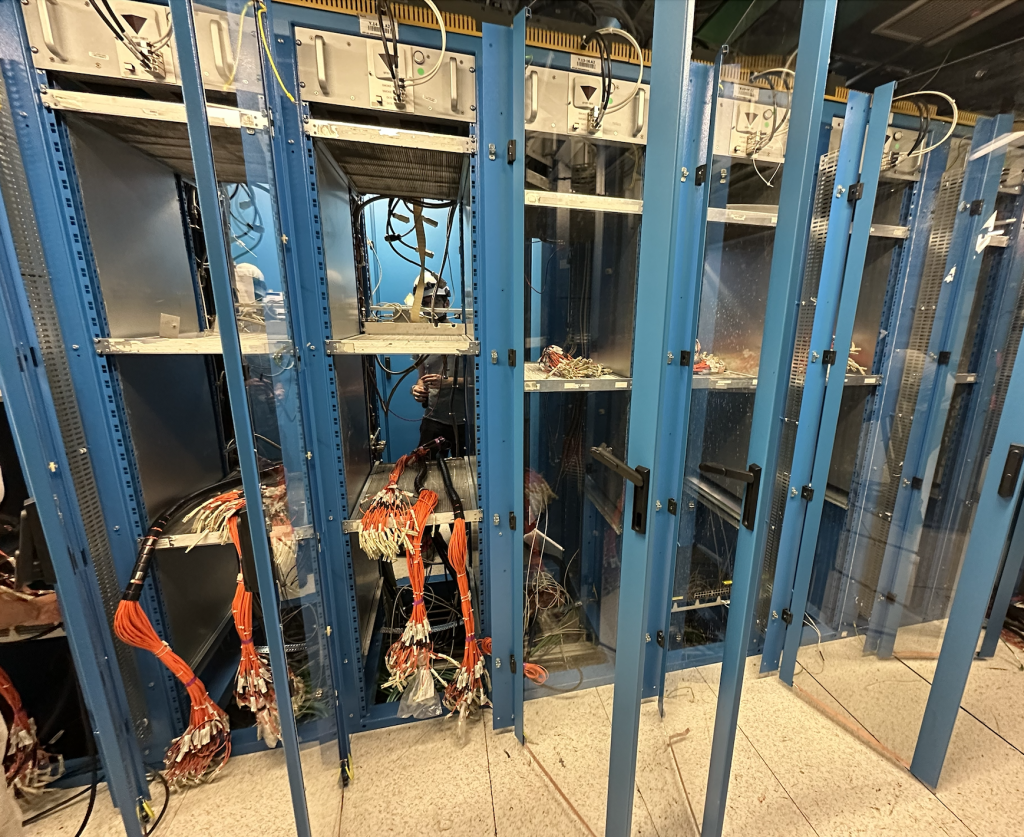
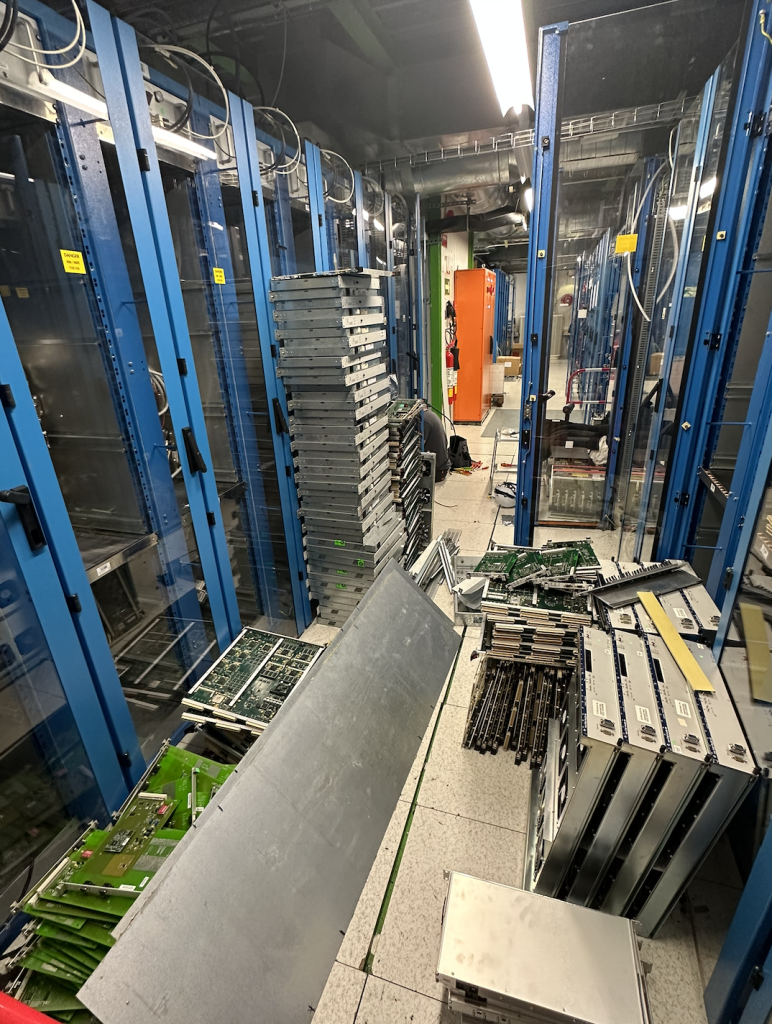
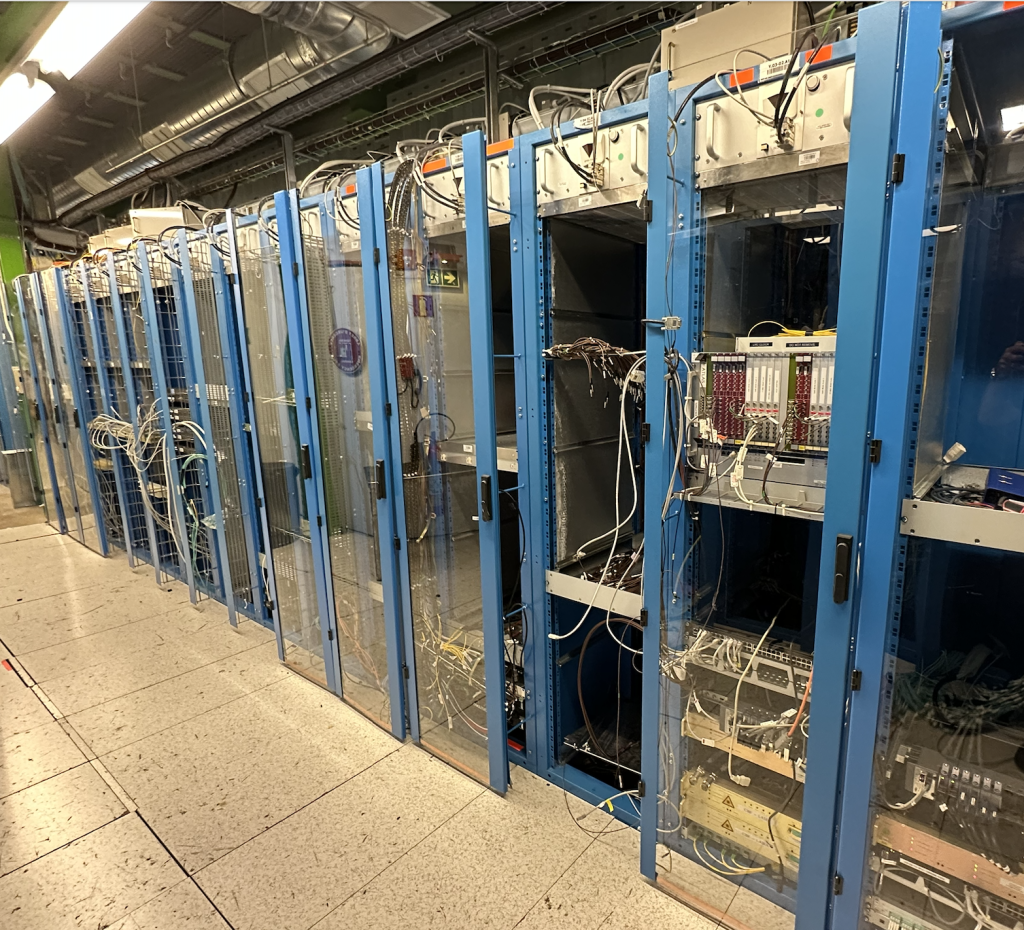
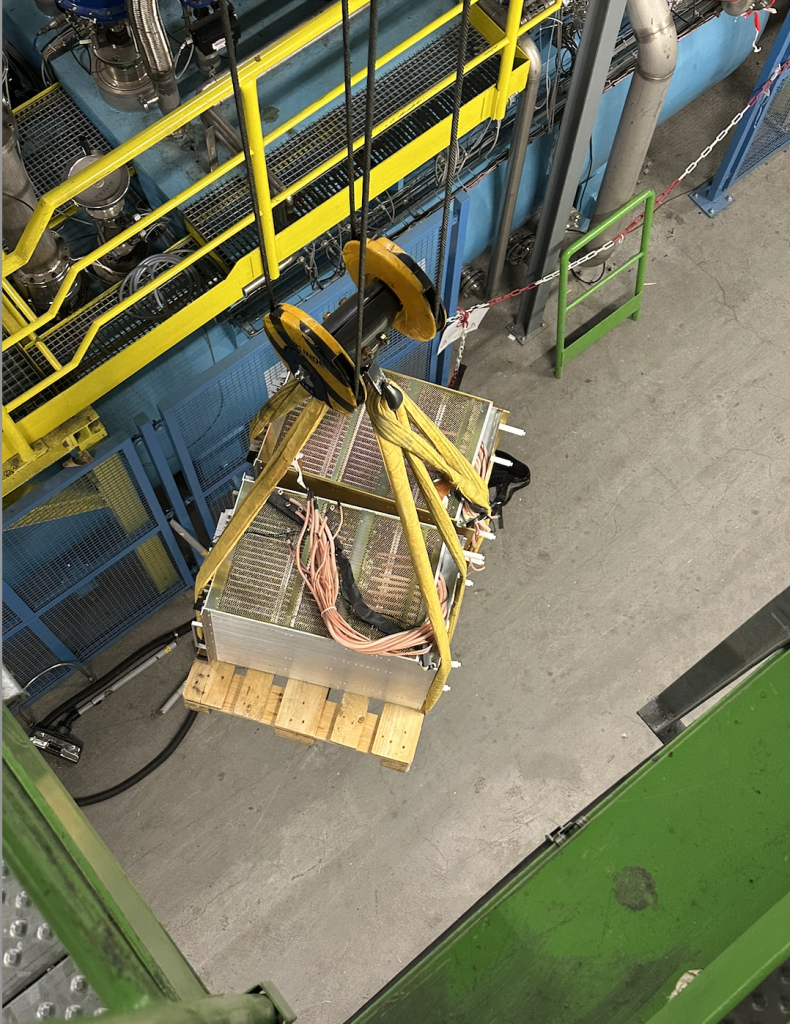
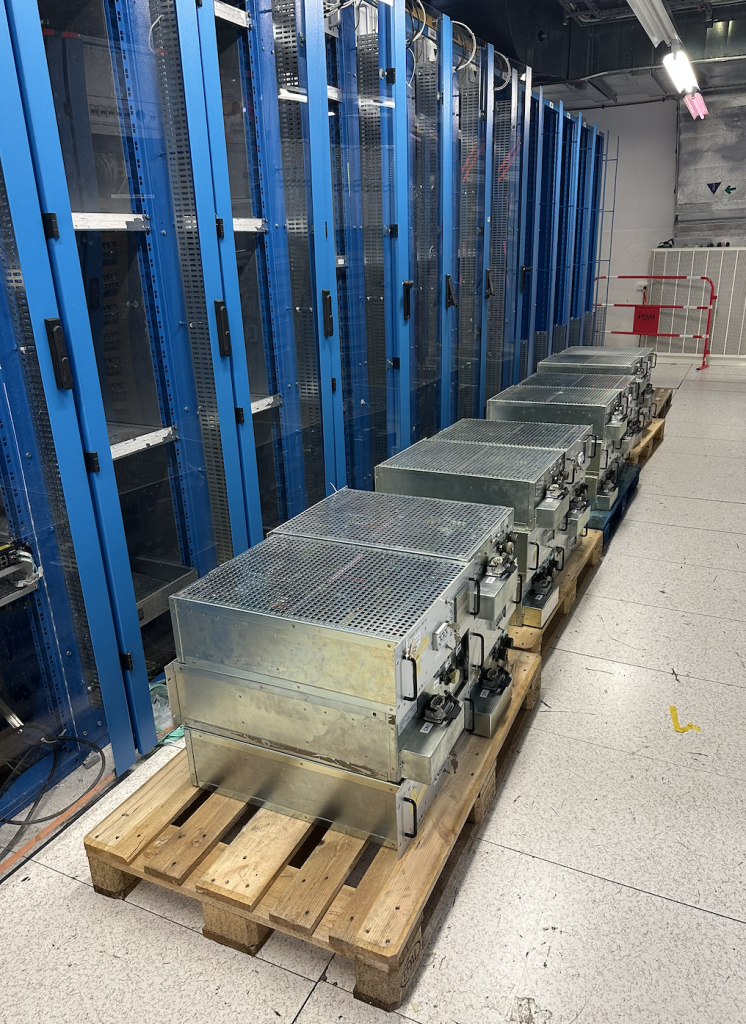
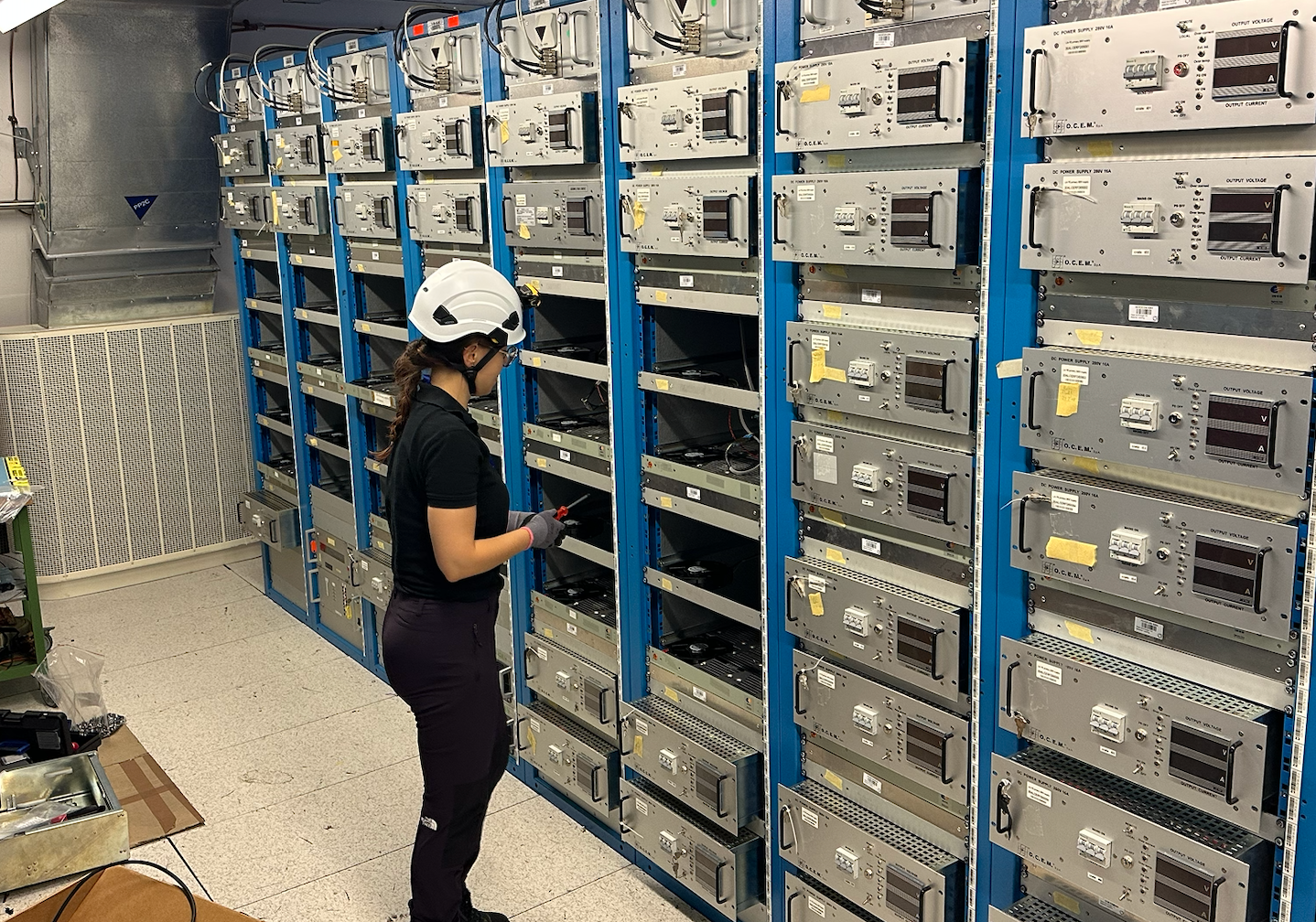
The first weeks of LS3 at ATLAS: teams remove electronics and services, clear racks and work areas, and prepare the detector and Point 1 infrastructure for the installation of upgraded systems. Credit: ATLAS Collaboration..
The detector’s geometry also dictates the sequence. Teams can currently reach the forward muon wheels, but opening the barrel later will largely close that access. Muon teams therefore have until the end of 2026 to replace electronics, install optical fibres and maintain legacy systems.
Other work must wait. The present Inner Detector can only be extracted once ATLAS reaches the required configuration in 2027. Until then, teams are removing accessible equipment and preparing routes for the new components. Removal can be fast; installation, connection and commissioning take much longer.
Cabling illustrates the scale. Up to six five-person teams will work in parallel for roughly three years, pulling about 700 kilometres of cable and fibre. The immediate challenge is coordinating thirty people in a confined environment. Meanwhile, the USA15 rack room is being emptied to make way for denser electronics and new power and cooling infrastructure.
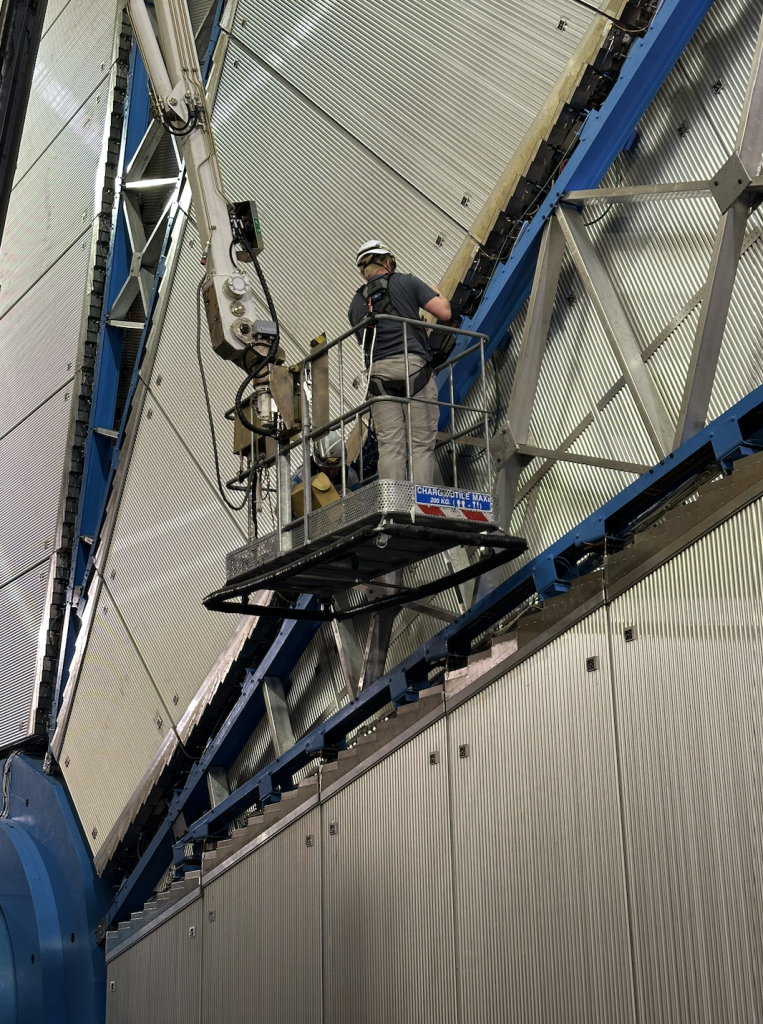
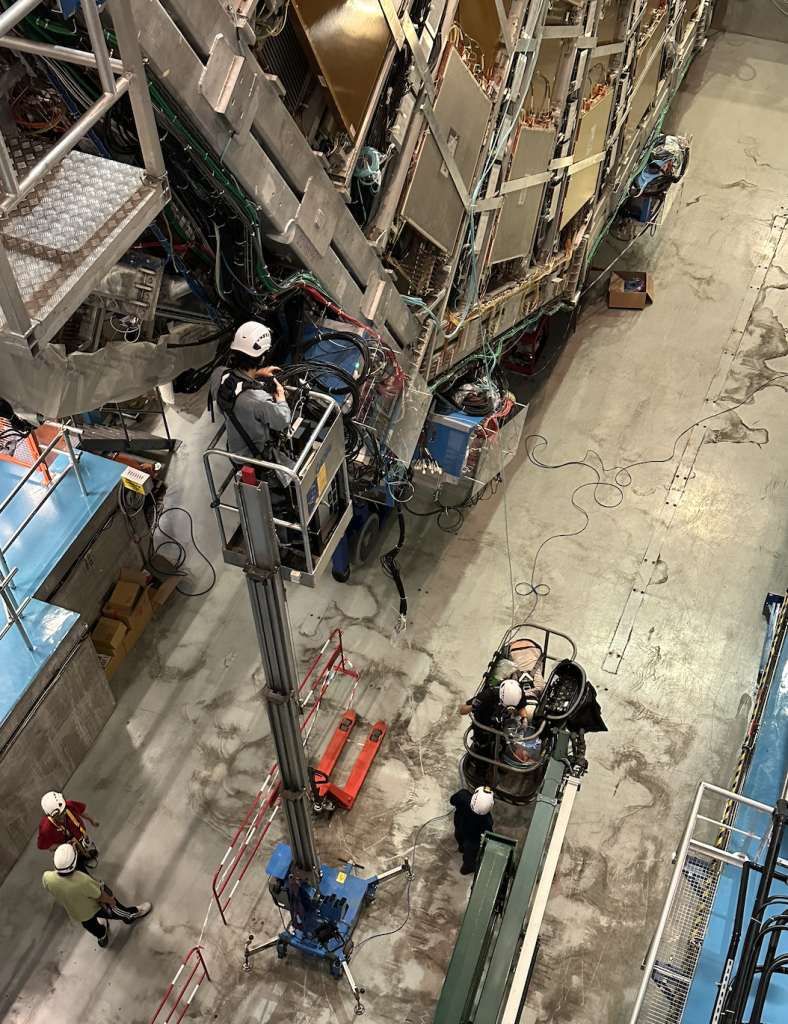
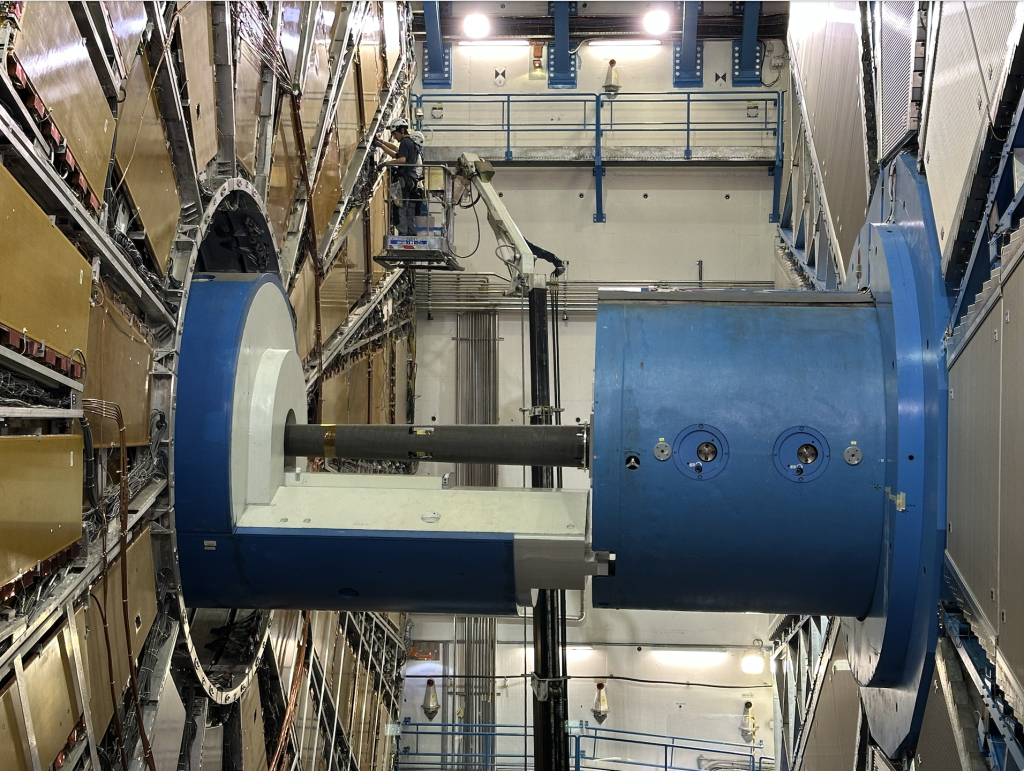
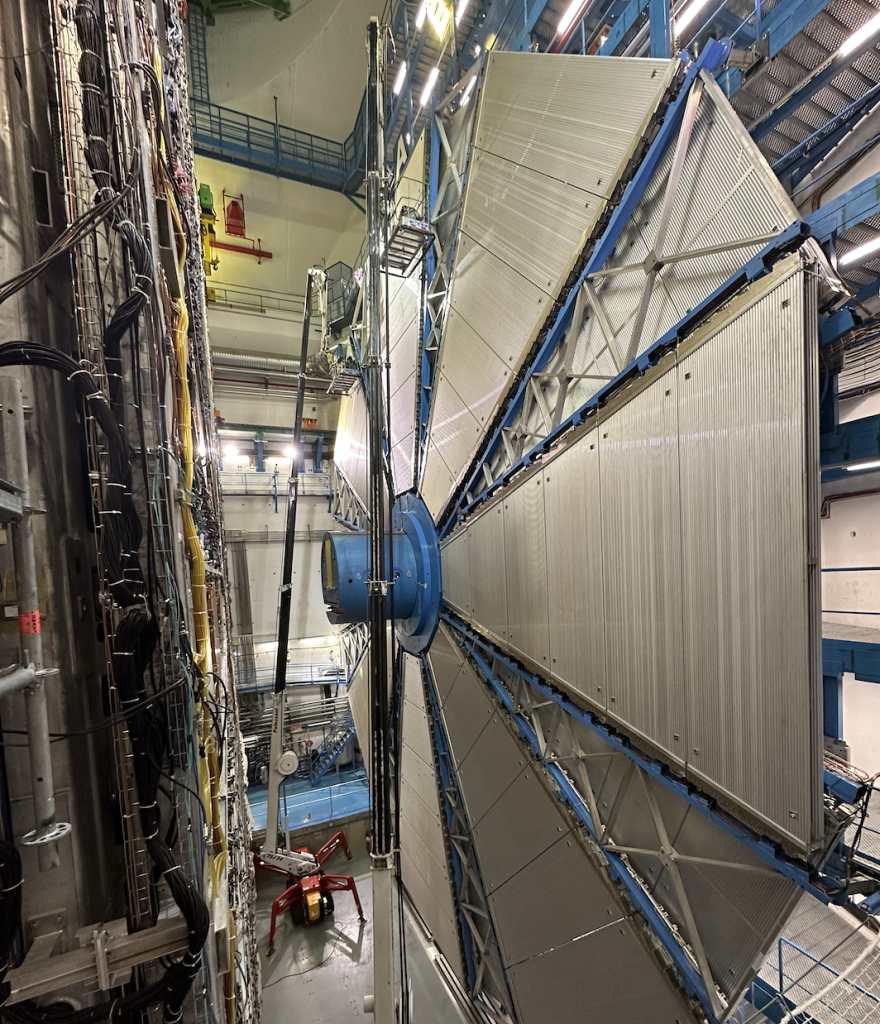
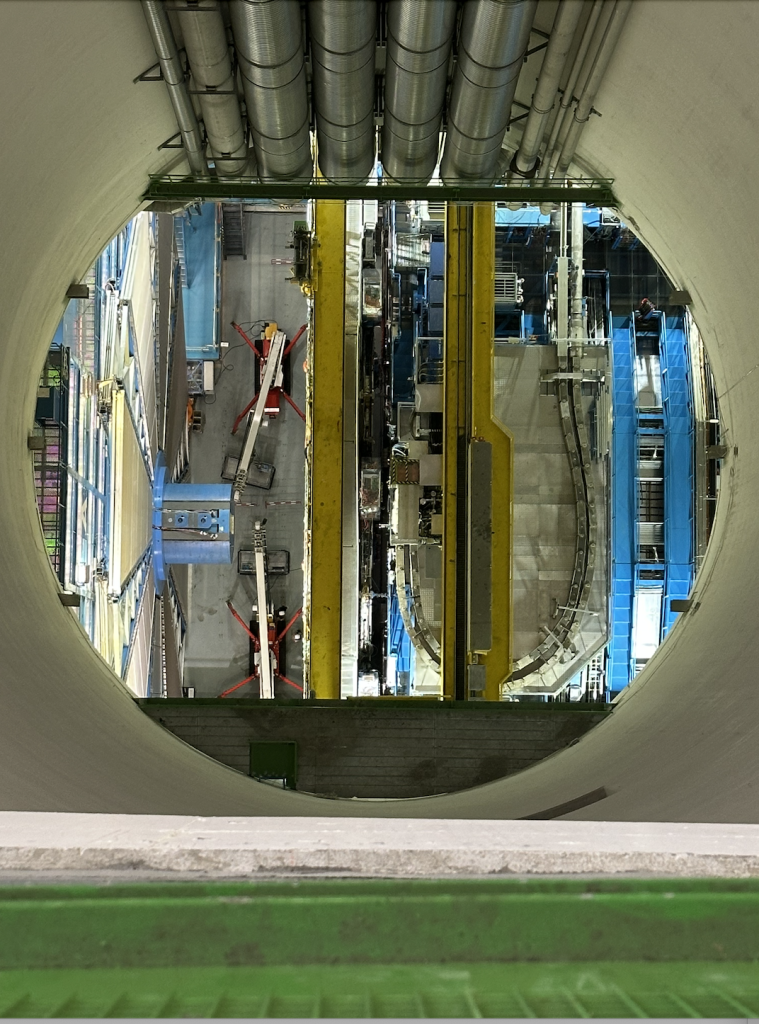
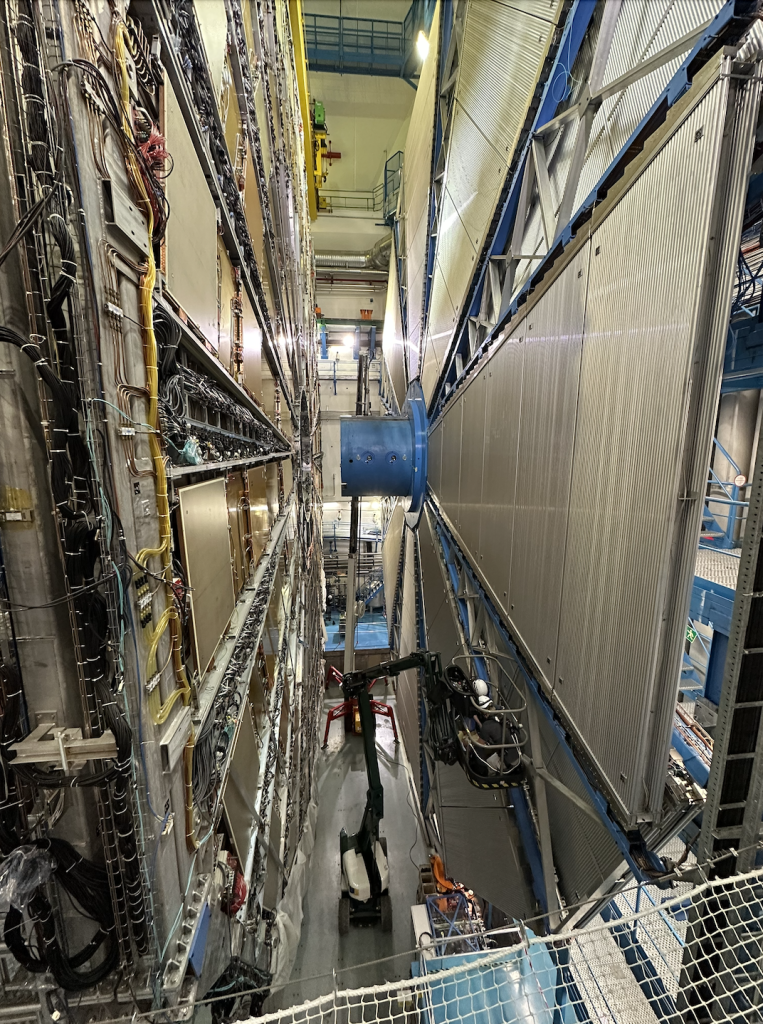
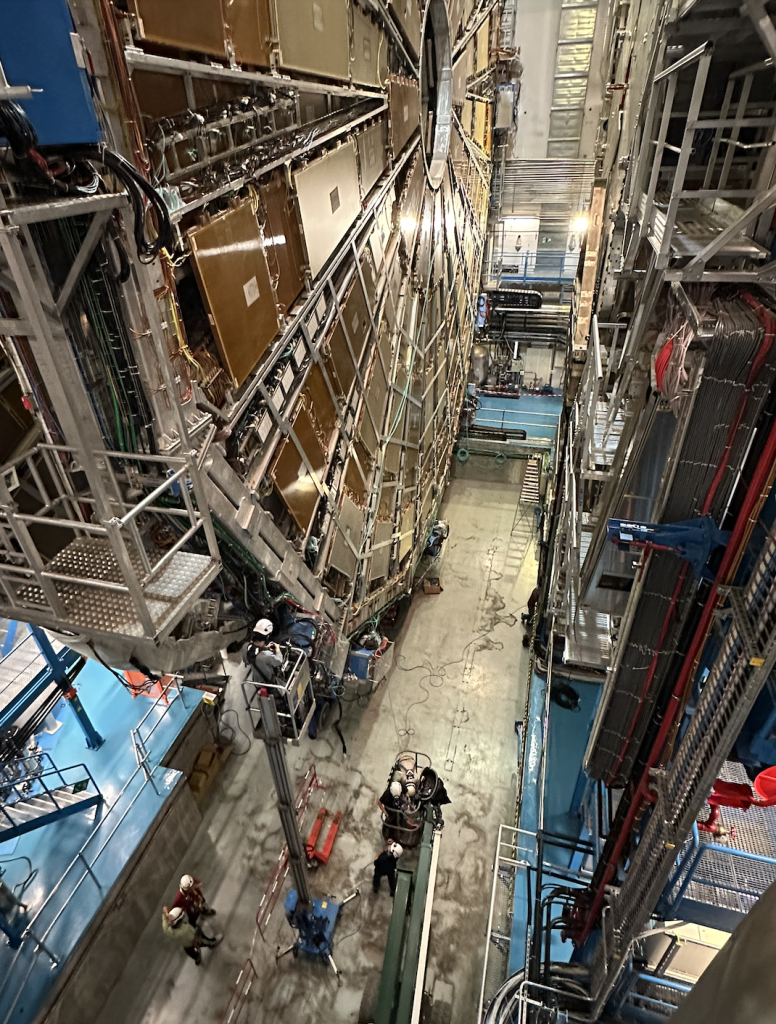
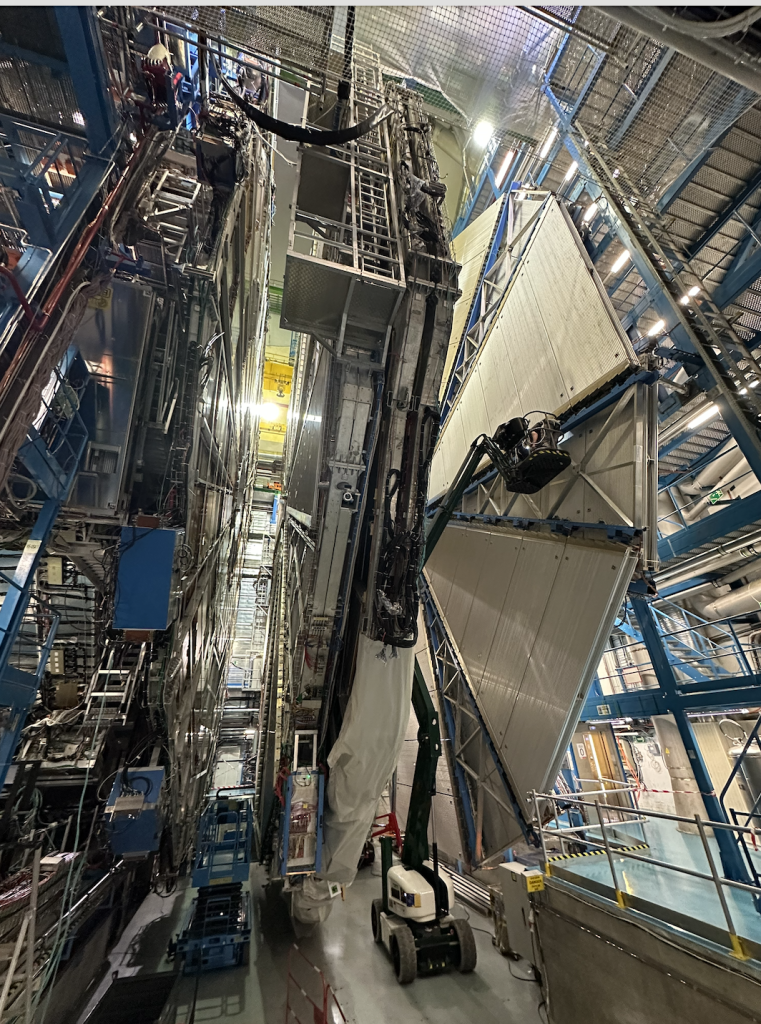
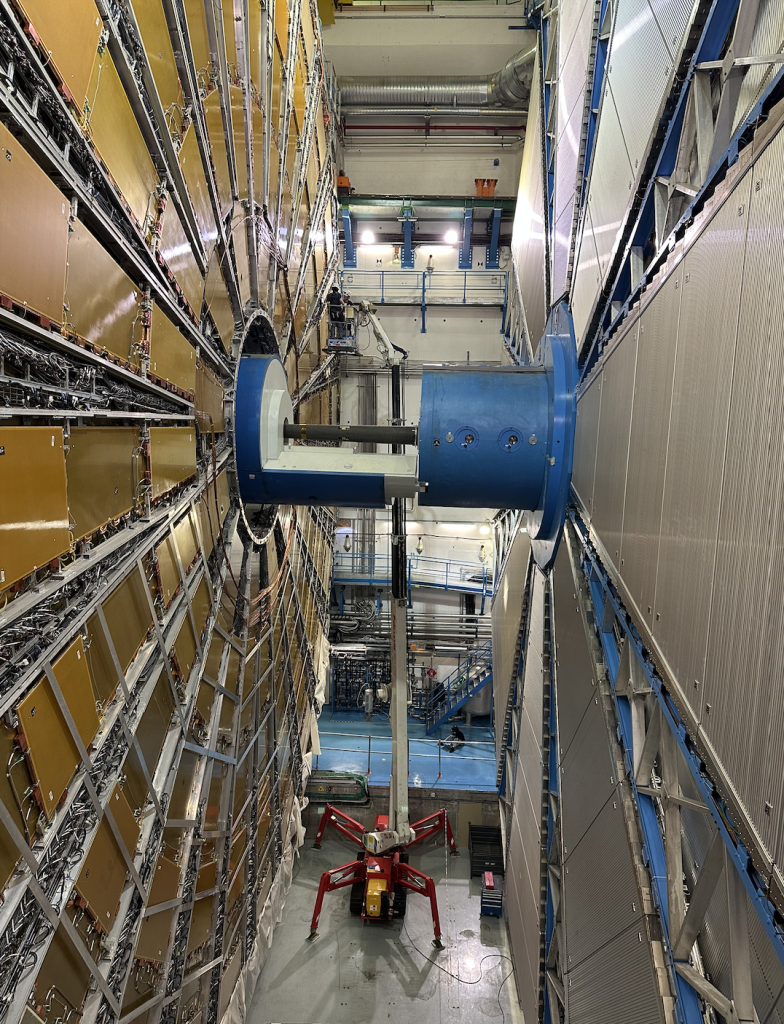
Opening ATLAS creates access to areas that remained largely inaccessible during operation. The photographs reveal both the scale of the detector structures and the narrow working spaces in which LS3 activities must be carefully coordinated. Credit: ATLAS Collaboration.
Open-heart surgery for detector safety
In August 2026, ATLAS began what Schlenker described as “a kind of open-heart surgery” on the Detector Safety System (DSS). The DSS receives signals from services such as detector cooling and automatically places equipment in a safe state when it detects a serious fault. Its controllers and wiring had operated since ATLAS’s installation in 2006. The system, which had remained operational through LS1 and LS2, now had to be completely shut down for replacement.
The intervention was expected to take two to three weeks. With automatic equipment-protection signals unavailable, almost all equipment under DSS protection had to remain off. Separate systems continued to ensure personnel safety.
ATLAS could not switch off everything. The liquid-argon calorimeter had to remain cold, while the unenergised magnet had to stay below approximately 100 K. Both required continuous supervision. “We chose this moment because most of the detector was already switched off,” Aleksa explains. “But almost everything is off is not the same as everything is off.”
Once the new controllers and wiring were installed, every DSS signal path had to be tested to confirm that a fault produced the intended protective action. A de-cabling incident had already demonstrated the value of redundancy. Technicians removing obsolete orange fibre trunks beneath a raised floor inadvertently cut an orange fibre belonging to the DSS. The system registered the interruption but continued operating through a second link, coloured yellow and left in place. The episode showed why dismantling a detector is not simply construction run backwards.
The detector that will emerge
What will take the place of the equipment now leaving the cavern? At the HL-LHC, around 200 proton-proton interactions may occur in one bunch crossing. For ATLAS, the challenge will be to disentangle their overlapping signals: reconstructing particles, identifying which collision they came from and selecting the events worth keeping. More collisions create more opportunities for physics, but only if the detector can distinguish the interesting signatures within them.
At the centre of the upgrade is the all-silicon Inner Tracker (ITk), with about 178 square metres of active silicon and around five billion readout channels. Replacing the present Inner Detector will give ATLAS a new tracking system designed for this denser, higher-radiation environment.
The new High-Granularity Timing Detector (HGTD) will add another way to separate overlapping interactions, measuring charged-particle arrival times with a resolution of roughly 30 to 50 picoseconds per track. “Before, tracking was spatial,” Schlenker says. “Now it becomes spatial plus time.” Knowing not only where a particle passed but also when will help associate tracks with the correct collision and reduce pileup effects.
New Resistive Plate Chambers and small-diameter Monitored Drift Tubes will reinforce the muon system, while the liquid-argon and Tile calorimeters and much of the muon system will receive new electronics. Even components staying in the cavern need extensive changes to their power, cooling and readout services.
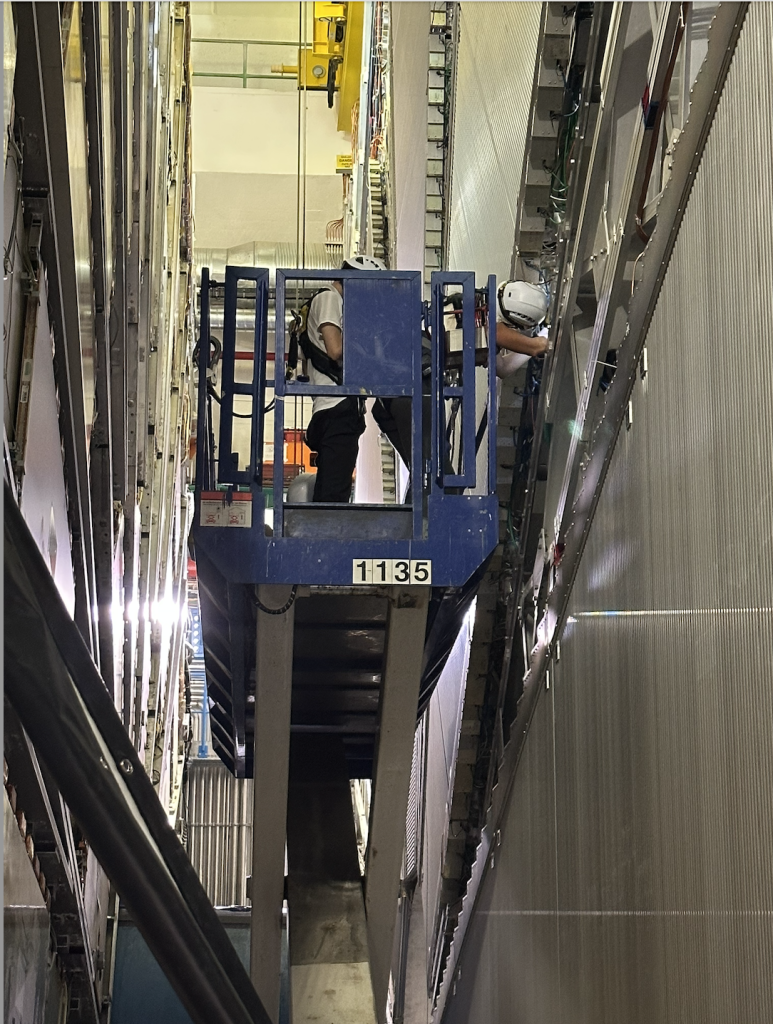
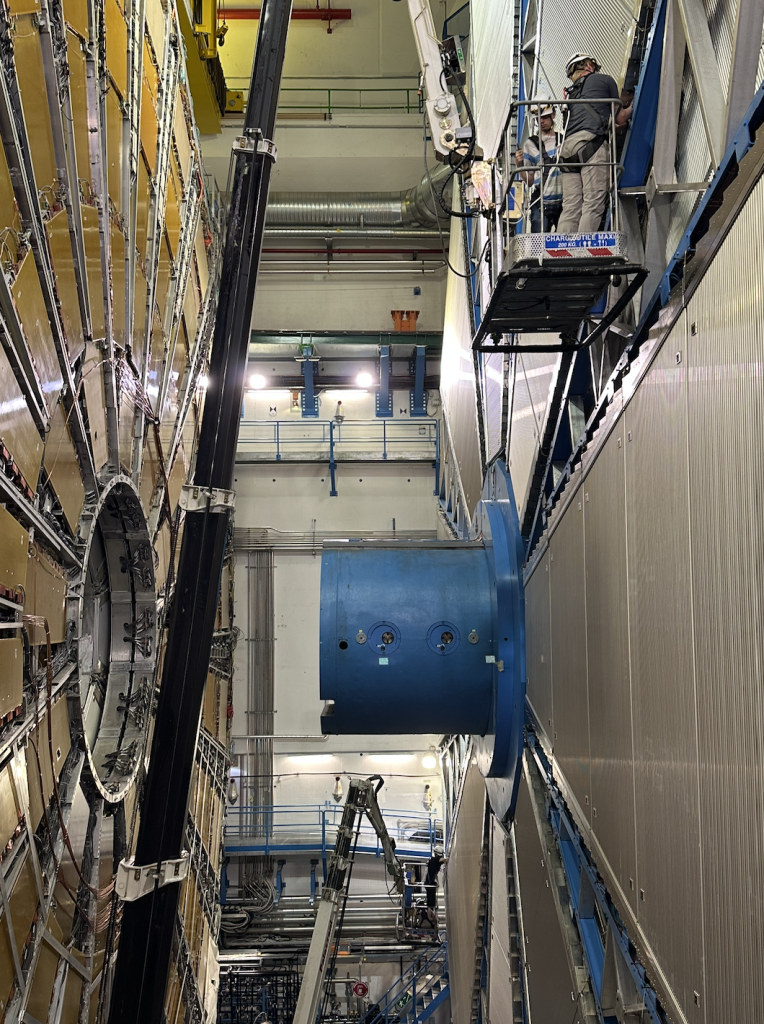
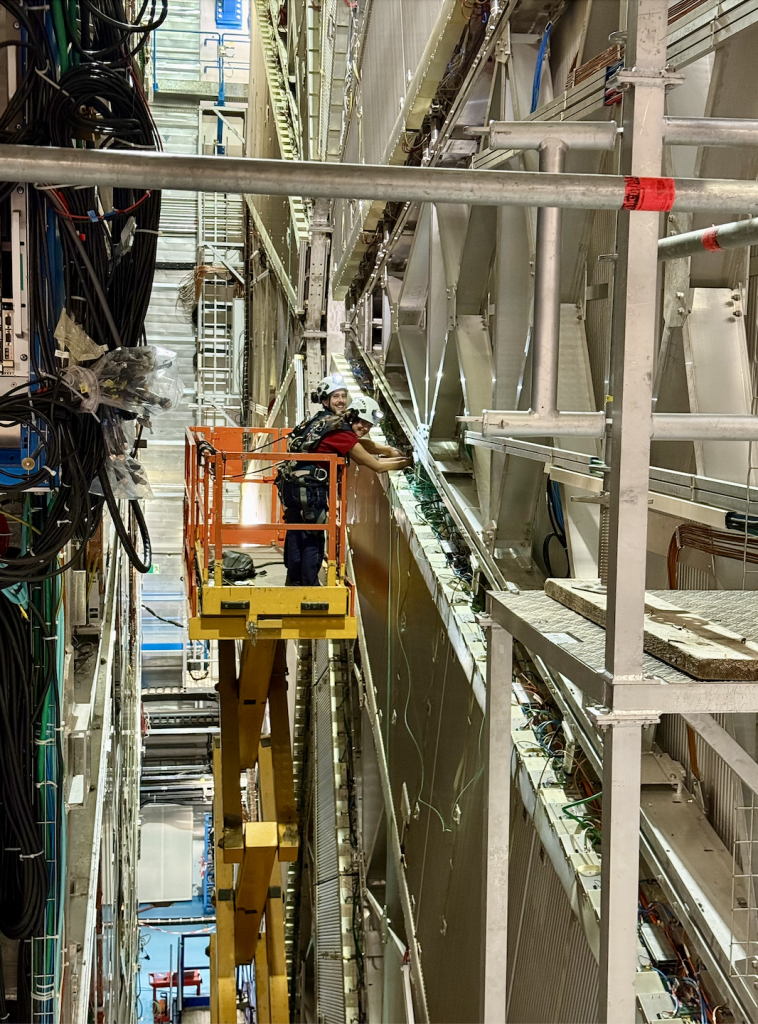
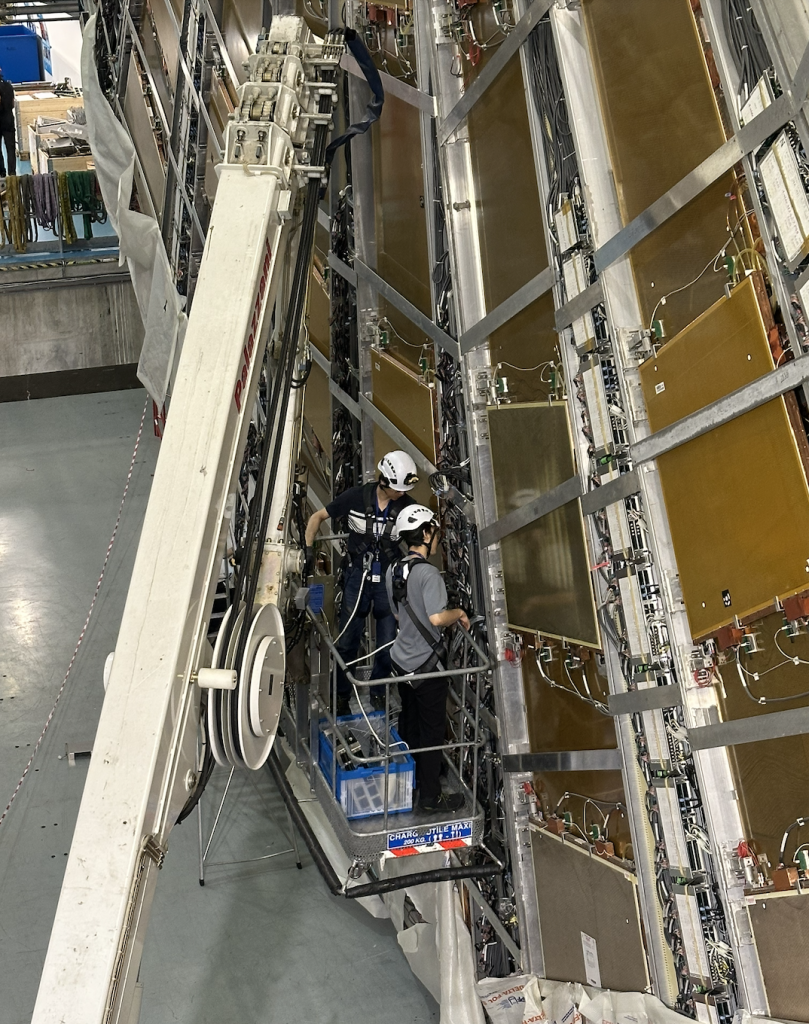
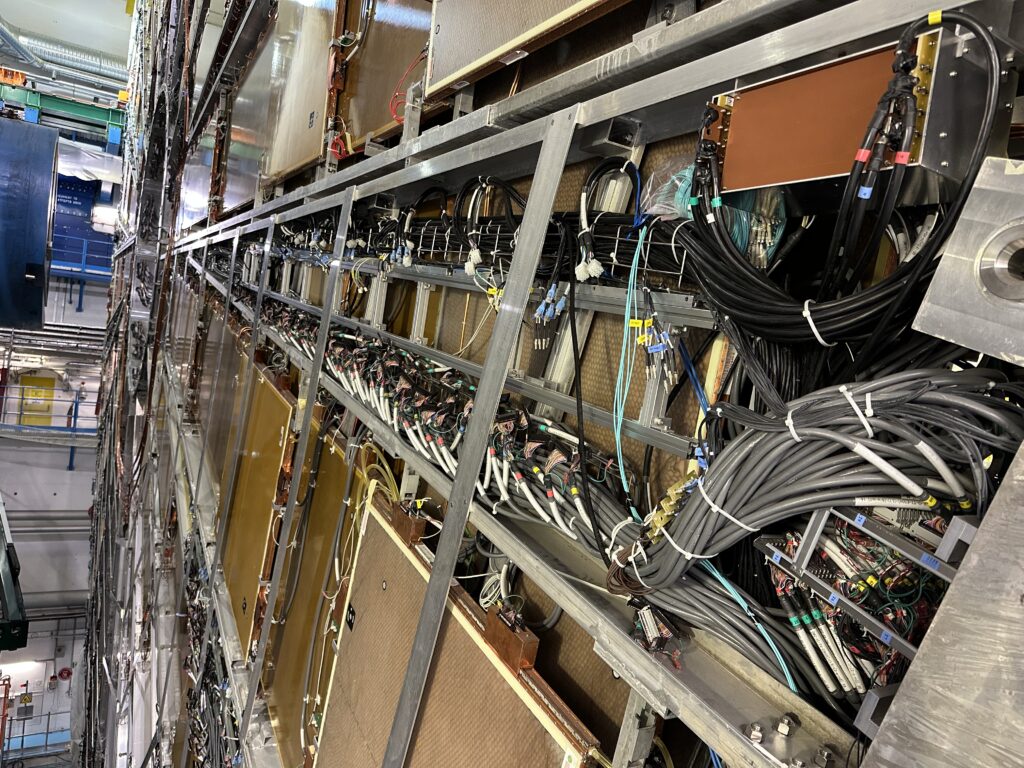
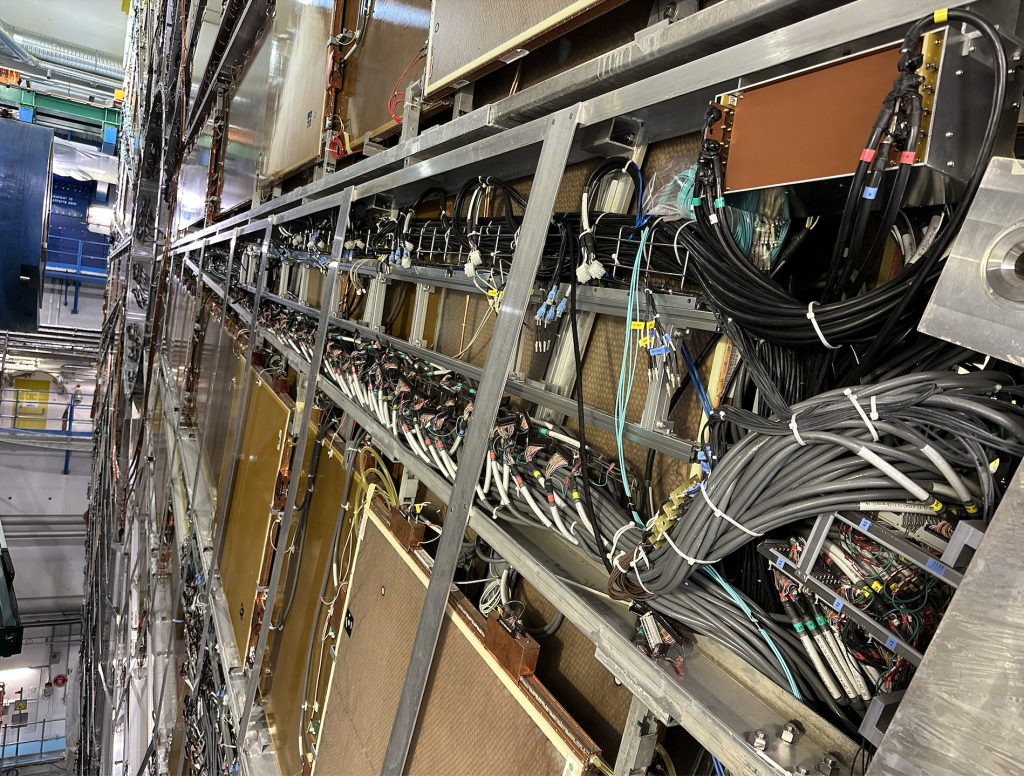
Preparing ATLAS for the HL-LHC requires extensive hands-on work on the electronics, cables and services surrounding the detector. Teams use mobile access platforms to reach components in confined spaces, where each intervention must be carefully planned and coordinated. Credit: ATLAS Collaboration.
Selecting events from this signal flow is another part of the transformation. A new Level-1 trigger will accept up to 1 MHz, compared with about 100 kHz for the Run 3 hardware trigger. Later processing will reduce the stream to around 10 kHz for permanent storage.
Bringing the upgraded ATLAS to life
The detectors depend on a parallel transformation of their infrastructure. Electrical capacity at Point 1 is increasing from about 3 to 8 MVA, alongside expanded cooling, ventilation and computing infrastructure. A new building houses the primary plants for the silicon detectors’ CO₂ cooling system, developed jointly by teams from CERN’s EP-DT, ATLAS and CMS. Underground installation and commissioning will continue through 2027.
But installing equipment is only the beginning. Many trigger functions rely on field-programmable gate arrays (FPGAs), whose firmware must make devices exchange data coherently. “An FPGA knows nothing if you do not tell it everything,” Aleksa says. “The hardware is one part, but the firmware has to be written, tested and debugged. That is a long commissioning cycle.”
The schedule leaves little room for delay. Development and production problems have consumed much of the roughly one-year margin the upgrade projects initially sought. “We saw that float melting away already years ago,” Aleksa says. Some systems retain comfortable margins; others do not.
At peak periods, more than 250 people may work at Point 1, where storage, road works and nearby civil engineering compete for space and access. Personnel are as critical to the upgrade as electricity or cooling.
From tension to collective action
Removal might seem the least rewarding phase of the shutdown. Yet the mood underground has been strikingly positive. “You see happy faces—people removing electronics, cutting cables and finally putting their hands on the detector,” Schlenker says, laughing. “It is a little like kindergarten.” Many younger collaborators are seeing ATLAS close up for the first time; project leaders can finally take apart the detector they spent years protecting.
Raymond saw the same change after a tense final period of checking the plan. “The last two or three months were quite difficult, because people were really afraid that they had missed something,” he recalls. Once work began, that anxiety gave way to common purpose. “Now people can do something for the future of ATLAS. Even if the first action is removal, it prepares the field. If you do not remove it, you do not have the space to put in the new things.”
ATLAS was assembled underground like a ship in a bottle. During LS3, it must be partly dismantled and rebuilt while vital systems remain alive. Every cable removed makes room for an experiment ready for the harsher HL-LHC environment.
| 77 Tonnes of ATLAS Shielding on the Move |
|---|
| On 22 July, CERN teams successfully completed the first major transport operation of LS3. A 77-tonne shielding component, known as the JFSU, was moved from the surface hall above the ATLAS experiment to Building 191 on CERN’s main site. The JFSU is a massive metal structure that forms part of the ATLAS radiation shielding. Two JFSUs are installed around the particle beamline on either side of the ATLAS detector, helping to protect muon chambers from background particles produced in secondary particle interactions. As part of the High-Luminosity LHC (HiLumi LHC) upgrade, the JFSU must be specially modified. From January 2027, the CERN robotic team from BE-CEM-MRO will precision-machine additional slots into the component to route services to new vacuum units. Approximately one tonne of material will be removed during a three-month operation, with this first JFSU scheduled to return to ATLAS in April 2027. This complex logistical operation marked the start of the Collider-Experiment Interface activities (WP8) during Long Shutdown 3 (LS3) and brought together teams from WP8, the ATLAS Collaboration, CERN Radiation Protection, CERN Safety and CERN Heavy Transport. Similar transport operations will take place in the coming years for the second JFSU and two other shielding elements. |