
Category: Newsletter
-
PH-DT activities in 2012
PH-DT activities in 2012 The PH Detector Technology (DT) group is a central part of the CERN Physics Department. DT comprises about 75 staff members, ~30 fellows and students and a FSU team of 14 people. The group makes major contributions to the development, construction, qualification and operation of particle detector systems for CERN experiments,
-

The Higgs boson, a History.
The Higgs boson, a History. Luis Álvarez-Gaumé and John Ellis discuss the history of the Higgs mechanism, indicate its importance for the Standard Model and examine its implications for the scientific community in a paper published in Nature Physics (January 2011). You can read the full paper here.
-
First Planck Results and Cosmological Implications
First Planck Results and Cosmological Implications
-
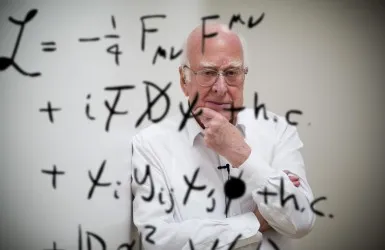
Eyes on a prize particle_unpublished
Eyes on a prize particle_unpublished Luis Álvarez-Gaumé and John Ellis in an article previously published in NATURE PHYSICS (VOL 7 | JANUARY 2011) trace the history of the formulation of the Higgs mechanism and discuss the importance of the long-theorized Higgs-particle. The Standard Model deals with three of the four fundamental forces; namely the electromagnetic
-
Let’s talk science: Hangout with CERN
Let's talk science: Hangout with CERN Every Thursday at 17:00 Geneva-time, physicists and other scientists from CERN present a YouTube show to talk to members of the public about their research. The medium used is the Google+ social network and its Hangouts On Air platform. A Hangout is essentially a multi-user video chat that can
-
CERN Open Days – Mark your Calendars
CERN Open Days – Mark your Calendars MARK YOUR CALENDARS FOR SEPTEMBER 2013 Do you want to descend 100m underground to explore the LHC caverns? Visit the laboratories where amazing new discoveries are made? Meet the people who try to answer fundamental questions about our universe? If the answer is yes, then you are in
-
SFT group participation in EPLANET project
SFT group participation in EPLANET project SFT group is participating in the Scientific Computing Work Package (WP8) of the EPLANET project (http://www.roma1.infn.it/exp/eplanet/). The main objective of EPLANET is to create and reinforce networks for joint research projects and for high-level training of personnel both in European and other Latin-American Institutes/universities. Another aim is to improve
-
Medipix presented at TEDx@CERN
Medipix presented at TEDx@CERN On May 3rd CERN hosted the TEDx@CERN event. TED is a nonprofit organisation devoted to the concept of ‘Ideas Worth Spreading’. The TEDx@CERN event included a number of speakers covering a wide range of topics from cosmology (by Nobel Prize-winner, George Smoot) to the Higgs Boson to DNA research. Among the
-
RD50 and RD51 research projects on silicon and gaseous detector developments
RD50 and RD51 research projects on silicon and gaseous detector developments Common Research and Development consortia provide CERN and CERN member institutions with many benefits. For many detector developments significant R&D is needed in order to bring new detector concepts to a state where they are mature enough to be proposed as part of a
-
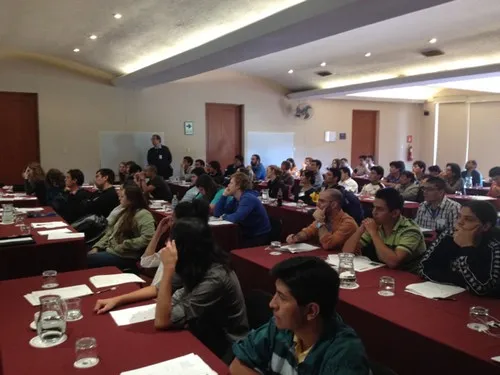
The CERN – Latin America School
The CERN – Latin America School Each year CERN organizes a number of schools that give junior researchers the chance to study the latest research topics in High Energy Physics. Two Schools are held by CERN every year: namely the European School that is annually organized and another School that is organized successively in Latin