
Category: Newsletter
-
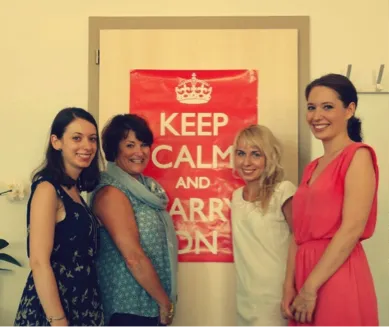
A word from the organizers of the Summer Student programme
A word from the organizers of the Summer Student programme The Summer Student Programme gives undergraduate students of physics, engineering and computer science the unique possibility to join CERN for 8-13 weeks. It gives the students not only the chance to work on an exciting project, the students can also attend first-class lectures, workshops and
-
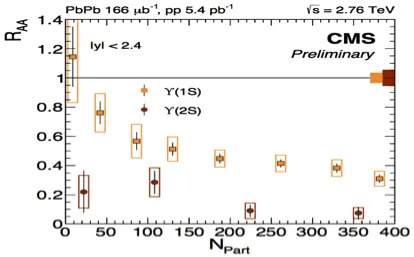
CMS results in Hard Probes 2015
CMS results in Hard Probes 2015 CMS has delivered a comprehensive set of differential RAA measurements, quantifying the jet quenching effect for hard probes of various flavors. Profound suppression of strongly interacting probes in 2.76 TeV PbPb collisions is established with high precision for inclusive charged hadrons, spanning the wide range of transverse momenta from
-
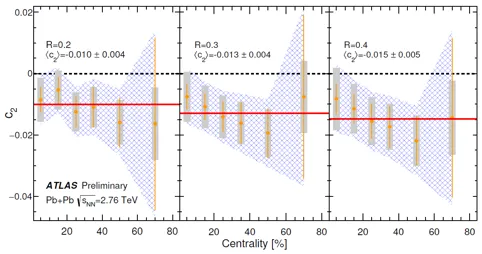
ATLAS results from lead-lead and proton-lead collision
ATLAS results from lead-lead and proton-lead collision The ATLAS results from PbPb data included a measurement of high-pΤ photons and W mesons, high-precision measurement of jet and charged particle RΑΑ, studies of jet fragmentation, path length dependence of jet quenching, neighbouring jet production and studies of flow and correlations of low pΤ particles. The pPb
-
ALICE presents latest results at Hard Probes 2015
ALICE presents latest results at Hard Probes 2015 ALICE, presented a wealth of scientific results. Equipped with a central barrel with high-resolution tracking systems, several detectors for identifying particles from low to high momentum, electromagnetic calorimeters, and with a muon spectrometer at forward rapidity, the ALICE detector is ideally suited for studies involving hard probes.
-
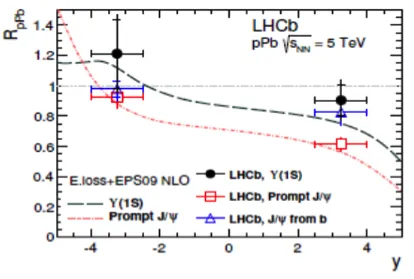
LHCb results from proton-lead collisions and prospects for heavy ion interactions
LHCb results from proton-lead collisions and prospects for heavy ion interactions At the 7th edition of the Hard-Probes conference, taking place at McGill University, Montreal, from June 29 – July 3, the LHCb collaboration presented for the first time its plan and potential in heavy ion physics. Beyond the rich programme in flavour physics based
-
LHC experiments present latests results from heavy-ion runs (old)
LHC experiments present latests results from heavy-ion runs (old) The 7th edition of the Hard Probes International Conference series was hosted by McGill University in Montréal, Québec, Canada, from 29 June to 3 July. During the last two decades, high-energy nuclear physics has seen a tremendous progress; thanks to the combined efforts of CERN SPS,
-
Measurement of J/ψ production cross-sections in pp collisions at 13 TeV
Measurement of J/ψ production cross-sections in pp collisions at 13 TeV At the EPS-HEP 2015 conference in Vienna the LHCb collaboration has presented today the first measurement of the probability to produce a J/ψ meson in proton-proton collisions at 13TeV. Using this measurement they also determined the rate at which beauty quarks are produced at
-
Can Future Energy Needs be Met Sustainably? CERN Colloquium on 15 September 2015
Can Future Energy Needs be Met Sustainably? CERN Colloquium on 15 September 2015 Global energy use is increasing rapidly, driven by rising living standards in developing countries. Although the percentage of primary energy provided by burning fossil fuels is falling slowly from its current value of some 80%, their contribution is rising in absolute terms
-

Editorial September 2015
Editorial September 2015 Dear Colleagues, Summer is coming to a close, and I hope you have found time for some vacation and have returned reinvigorated, ready for the full exploitation of the restarting of the experimental programme. The summer students who enliven the laboratory at this time of year will now be leaving us, but
-
LHC experiments present latests results from heavy-ion runs
LHC experiments present latests results from heavy-ion runs The 7th edition of the Hard Probes International Conference series was hosted by McGill University in Montréal, Québec, Canada, in the Summer of 2015 (June 29 – July 3). During the last two decades, high-energy nuclear physics has seen a tremendous progress; thanks to the combined efforts