
Category: Newsletter
-
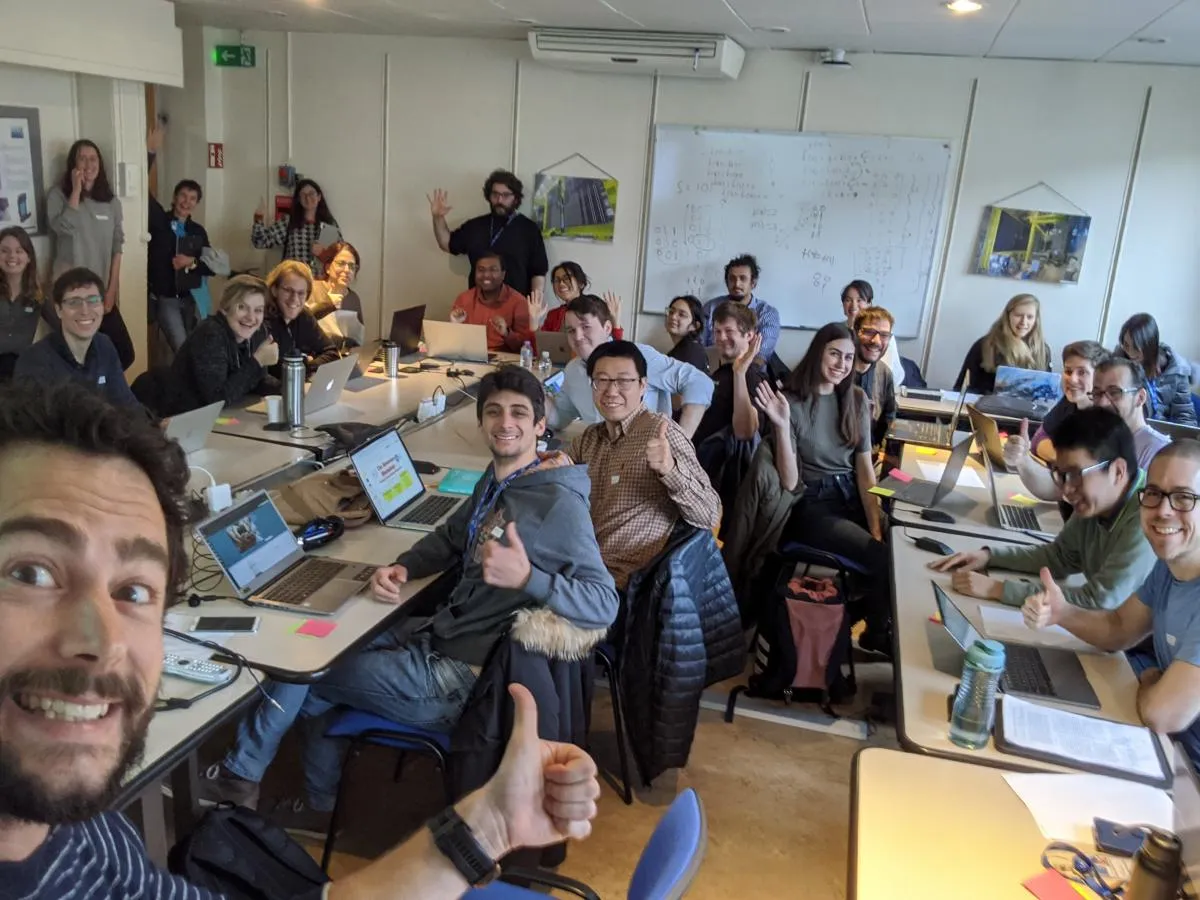
ATLAS and CMS joint bootcamp for analysis preservation
ATLAS and CMS joint bootcamp for analysis preservation Last month, 30 young graduate students and postdocs gathered at CERN to attend the first joint ATLAS+CMS analysis preservation bootcamp, organised by Sam Meehan, Clemens Lange, Lukas Heinrich (CERN), and Savannah Thais (Princeton). Over the course of three days, the workshop participants learnt through hands-on tutorials and
-
Deep Neural Networks for particle reconstruction in high-granularity calorimeters
Deep Neural Networks for particle reconstruction in high-granularity calorimeters Precision measurements in high energy physics as well as an increasing amount of searches for new phenomena rely on a precise reconstruction of the event that caused a particular signature in the detector. Particle flow algorithms [1, 2, 3, 4] aim to identify individual particles before
-
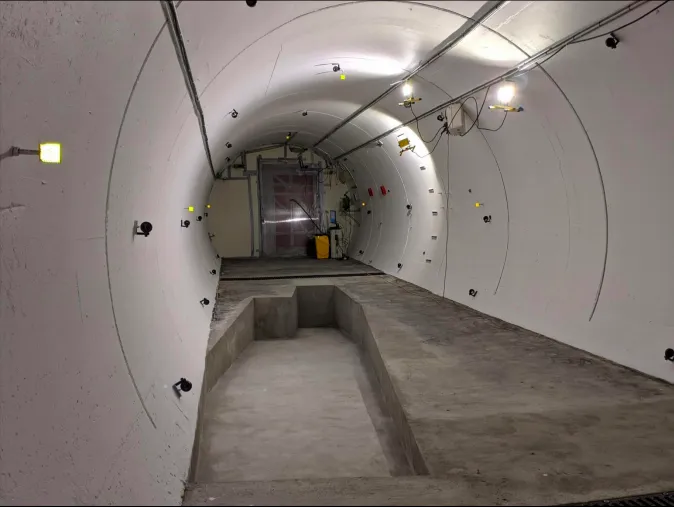
Civil engineering for FASER
Civil engineering for FASER Civil engineering work to enable the installation of the FASER experiment in TI12, which is the former LEP injection tunnel from the SPS, successfully completed this month. The FASER experiment is designed to detect new physics particles produced by the LHC at Point 1. To detect any long-lived weakly interacting particles
-
FASERν: looking for high-energy collider neutrinos
FASERν: looking for high-energy collider neutrinos In December 2019 a proposed upgrade of the FASER detector designed to study neutrinos at the LHC was approved by CERN. The new detector called FASERν will be placed in front of the main FASER detector, 480-m in front of the ATLAS collision point, and exactly aligned with the
-
Using 3D printing techniques for future neutrino detectors
Using 3D printing techniques for future neutrino detectors Plastic scintillator is one of the most used active materials in high-energy physics. A charged particle crossing a plastic scintillator loses part of its initial energy and produces a quantity of scintillation light that depends on its energy and type. This property allows using this technology for
-
You have to love the penguins
You have to love the penguins In 1977 John Ellis made a bet with a student, Melissa Franklin, “If you lose this game of darts,” Franklin said, “you have to use the word ‘penguin’ in your next paper.” John Ellis lost and as a result he coined the term Penguin decays while investigating charge-parity violation
-
Upgrade of the EP Irradiation Facilities: The Gamma Irradiation Facility GIF++
Upgrade of the EP Irradiation Facilities: The Gamma Irradiation Facility GIF++ In the spirit of the ongoing LS2, the time without particle beams is currently used to significantly upgrade the two CERN Irradiation facilities run by EP-DT, namely IRRAD and GIF++. Both facilities deliver essential services to the HEP community, with the focus on validating
-
PUMA: Exploring exotic nuclear phenomena with antimatter
PUMA: Exploring exotic nuclear phenomena with antimatter PUMA is a new experiment proposed at both the CERN AD and ISOLDE facilities, that would for the first time transport antiprotons trapped at AD/ELENA to ISOLDE, by carrying them in a trap loaded onto a truck. The antiprotons would then be used for nuclear physics experiments at
-

A word from the Head of the EP department – December 2019
A word from the Head of the EP department – December 2019 Dear Colleagues, dear Members of the EP Department and CERN Users, Another year turns to its end. It was the first year of the Long Shutdown 2 with all the accelerators stopped at CERN. This didn’t mean that we were idling in EP.
-
AMVA4NewPhysics legacy in searches for new physics
AMVA4NewPhysics legacy in searches for new physics A couple of months ago, the four-year life cycle of AMVA4NewPhysics, a Horizon2020-funded Marie Skłodowska-Curie Innovative Training Network (ITN), in which CERN participated as one of the member institutions, was completed. With the ultimate objective of searching ways which would improve the measurement and search sensitivity of the