
Newsletter Articles

…
October-December 2024
The unification of the electromagnetic and weak-nuclear forces into an electroweak theory was one of the major breakthroughs of 20th century particle physics. In the 1960s, Steven Weinberg, Sheldon Glashow, and Abdus Salam proposed that these two…
Read MORE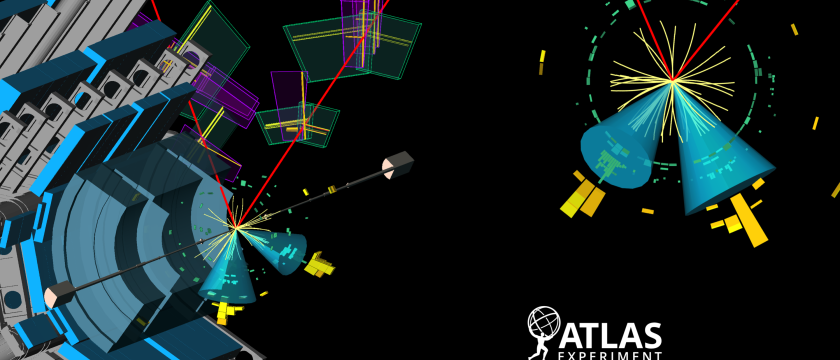
…
October-December 2024
Candidate event for the ZH → μμ cc process, where a Z boson and a Higgs boson decay to two muons (red tracks) and two charm-tagged jets (blue cones). (Image: ATLAS collaboration) In the summer of 2024, the ATLAS collaboration released two new…
Read MORE
…
October-December 2024
Lead is an abundant element of the solar system and is particularly abundant on the Earth’s crust (Figure 1). The origin of three of its four stable isotopes (206Pb, 207Pb, and 208Pb) can be partially traced back to the decay of uranium and thorium…
Read MORE
…
October-December 2024
The TOTEM experiment is designed to explore the proton interactions when they survive intact after the collisions. With this goal, special detectors have been placed far from the interaction points to detect a small angular deflection, due…
Read MORE
…
October-December 2024
Using the Large Hadron Collider as a neutrino source is the goal of the SND@LHC experiment. High-energy neutrinos, from a few hundred GeV to a few TeV, have never been studied. Moreover, neutrinos, particularly electron and tau species, in the SND…
Read MORE
…
October-December 2024
Thanks to the excellent beam conditions provided by the PS staff, combined with the efficiency of research groups participating in the n_TOF Collaboration, an intense experimental program has been performed during the 252 days of measurements of the…
Read MORE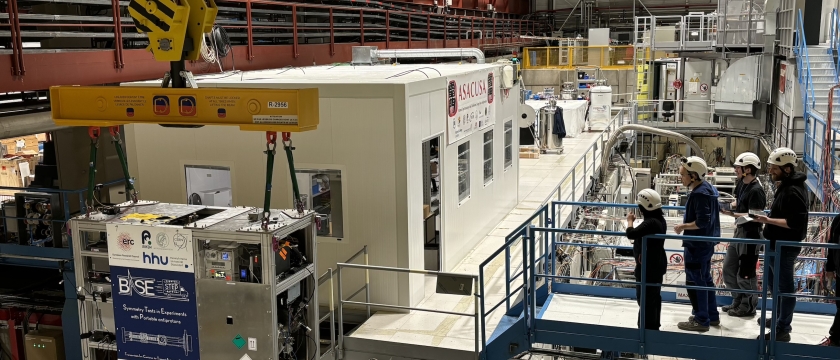
…
October-December 2024
Antimatter, often portrayed as the elusive counterpart to ordinary matter, has long captivated the scientific community with its potential to unlock some of the universe's most profound mysteries. Yet, one of the most significant challenges in…
Read MORE
…
October-December 2024
Fibre optic links are crucial in High Energy Physics (HEP) experiments, allowing the transmission of large volumes of data from particle detectors operating in harsh radiation environments to radiation-free zones. Silicon Photonics (SiPh) [1] has…
Read MORE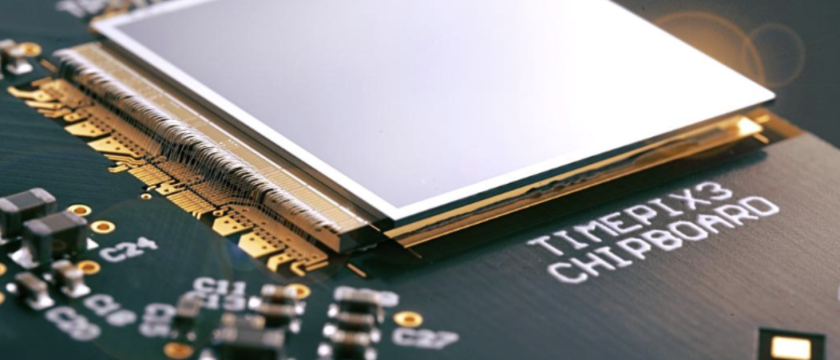
…
October-December 2024
The Medipix and Timepix family of hybrid pixel detectors represents one of the most groundbreaking innovations to emerge from CERN's detector technology. These chips, based on the hybrid pixel technology developed for high-energy physics experiments…
Read MORE
…
October-December 2024
Within the CERN Axion Solar Telescope (CAST) collaboration, scientists from the Center for Astroparticles and High-Energy Physics (CAPA) at the University of Zaragoza led the research that has achieved a significant milestone in the search for axion…
Read MORE