
Newsletter Articles
…
June 2021 - August 2021
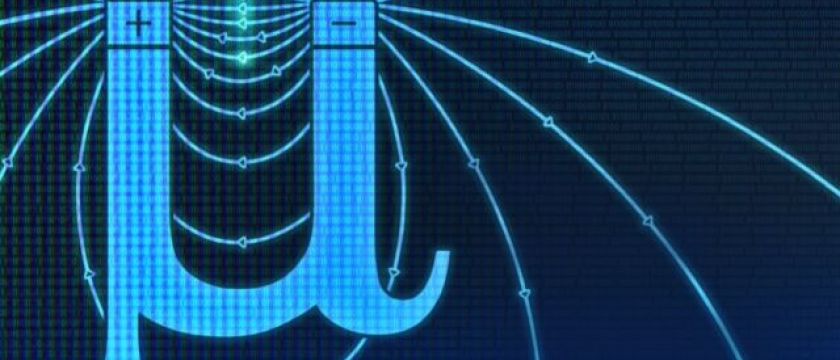
The Dirac equation predicts the muon gyromagnetic ratio g=2. Loop effects from quantum field theory lead to a small deviation from this value, parameterized by the so called anomalous magnetic moment which is defined as aμ=(g-2)/2. The difference…
Read MORE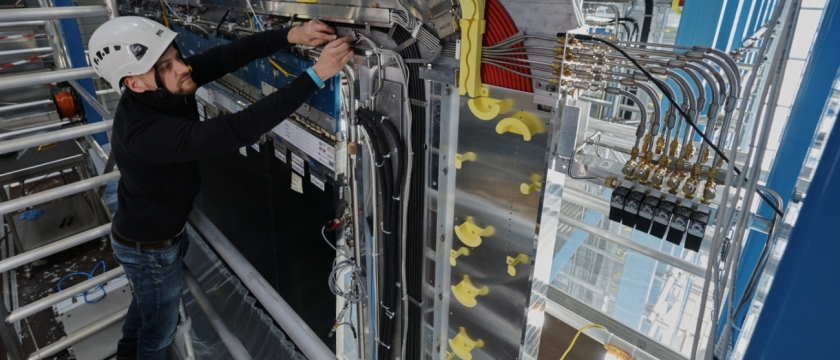
…
June 2021 - August 2021
Last week, CERN's EP-DT group published their annual report for 2020; a detailed accound of the group activities at CERN conducted over the year in collaboration with the LHC and non-LHC experimental groups along with their academic and…
Read MORE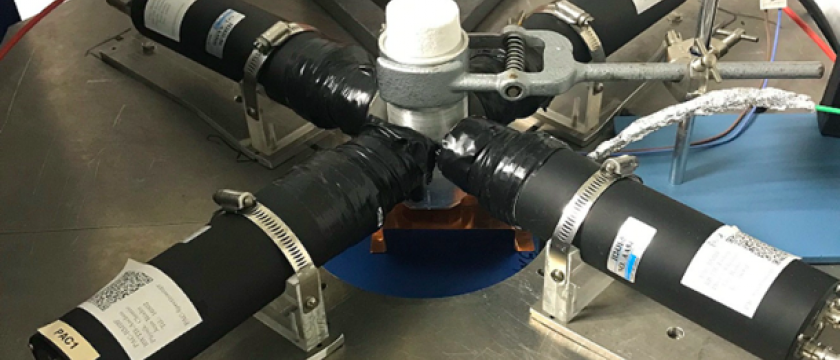
…
June 2021 - August 2021
Nuclear quadrupole moments (Q), a measure of charge asymmetry in nuclei, are experimentally accessible via the quadrupole interaction frequency νQ=eQVzz/h. To extract Q from this information one needs to know Vzz, the electric-field gradient at the…
Read MORE
…
March 2021 - May 2021
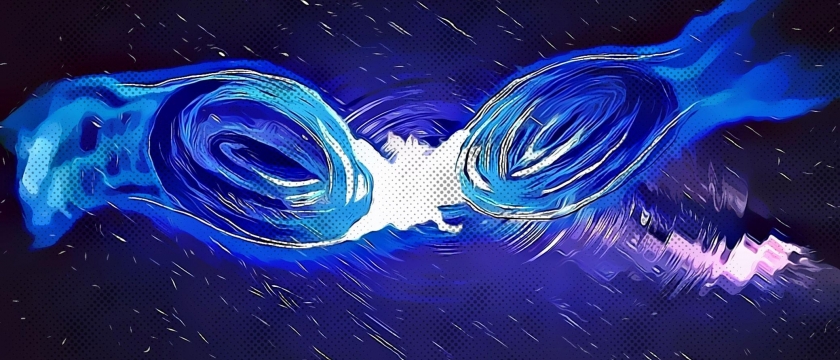
Gravitational waves contain crucial information on the structure and on the history of the Universe. They can give us access to unique insights on particle physics at very high energies and astrophysics in extreme regimes. The detection of…
Read MORE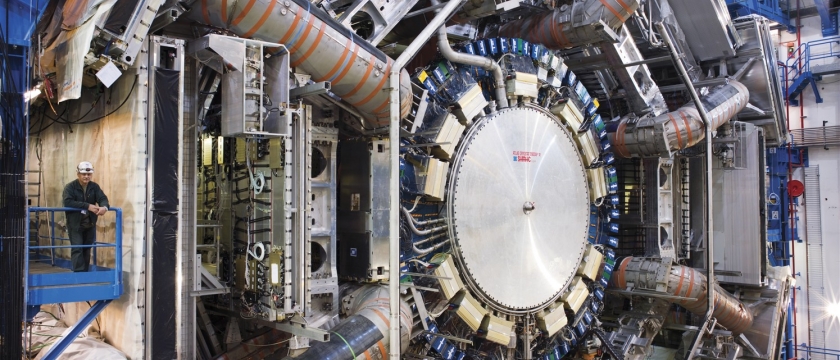
…
March 2021 - May 2021
The ATLAS experiment is a general-purpose particle detector operating at the LHC. It consists of several concentric layers of particle detectors occupying a cylindrical volume 46m long and 25m in diameter. The innermost detectors reconstruct the…
Read MORE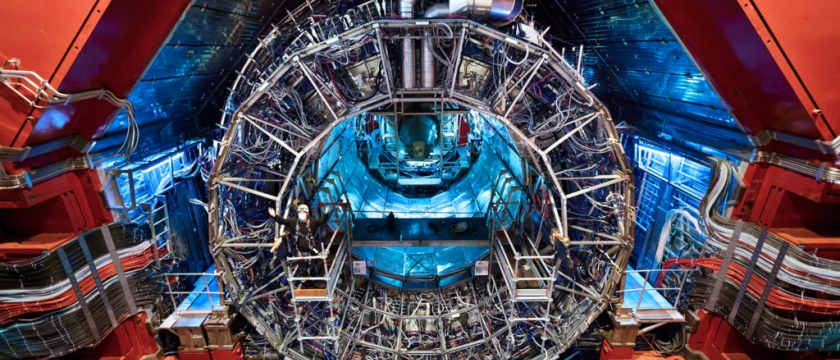
…
March 2021 - May 2021
Quantum Chromodynamics (QCD), the theory of strong interactions, is characterised by a rich phase diagram. The elementary coloured degrees of freedom of the theory, quarks and gluons, under ordinary conditions are confined in colour-neutral hadrons…
Read MORE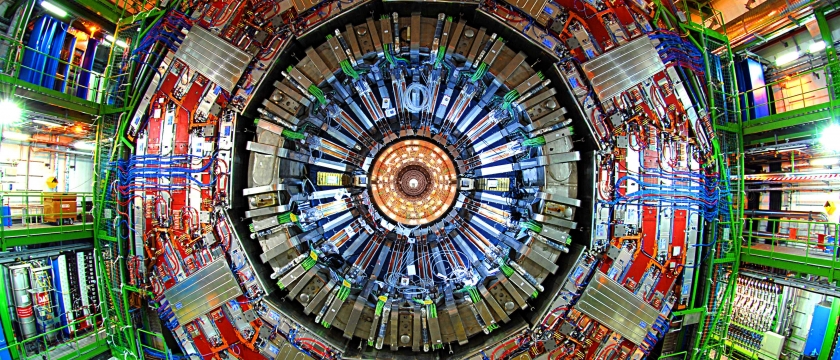
…
March 2021 - May 2021
The CMS experiment is one of the four large experiments at the LHC and a detailed description of the detector's inner and outer layers can be found here. The detector successfully operated with LHC collisions since 2010 leading to the Higgs…
Read MORE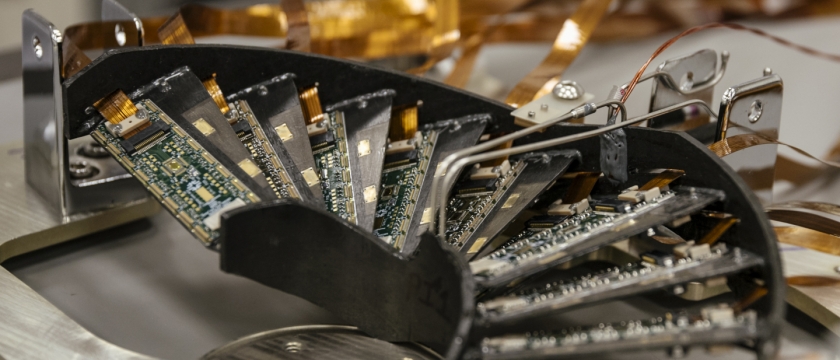
…
March 2021 - May 2021
For more than two decades, a number of coordinated initiatives in Europe have targeted the fundamental and technological issues associated with the development and exploitation of the most advanced detectors for particle physics research. From the…
Read MORE
…
March 2021 - May 2021
CERN has the legal obligation to protect the public and the people working on its premises from any unjustified exposure to ionising radiation. In this context, radiation monitoring is one of the main tasks of the Radiation Protection Group.…
Read MORE